
 Prefer Jewish News on Google
Top Israeli VC eyes London for a specialised AI hub
JVP founder Erel Margalit says a transatlantic triangle linking Israel, New York and the City can spur new technologies in finance, insurance, cyber security and climate risk

Erel Margalit, one of Israel’s most influential venture capital investors, is actively exploring the creation of a future centre of excellence in London, as demand for cyber security and micro-vertical AI in the fields of insurance, fintech and climate pulls more Israeli tech companies towards the City.
Micro-vertical, or “vertical,” AI refers to highly specialised artificial intelligence built for specific industries such as insurance, banking, cyber security or climate risk, rather than general-purpose consumer AI.
While many markets remain fixated on generative AI, Margalit, the founder and executive chairman of Jerusalem Venture Partners (JVP), is betting on what he calls micro-vertical and predictive AI inside tightly regulated industries. “The world is talking about generative AI,” he says, “but Israel is very strong in what micro-vertical AI – cyber security, fintech, insurance, enterprise and climate tech.”
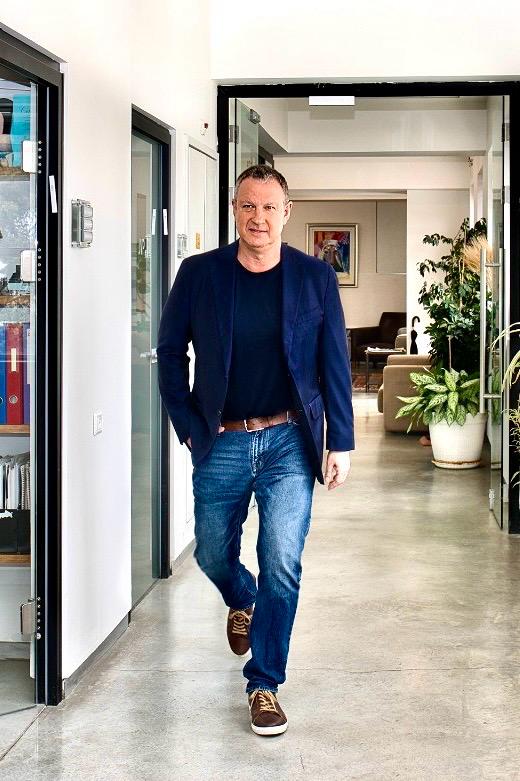
Margalit says Britain’s position at the crossroads of global finance, regulation and specialised insurance makes London a natural anchor for the next phase of Israeli AI growth.
He tells Jewish News: “Alongside New York, London is the financial centre of the world. We built a bridge between Israel and New York. I want to build a similar bridge between Israel, London and Europe.”
JVP already operates several AI-driven companies from bases around the City, some close to the Lloyd’s of London insurance market, but Margalit hopes to formalise and scale that presence. “Some of the most sophisticated insurance policies in the world come out of the Lloyd’s market and then go global,” he says. “For me it’s critical to be close to Lloyd’s.”



Founded more than 30 years ago, JVP combines venture capital, company-building and later-stage private-equity ownership. It has funded more than 160 companies and is perhaps best known internationally for backing CyberArk, the Jerusalem-founded cyber security group in which JVP once held a 47% stake and where Margalit served as chairman as it grew into a multi-billion-dollar global player. In July, CyberArk announced its planned $25 billion acquisition by Palo Alto Networks.
Margalit previously served as a member of the Israeli Knesset, where he focused on innovation and regional development. He also founded the Margalit Startup City network, a series of innovation hubs designed to combine tech investment with community development.
Today JVP operates permanent hubs in Jerusalem, Tel Aviv, the Galilee, Be’er Sheva and New York, where it works with 35 later-stage scale-ups, many already generating between $50m and $150m in annual revenues.
Margalit sees London as part of a wider three-node strategy. “There’s a big interest in creating this triangle,” he says. “Israel as the hub for technology. New York as the gateway to North America. And London and Europe as the place that validates a big part of the business and comes up with some of the most sophisticated ideas for the next generation of finance, insurance, and AI climate-related projects.”
Margalit’s model is attracting direct interest from UK institutions.
“Some of the leading public institutions are visiting New York to look at the model we created there to see if it could be relevant for London.
Unlike most US startups, which grow first in a vast domestic market, Israeli companies typically internationalise early, building multinational teams across the US, the UK and Europe from relatively early stages.
London has become a growing focal point for the JVP portfolio. One of the venture firm’s flagship companies is Earnix, an Israeli-founded unicorn with a major London presence. The company provides AI-driven pricing, rating and underwriting tools to the insurance industry. Earnix first worked with the Lloyd’s market before scaling into the US and internationally. “We started small. We invested and then we invested again,” Margalit says. “Today the company is growing over 25 per cent a year.”
Another London-linked Israeli company is ThetaRay, which uses AI to detect money laundering, terror financing and financial crime for banks across Europe, North America, Africa, and South America. “The crooks are so much more sophisticated today than they were five years ago. So you need AI and the intelligence to protect against all these threats.”
ControlUp, which uses AI to manage digital work environments for employees working on- and off-premise, also runs a major London hub and is scaling internationally. Nanit, JVP’s baby-monitoring and infant-sleep analytics company, which was born at the Technion and Cornell Tech, also recently entered the UK market.
Margalit says regulation is a decisive factor. “If you don’t bring AI in the language that the insurance industry or the banking industry understands, then the regulator won’t accept it – they need to follow your decision-making process. Regulators cannot accept AI in a black box and that’s why it’s so important to have a micro-vertical AI for each of the respective industries.”
He continues: “Climate risk is emerging as one of the most urgent areas of application. Climate is not only about alternative energy. It’s also about using data to understand how the world is going to act and to come up with solutions ahead of time, because disasters are happening everywhere.
“If you want to understand forest fires or how many hurricanes will hit a coastline or crop failures, you can’t do it with traditional tools,” he continues. “You need predictive AI in the language of the industry.”
At the same time, AI is transforming cyber security itself. “We used to deal with people against people. Now it’s machines against machines. The big challenge for 2026 and 2027 is how to use AI in a secure fashion.”
Margalit says the combination of Israeli engineering and London’s financial industry and regulatory expertise is what makes the UK such a powerful partner. “That’s where Israelis and people from London can really cooperate,” he says. “There is deep understanding of vertical industries in the UK, in Europe and in Israel, alongside what is happening in the US.”
But he insists that ambitions for London must go beyond a conventional venture office. “We don’t just build companies. We build centres of excellence with public-private partnerships behind them. That’s how you create something that lasts.”
Margalit also frames UK-Israeli technology cooperation as part of a broader economic and geopolitical reset for Israel after two years of war. “I think the high-tech industry is Israel’s way forward out of what happened in the last two years,” he says. “We need to change the discourse from a discourse of war to a discourse of cooperation and technology and innovation.”
JVP’s impact work in Israel’s north, where more than 100 startups were evacuated from the Galilee during the conflict, now sits at the heart of that effort. “Israel needs a new chapter – support internally in the Galilee and in the south for the younger people, and also internationally in the region,” he says.
He draws an explicit parallel with post-war Britain. “The UK understood after the world wars that it needed to give welfare and support to the people who came back from the front. Otherwise, they leave. Israelis need a challenge. They need to be pioneers. They need a new frontier.”
For Margalit, deeper cooperation with Britain is also about keeping Israel outward-looking. “I would rather talk to British business leaders about what we can build together than be locked forever in arguments about antisemitism,” he says. “People need to see the kind of Israel they saw before the war – cooperating, building, creating.”
As he looks ahead to 2026 and beyond, Margalit’s message is clear: the real impact of artificial intelligence won’t come from chatbots, but from the invisible systems reshaping global insurance, finance, climate risk and cyber security, and he believes London could be one of the places where that future is built.

Keep community journalism free.
Jewish News is free for everyone. No paywall. No barriers. Just trusted journalism for anyone who wants to stay connected to Jewish life in Britain.
If you value that, please support us.
From as little as £5 a month, you can help keep our journalism free and accessible to all.
Every day, we report on the issues that matter to our community. We celebrate achievements, support charities, challenge antisemitism and ensure Jewish voices are heard more widely.
From as little as £5 a month, you can help us continue to:
- Report on the stories shaping Jewish life in the UK and beyond
- Bring our community together through shared stories, events and campaigns
- Celebrate the people, culture and moments that define our community
- Support organisations doing vital work across Jewish Britain
You can make a one-off donation or become a regular supporter. Every contribution helps keep our journalism free, independent and accessible to all.
If everyone who values Jewish News gave a small amount, it would make a real difference to our future.





















