Prefer Jewish News on Google
Travelling to a country at war, with World Jewish Relief
I have seen videos covering the work of World Jewish Relief, but there is no substitute for seeing the work with one’s own eyes and meeting the people involved on the ground.
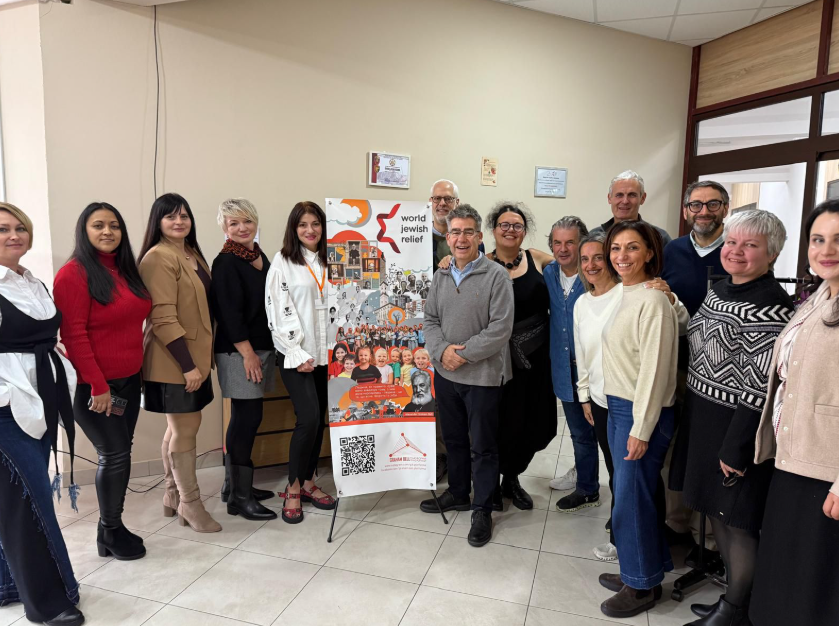
Earlier this month I was privileged to visit Western Ukraine with World Jewish Relief to see the invaluable work the charity is doing with its local partners. I was part of a small group of trustees and other stakeholders of the charity led by the Chief Executive, Paul Anticoni, and Head of Livelihood Development Programmes, Ekaterina Mitiaev. Mostly we were based in Lviv but we also ventured to another town in the Lviv oblast called Stryi.
I have a personal history with Ukraine, having worked there as a lawyer on a series of transactions over several years, and I had spent time in Kyiv and Kharkiv pre covid and pre the Russian invasion in early 2022. Like many British Jews I have ancestral connections with Western Ukraine, much of which is also known as Galicia and at various times has been part of Poland, the Austro-Hungarian Empire and the Soviet Union.
The week before we left for Lviv we had a briefing, inevitably focusing on the fact we were going to a country at war, albeit we were a long way from the front line.
You cannot fly directly to Ukraine, so we travelled to Rzeszow in Poland, which is an hour’s drive from the border. You know it’s an area of conflict because it’s surrounded by anti-missile batteries. When you cross the border by foot the first thing you see are posters recruiting for the Ukrainian international Brigade. We downloaded an app to alert us to any sirens. During our first night in the hotel in Lviv we heard the sirens going off across the city – there was no need to rely on an app. We made our way down to the basement until we got the all clear. In truth, the number of alerts are not that intensive in the Lviv oblast compared to other areas of Ukraine, which are under constant attack.
Lviv is a city of outstanding beauty. It is rich in heritage and has a long and deep Jewish history. Before the Holocaust, approximately a third of the city’s population were Jewish. It was the capital of Galicia and reminded me of Krakow. It hosted the oldest synagogue in Ukraine, the Golden Rose Synagogue built in 1582, but as with most Jewish monuments in the city, it was destroyed by the Nazis. You could almost forget you were in a place of conflict but there are stark reminders, like the relative absence of men, the occasional attacks, the daily 9 am sirens followed by a minute’s silence (resonant of Yom Hazikaron), and, most shockingly, the local military cemetery in the heart of the city with endless fresh graves; each with a photo of a young man and occasionally a woman in army fatigues. Walking through the cemetery amongst the grieving families brought home the severe cost suffered by this proud nation fighting for its survival in a brutal war.

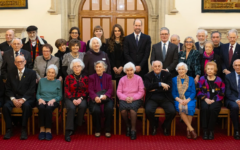
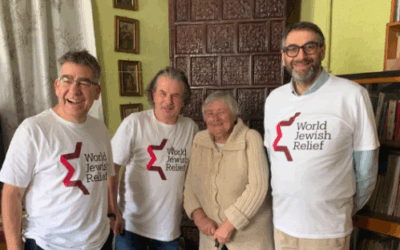
I have attended several World Jewish Relief charity dinners over the years. I have seen videos covering the work of the charity and its partners and listened to various impassioned speeches, but there is no substitute for seeing the work with one’s own eyes and meeting the people involved on the ground. I got a real sense for the breadth of work being done by World Jewish Relief and the real impact it has on people’s lives. Within the Lviv oblast there are up to 600,000 internally displaced people and many families often with absent husbands and fathers. This has created widespread vulnerability. Since the Russian invasion, World Jewish Relief has helped 5,473 individuals through a series of projects and we were able to meet the various beneficiaries including ‘Active Ageing’ for older people, ‘Back to Work’ placing people in work and ‘Building Stronger Families.’
We met with older women who receive home care visits who would otherwise be very isolated, and others who are able to come into the day centre to make and enjoy music, exhibiting considerable talent! The people we met had lived incredible lives with fascinating family stories spanning the Second World War and its aftermath and post war Soviet history. I was struck by their high level of education and erudition. We met with a range of people who had been helped to either secure employment or to start and build a business including a florist, clothes designer and a poultry farmer! This is particularly important for those who had been displaced, who have had to rebuild their lives and develop new skills, all while providing for their dependents. We met teenagers benefiting from career orientation sessions and mothers with younger children benefiting from social activities and emotional support.
Visiting Western Ukraine was a bit like peeling an onion. We peeled back the layers of history of the different communities and the moving borders, the despair and the resilience, death and survival, and, just like peeling an onion, at time there were tears. Given the current conflict it’s easy to sink into dark thoughts, which is why the work of World Jewish Relief is so impactful. And in the coming winter months that work will only be more essential. Leaving the country we were, by chance, waved off by a large group of children on a school visit to the border. I pray for their future and a swift and just resolution of this conflict.
Adrian Cohen is Senior Vice President of the Board of Deputies and Chair of the organisation’s International Division

Keep community journalism free.
Jewish News is free for everyone. No paywall. No barriers. Just trusted journalism for anyone who wants to stay connected to Jewish life in Britain.
If you value that, please support us.
From as little as £5 a month, you can help keep our journalism free and accessible to all.
Every day, we report on the issues that matter to our community. We celebrate achievements, support charities, challenge antisemitism and ensure Jewish voices are heard more widely.
From as little as £5 a month, you can help us continue to:
- Report on the stories shaping Jewish life in the UK and beyond
- Bring our community together through shared stories, events and campaigns
- Celebrate the people, culture and moments that define our community
- Support organisations doing vital work across Jewish Britain
You can make a one-off donation or become a regular supporter. Every contribution helps keep our journalism free, independent and accessible to all.
If everyone who values Jewish News gave a small amount, it would make a real difference to our future.