Prefer Jewish News on Google
UK minister: ‘Sustained change’ needed before resuming Israel trade talks
Peers warn against boycotts as UK maintains trade freeze with Israel

The UK would need to see “sustained change” in the Israeli government’s position on Gaza and the West Bank before resuming trade negotiations, a minister has confirmed.
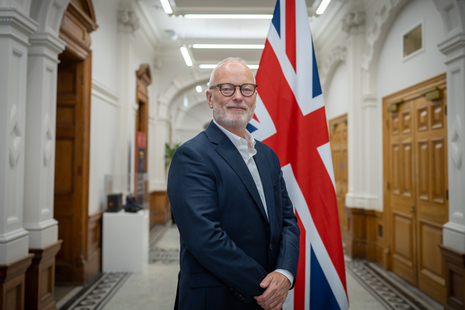
Speaking in a Lords Committee debate on the contribution that trade with Israel makes to the UK economy, Business and Trade Minister Lord Stockwood said: “While this Government have consistently made our concerns with the conduct of the Israeli Government known, Israel remains a trading partner that plays a significant role in the UK’s economy, with business and personal ties that we continue to value greatly.”
Asked what more the UK government wished to see, now that an uneasy ceasefire has been enforced in Gaza, before it would restart trade talks, the Labour minister said: “We are waiting to see phase two of the ceasefire put in place. At that point, the dialogue can continue.”
Israel has pushed back on proceeding with phase two—which envisions the establishment of mechanisms involved in the rebuilding and management of postwar Gaza—before Hamas returns the remains of Israel Police Master Sgt: Ran Gvili and hands over its weapons.


Responding to pressure for the UK to reverse its position on trade talks with Israel, Stockwood accepted that Israel’s innovative, high-tech economy is well aligned with the UK, providing an avenue for critical imports in key sectors mentioned, such as healthcare, medicines for respiratory care, neurology, oncology and pain management to support the treatment of chronic and high-burden diseases.
However, the peer then said:“We have also been clear that an enhanced trading relationship with Israel cannot come at any cost.”
He continued: “That is why, as the Committee will be aware, we took the decision to pause negotiations on an enhanced trade free trade agreement in May this year in response to the Israeli Government’s rhetoric and actions in Gaza and the West Bank.
“Since that announcement, we have been, and continue to be, clear that we would need to see sustained change in the Israeli Government’s position before we could resume trade negotiations.”
He said this position also applied to reversing the ban on Israeli soldiers attending the Royal College of Defence Studies course in the UK.
Thursday’s Question for Short Debate saw several peers known for their supportive positions on Israel put forward arguments for allowing the UK-Israel trade relationship to flourish freely again.
Last May UK-Israeli relations plunged to their worst state for decades after former foreign secretary, David Lammy suspended negotiations over a new free trade deal, saying Israel’s cabinet ministers’ calls to “purify Gaza” by expelling Palestinians were repellent, monstrous and extremist.
Lord Austin, who secured the debate, pointed to official figures from the Department for Business and Trade which showed that total trade amounted to £6.2 billion in the year to June last year.
That represented a 3.2%—or £218 million—increase driven by a surge of financial services exports to Israel.
“Israel supplies one in seven NHS prescriptions, which save the health service nearly £3 billion every year,” said the former Labour MP, who serves as a UK trade envoy to Israel.
“It is a global leader in digital health, biotech and medical innovation, delivering cutting-edge breakthroughs in early cancer detection, gene editing, Alzheimer’s research and cardiovascular treatment.”
He added: “We are like-minded partners with shared values, free societies and open democracies.
“We are liberal countries which value the contribution of every citizen, regardless of background or gender.
“We are two countries focused on trade and innovation, working together to create jobs, boost prosperity, improve defence and security, and tackle the world’s biggest challenges.
“This is the truth about our relationship with Israel. We should celebrate that success and do all we can to bring our two countries closer together.”

Conservative peer Lord Leigh then spoke of what he said was a “hugely disappointing approach sometimes taken by UK governments” in relation to the aborted bill aimed at banning BDS—boycott, divestment and sanctions.
“As I understand it—I am happy to be corrected—they have no intention to bring it back,” said Leigh.
“Boycotts create a chilling effect: they deter investment, research and partnership far beyond their formal scope, and in fact, they nurture violence, extremism and antisemitism.
“The attempt to normalise the delegitimisation of Israel is pure antisemitism undertaken by bad actors with dangerous motives. It needs to be challenged rigorously at every opportunity.”
Former Tory trade minister Lord Parkhead also noted the “misguided views” of those wanting to boycott Israel.
“If they want to be serious, for a start, they must stop using their iPhones, which contain a huge amount of Israeli products,” he said.
“They must turn off their computers, because one of Microsoft’s major research hubs is based in Israel, and not use AI: Nvidia recently described Israel as its second home, so they would have to stop using AI.
“They must also reject the range of medicines and cutting-edge treatments that Israeli health companies provide. When they come down for their weekly protests, please can they not use the mapping software provided by Waze, which is Israeli, or the buses, because the software that supports all our bus scheduling comes out of Israel as well.
“I would tell them to get lost, but they will probably manage that on their own, in the circumstances.”
Lord Blencathra also said there was an impact on the UK Jewish community of a negative government position towards Israel.
“The relevance to this debate of the huge contribution that British Jews have made to this country is that many of them still have links with and have relatives in Israel,” he argued.
“Israeli Governments and businesses saw that the UK was a Jewish-friendly country with which they could do business.
“I worry that that is now under threat with the despicable rise of antisemitism against the very community of whom we should be most proud in terms of what it has done for the UK.”
Crossbench peer Baroness Altmann added: “Past Governments built a strong defence partnership and developed close co-operation on counterterrorism and cyber security, with Israeli experts playing an important role in defending our country against bad actors.
“In that connection, I repeat that it is an extreme disappointment that our Government have suspended some of our trade with Israel—and only Israel—on what I consider spurious grounds.”

While Lord Gascoigne questioned the government’s stance towards Israel, compared to other countries.
“Is our economy performing so well that we can afford to turn away deeper trade with a key partner?” he asked.
“If the Government are so opposed to Israel’s actions, do they no longer consider Israel an ally? If we truly objected to Israeli policy, why did we not suspend all trade rather than only these new discussions?”
“I am afraid to say that this makes me feel as though this was simply something for the Prime Minister to placate his backbenchers.”
“If we were so opposed to what Israel was doing, why did we not apply the same approach to the United States, whose support for Israel was unequivocal?”
US President Donald Trump’s administration told Prime Minister Benjamin Netanyahu last week that it is committed to both bringing back the final deceased hostage from Gaza and disarming Hamas.
But is not prepared to condition the commencement of phase two of its peace plan on either.

Keep community journalism free.
Jewish News is free for everyone. No paywall. No barriers. Just trusted journalism for anyone who wants to stay connected to Jewish life in Britain.
If you value that, please support us.
From as little as £5 a month, you can help keep our journalism free and accessible to all.
Every day, we report on the issues that matter to our community. We celebrate achievements, support charities, challenge antisemitism and ensure Jewish voices are heard more widely.
From as little as £5 a month, you can help us continue to:
- Report on the stories shaping Jewish life in the UK and beyond
- Bring our community together through shared stories, events and campaigns
- Celebrate the people, culture and moments that define our community
- Support organisations doing vital work across Jewish Britain
You can make a one-off donation or become a regular supporter. Every contribution helps keep our journalism free, independent and accessible to all.
If everyone who values Jewish News gave a small amount, it would make a real difference to our future.