Prefer Jewish News on Google
‘Ukraine has no Iron Dome – it needs equipment to defend itself’
After the announcement that he will receive Ukraine's Order of Merit, Brooks Newmark tells Jewish News the West has to do more to support Ukraine with actions, not just words

In February 2022, Brooks Newmark had just returned from Rwanda, having completed field research for a doctorate. The former MP was planning to go away again – this time for a holiday, when he heard the news that Russia had invaded Ukraine. Instead of a ski-slope or a sun lounger, Newmark found himself in Eastern Europe, helping with the evacuation of thousands of civilians, predominantly women and children, from villages threatened by the Russian advance.
Soon after, he would help found a charity, Angels in Ukraine, which initially focused on the evacuation effort, but later, as the front line stabilised, would get involved in helping with other elements of life in a country during wartime.
Last month, his work in Ukraine led to Newmark being notified that he would receive the country’s Order of Merit, given to individuals for outstanding achievement and significant contributions to the nation. In the UK the Honours system informs recipients themselves well before any public announcement, but for a country in wartime, things work slightly differently.
“I was there [in Kyiv] on Independence Day”, Newmark told Jewish News.
“I was invited by the first lady, and…I’m sitting listening to her speech, and I get a WhatsApp message from the Ukrainian embassy in London saying, ‘Congratulations on your award’ I said: ‘What award?’ And they said, “You got the Order of Merit’. And they sent me the press release, which was of course in Ukrainian, so I couldn’t read it. But, anyway, I was very pleased.”


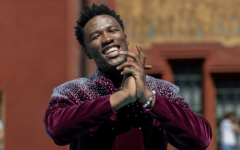
It was a particular pleasure for Newmark, given the company he was in.
“It was a great coincidence, because just before I was with Natan Sharansky, whom I had heard was getting the Order of Merit as well. So luckily I got this amazing photo of me, Natan Sharansky and the Chief Rabbi of Ukraine [Moshe Atzman].”
Newmark has previously described how he was not particularly religious, but that his move to Ukraine has seen him develop a close link with Rabbi Atzman, reconnecting with his Judaism. Having spent almost half his time in Ukraine since the beginning of the war, in early 2025 Newmark decided to put down roots there, purchasing an apartment in Kyiv, having previously “been living out of hotel rooms”.
The nature of the work done by Angels in Ukraine has shifted, too. At the beginning of the war, Newmark reflected, “we were based in Kharkiv , which is 25 kilometres from the front line, and covering all the villages, the small villages, mainly in Kharkiv Oblast and Donetsk, evacuating people from the villages. But then, in 2023, when the Ukrainians pushed out the Russians from many of these villages, then we did a lot of humanitarian aid drops; packages of clothing, food, medical supplies, and so on, to lots and lots of the small villages. We focused on the small villages because all the aid was going to the bigger towns in the east, but none of it was getting to the villages. That’s what we did for pretty much the next year.
“Then we set up a PTSD training program; we try to make sure that almost every school has an adult trained in PTSD. That programme is ongoing, we work with the [Ukrainian] Department of Health and Department of Education in providing some form of PTSD training.”
The initial training, he said, came from Israel.
“The group we used originally used to provide PTSD support for children who lived very close to Gaza and who were constantly getting shelled.”

I ask Newmark what the general feeling in Ukraine is, given recent protests over the sacking of the country’s Minister of Defence.
“The mood is not good”, he responds. “We’re now in year five of the war, yeah, so people are getting hugely emotionally stressed”.
There was anger over the sacking of Fedorov, he said, not because of Fedorov personally but what he represented, “somebody who wanted to address corruption in defence”.
People, he says, “are just tired after night after night of bombing. And by the way, the bombing in the last three to six months has gotten much worse. Imagine you’re constantly sleep deprived; it leads to this sort of tension in civil society.”
He tells me, for example, that a few days ago Ukraine’s two intelligence agencies, the SBU and GUR, “had a shootout when they were trying to deal with a particular individual who was working with one of the sides, because there are a lot of Russian expats that work with the army and the intelligence agencies, and for some reason there was a fallout there.”
This exhaustion, he suggests, is something the Russians have fully intended to cause, as part of their hybrid warfare.

“If they [the Russians] can break down society and can get people to start fighting with each other, that plays into what they’re trying to do. They’re not just fighting Ukraine on the what I’d call the kinetic battlefield, i.e. dropping bombs, but in the cognitive war space. There’s this sort of constant manipulation that goes on.”
Newmark has seen this directly from a military perspective as well. In 2024 he started a company, Trypillian, to develop combat-proven technology, including deep strike systems, battlefield communication tools, and tactical drones.
“The uptick and up pace of bombing and targeting civilians and civilian targets, particularly in Kyiv, is very bad”, he says.
“The number of civilian deaths each time the Russians bomb is having a bigger impact. Part of the problem is the West, and particularly America, is not giving Ukraine the equipment it needs to defend itself.
“There’s a whole group of people, my company included, that are in the midst of developing interceptor drones, interceptor missiles, to try and deal with these. Before they were able to intercept, but with this war we’re finding technology keeps leapfrogging. Right now, they can deal with the [Iranian developed] Shahid drones. But the ballistic missiles, at the moment, there’s nothing there. Ukraine has no iron dome like Israel has. When I was there just over a week ago, there were 24 missiles fired by Russia, and all 24 got through.
“Every time the Ukrainians do something and improve technology, whether it’s defensive or offensive, the Russians counter it. So yes, the Ukrainians are great at technology and developing technology, but the Russians are as well, and we shouldn’t forget that.”
He feels that “the West more broadly has to do more to be supporting Ukraine with actions, not just words. I’m at this security conference now here in Sarajevo, and there are a lot of warm words. You know, we must do this, we must do that, but you’ve got to follow actions with words, and there has not been enough of that.
“Unfortunately, we’re in a different era now. We’re seeing hybrid attacks whether in Leipzig recently, or in Romania and Poland, where they’re using third parties or drones. This is part of low-level provocation by the Russians to see what will trigger NATO to do something. They’re constantly doing these provocations, and we’re trying to be proportionate.
“But what we need to do is to understand that Russians don’t understand signals. They don’t understand proportionality. All they understand is getting punched in the face very hard. If you punch them in the face very hard, then they understand you’re serious. If you go in with sort of cap in hand, saying, ‘Hey, let’s have a discussion’, unfortunately, the evidence seems to be that doesn’t achieve anything, other than signal to the Russians the West is weak. Lack of resolve is not going to do anything.”

Keep community journalism free.
Jewish News is free for everyone. No paywall. No barriers. Just trusted journalism for anyone who wants to stay connected to Jewish life in Britain.
If you value that, please support us.
From as little as £5 a month, you can help keep our journalism free and accessible to all.
Every day, we report on the issues that matter to our community. We celebrate achievements, support charities, challenge antisemitism and ensure Jewish voices are heard more widely.
From as little as £5 a month, you can help us continue to:
- Report on the stories shaping Jewish life in the UK and beyond
- Bring our community together through shared stories, events and campaigns
- Celebrate the people, culture and moments that define our community
- Support organisations doing vital work across Jewish Britain
You can make a one-off donation or become a regular supporter. Every contribution helps keep our journalism free, independent and accessible to all.
If everyone who values Jewish News gave a small amount, it would make a real difference to our future.