Prefer Jewish News on Google
Under fire in Ukraine, World Jewish Relief continues to make a difference
The chief executive of World Jewish Relief spent 7 hours in a basement shelter as Russian missiles hit Kyiv on Monday. He talks to Jewish News about the charity's ongoing efforts
The sirens came first; howling their early warnings, as they have done for almost four years. And then the explosions began. Ballistic Missiles. Cruise Missiles. Hundreds of attack drones.
That was Monday night in Kyiv. Now. In February 2026.
For those of us sitting in the UK, it is sometimes easy to forget that there is a full-blown war being fought on the continent. Ukraine, once the lead item on every news broadcast in the Western hemisphere, has fallen out of the headlines.
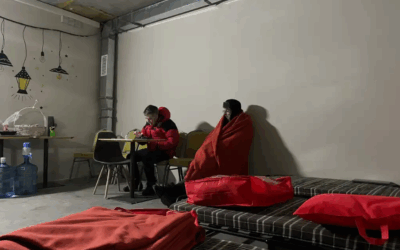
But for World Jewish Relief, the UK Jewish community’s humanitarian agency, Ukraine continues to be a key crisis point. Which is why WJR’s Chief Executive, Paul Anticoni, spent seven hours in a bomb shelter on Monday night – and by ‘bomb shelter’, we’re talking about the basement car park of the hotel, which has some seats and a few beds in it.
“Despite the regularity of my visits, I’ve never got used to the noise of air-raid sirens on my phone or in the streets, or trying to sleep in a shelter”, he tells Jewish News.
“It was made harder, because while we were trying to sleep we could also hear the boom of explosions and of Ukrainian air defence systems.”


As Anticoni points out, “we all have family and friends who spent the last couple of years in Israeli bomb shelters”. But Israel, through terrible necessity over decades, developed one of the most sophisticated air defence systems in the world – and Ukraine defence systems have to cover an area hundreds of times the size. Only around half the missiles fired by Russia were intercepted.
Another factor which compounds the severe difficulty is the cold – to simply call it ‘freezing’ would be a laughable understatement.
“It’s lower than minus 20 in Kyiv at the moment”, says Anticoni, describing it as “a cold which I’ve hardly experienced in my 40 years of working in disaster zones.
“A cold where if you breathe in, it gives you a shock. You don’t breathe in through your nose because your nostrils freeze. You don’t touch metal because you’ll stick to it.”
More than any other nation, perhaps, Russia knows how to use winter as a weapon. Putin has targeted Ukraine’s power plants. Apart from the obvious result – lack of heating, the secondary effect is that the pipes freeze, meaning a lack of water.
“I have probably some of the best winter kit I could have prepared myself with”, Anticoni says, “but when I’m meeting some of our elderly Jewish clients, ladies in their mid-80s, wearing all their clothes, but it’s just not enough. No heating, windows that barely keep out a draft. It’s unbelievable how they’re surviving.”
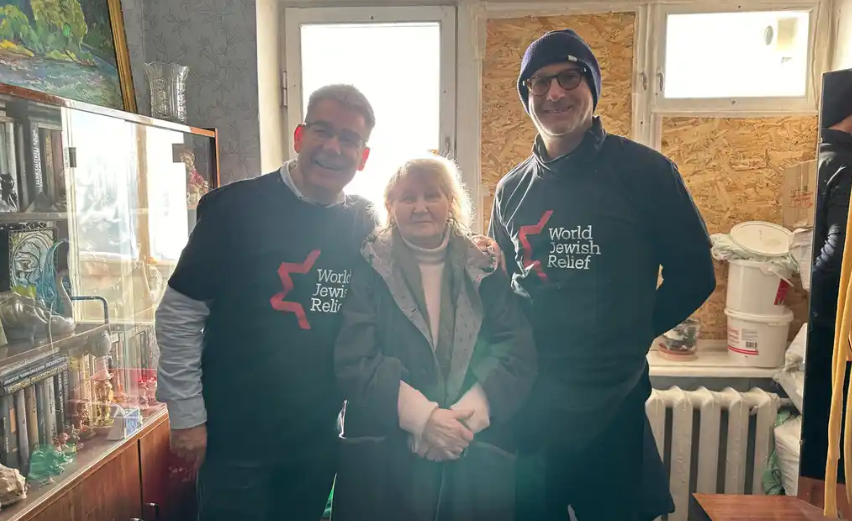
WJR’s Chief Executive has been to Ukraine around a dozen times since the full-scale invasion by Russia in 2022, with other members of staff regularly going back and forth. The charity works via a network of trusted Ukrainian partner organisations, and Anticoni praised WJR’s “Ukrainian partners that do all the heavy lifting, all the work, often in frontline areas.” Yesterday he met one of the team members working for a WJR partner organisation, a psychologist “who was hit by a Russian explosion in August” and spent months in hospital recovering.
“It brought home to me that the teams of the partner organisations we work with are taking immense risks.”
Given the current situation, one of the key elements of WJR’s work in Ukraine is home repairs.
“We’ve repaired over 400 homes over the last 12 months”, says Anticoni. “I estimate that there’s another 2000 ahead of us, and I think sadly, Putin is hitting their houses quicker than we are able to repair them. We’ve got a very, very long waiting list. Given the scale of need, we only have resources at the moment to be supporting clients within the [Jewish] community. We would love to be able to do more beyond.”
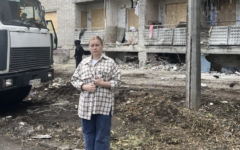
There are of course buildings that suffer direct strikes, but the damage to homes in the general vicinity of any blast is one it can be hard for those who do not live in warzones to consider. For example, the WJR chief describes how, when “drones hit the neighbourhood, every pane of glass for maybe a kilometre surrounding is absolutely shattered. You could just about get away with that in August, September here, because it’s really hot. But from October, November, temperatures start to drop. In November, we saw temperatures go below freezing. You really don’t want to have no glass in your windows at the moment.”
He praises the response of the charity’s home affairs response teams, describing how they “are able to be on the spot pretty quick, put ply boards up and do some immediate repairs within hours. Then they’ve got to measure up and get specialist windows fitted – meaning that their clients may have to be out of the flat only for a few days, as opposed to permanently out of the flat.”
Often these clients are elderly Jewish people, who may be living alone on the fourth or fifth floors of apartment blocks, and who “would not themselves, sadly, on the pensions they’re on, be able to afford to have those those homes repaired.”
Anticoni describes “The resilience and bravery of these older ladies” – a typical account goes as follows: “I was fast asleep, the bomb hit, the glass shattered all over me, I dusted it off, and was around until the emergency services came. I phones the World Jewish Relief home repairs team. And within a week, I was in the flat and it’s back to normal.”
Of course, the WJR chief says, “we ask ourselves, ‘is it worth repairing the homes if they might get shattered again with another attack?’ Well, the choice is obvious, because there’s nowhere else for these individuals to go. They can’t leave the homes. They don’t want to be living in hotels or either winter accommodation that would be far too expensive. They want to be back home.” But he describes “the worry, fear and weariness in the faces of everyone I meet…the abnormal has been normalised here.”
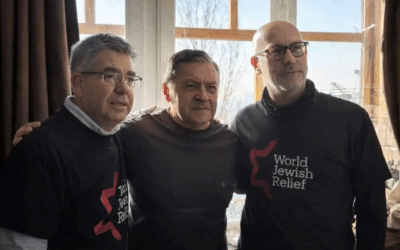
WJR’s Chief Executive praises both the response of British Jews and Britain in general, under successive government, to the ongoing crisis in Ukraine.
“Of course, in recent years, our community has focused and been worried on events in Israel”, he says.
“I think that has understandably meant that other priorities have come to the fore. It’s entirely normal that the longer the conflict goes on, the less it is a news headline, and the less people are aware of the scale of humanitarian suffering. Our focus, of course, is only on the level of need and what we can do. So I worry that the longer this war goes on, attention focuses elsewhere.”
Speaking down the line from Kyiv, he says that “part of my reason in coming here now was firstly to understand what it’s like to live in this context and how you can survive. Secondly, it was to find a way to both acknowledge the support that our community has provided through World Jewish relief and other organizations working in Ukraine, and to highlight the ongoing plight of those that need our assistance.
“I think it is the single most significant Jewish community which faces the most insecure future anywhere in the world, and we have a responsibility to try and find a way to keep that community safe, healthy, warm, alive, and knowing that there is another community elsewhere that cares for it and is worried about it.”
But while there is desperation, there is also determination, and positivity.
“World Jewish Relief focuses on an older part of the community here and repairing their homes, but we’re also working with a younger part of the community, many of whom have been fighting, and who lost their homes, jobs, or sources of income,” Anticoni says.
“World Jewish relief is known all over the world for its Back to Work program. These Jewish clients, having lost everything and almost given up a sense of hope, are given the confidence to become job ready, and then we were able to find them a vacancy because of our relationship with many, many different employers.
“There is nothing better than one of these individuals saying to me, ‘I do not need World Jewish Relief help anymore. Not only am I now self-sufficient, I’ve got an income, I’ve employed somebody else from the community, and they also don’t need your help’. Obviously, we want to help people help themselves, but when you see it in action in the midst of a conflict, it’s really inspiring.”
For donors and would-be donors, Anticoni says: “There are a lot of less good news stories in the charity world, and times when you think ‘is my money making a difference?’ On this one, it’s very, very measurable.”
World Jewish Relief’s fundraising page for Ukraine can be found here.

Keep community journalism free.
Jewish News is free for everyone. No paywall. No barriers. Just trusted journalism for anyone who wants to stay connected to Jewish life in Britain.
If you value that, please support us.
From as little as £5 a month, you can help keep our journalism free and accessible to all.
Every day, we report on the issues that matter to our community. We celebrate achievements, support charities, challenge antisemitism and ensure Jewish voices are heard more widely.
From as little as £5 a month, you can help us continue to:
- Report on the stories shaping Jewish life in the UK and beyond
- Bring our community together through shared stories, events and campaigns
- Celebrate the people, culture and moments that define our community
- Support organisations doing vital work across Jewish Britain
You can make a one-off donation or become a regular supporter. Every contribution helps keep our journalism free, independent and accessible to all.
If everyone who values Jewish News gave a small amount, it would make a real difference to our future.