Prefer Jewish News on Google
We need new initiatives to combat antisemitism in Britain: so I founded one
Politics and society have fundamentally changed. Our communal institutions and structures were designed for a different age
A year ago, Islamist terrorism left two worshippers dead at Heaton Park Synagogue.
This week, the shul’s Rabbi Walker warned that British Jews are even more endangered because of the failure to “deal with core problems.”
He’s right. If we are serious about protecting Jewish life in Britain, we need to ask what those core problems are and ask: Are we set up appropriately? Are we trying everything?
For generations, we’ve relied on community representatives to access ministers, MPs, and authorities. Since 7 October 2023, we have discovered that this access is not influence; and influence is not action. Politics and society have fundamentally changed. Our communal institutions were designed for a different age.
As a new deputy at the Board of Deputies, we hardly ever discussed the antisemitism crisis. While assisting on a computer refurb charity initiative I was thinking: “People want to kill us. Is this really the best use of our time?”
Meanwhile, shul members were asking leadership organisations “What can we do?” They got short shrift.
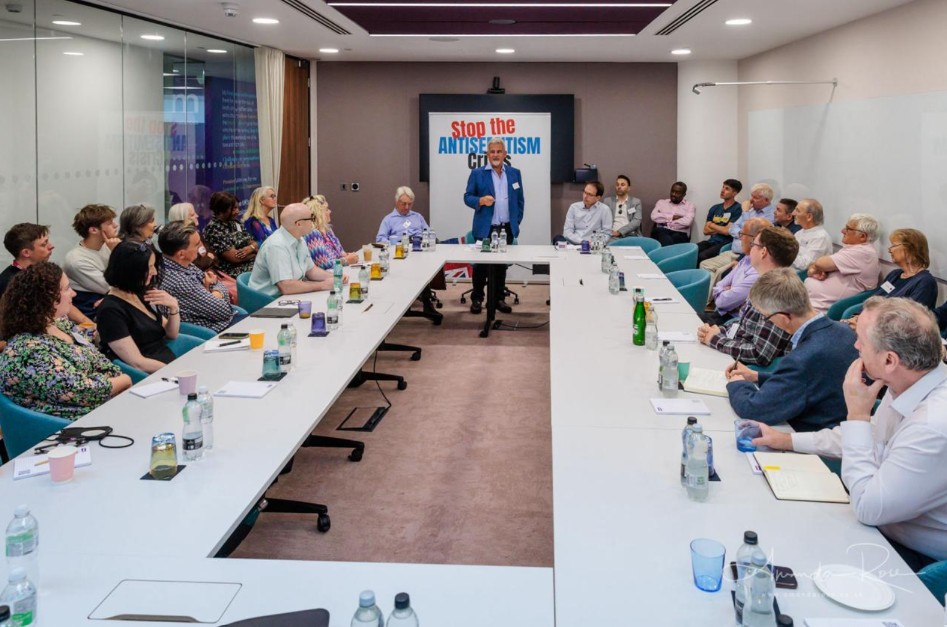
So I founded the GPS Network, a civic-resilience network to give people tools, opportunities and infrastructure to take action every day. Something the community structures were not interested in.
We give volunteers jobs.
With knowledge, contacts, technology and support, they organise locally, collaborate nationally, take action, and stop the antisemitism crisis.
From a loose network of over 400 groups, 12 divisions of volunteers now reach hundreds of thousands of people.
They remove online antisemitism, stop extremist events, enforce compliance at councils, are published in newspapers every day, on the radio, on TV and have developed technology to ensure informed pro-British (pro-Jewish) voices are heard across Middle Britain.
For success, as Rabbi Lord Jonathan Sacks z”l observed, antisemitism has to be confronted by “those active in the cultures that harbour it”.
One of the most encouraging developments has been the number of Christians who have approached us asking “what can we do?”
We Jews are too few. Our many Christian alliances provide a crucial route to communities where there are no Jews. In churches, workplaces, schools, pubs and working men’s clubs, in local newspapers, on local radio and in millions of conversations.
GPS is now a cross-community network of British citizens. With so many non-Jews in the network, that enables authorities to respond in the national interest rather than being accused of somehow “appeasing” Zionist, Israeli or Jewish lobbyists.
For example, the challenge to the Maccabi Tel Aviv football fan-ban was led by the small West Midlands Resilience Team who undertook extensive research into policing decisions and worked with parliamentarians to enable public scrutiny.
MPs described the work of our colleagues as “amazingly comprehensive,” “forensic,” and “unsung heroes.”
The Chief Constable was disgraced and retired, and WM police overhauled.
People can achieve extraordinary results when they are given opportunities.
We cannot simply put higher fences around Jewish buildings and imagine Britain has therefore become safer for Jews.
Security protects Jewish buildings.
Civic resilience protects the social environment in which Jewish life exists.
We need both.
The strategic shift we need is to concentrate on the social environment. It is unrealistic to expect British non-Jews to mobilise around Israel or antisemitism in sufficient numbers. So the aim must be to mobilise around Britain itself, and its core values: Democracy. Freedom of speech. Freedom of religion. Equality before the law. Women’s rights. The right to live without intimidation.
These freedoms protect everyone – including Jews.
Something’s got to change. There is no single solution to the antisemitism crisis. So we must try new ideas.
The solidarity shown after Heaton Park shows that many will stand with us. Our task now is to turn that solidarity into something permanent. An institution.
The GPS movement is now a tried and tested infrastructure, turning concern into action, challenging extremism, reaching the silent majority and stopping antisemitism. Now it needs recognition, investment and to be built at the scale this crisis demands.
The future of British Jews cannot be secured by Jewish leaders and politicians alone. It will be secured when ordinary British people decide that their country, its values – and the future of their Jewish neighbours – are worth fighting for.
Heaton Park was an attack on British Jews. The response must be ‘The Awakening of Britain.’ That is civic resilience.
Jeremy Wootliff is the founder of the GPS Network and is writing in that capacity.
Find out more about GPS here:

Keep community journalism free.
Jewish News is free for everyone. No paywall. No barriers. Just trusted journalism for anyone who wants to stay connected to Jewish life in Britain.
If you value that, please support us.
From as little as £5 a month, you can help keep our journalism free and accessible to all.
Every day, we report on the issues that matter to our community. We celebrate achievements, support charities, challenge antisemitism and ensure Jewish voices are heard more widely.
From as little as £5 a month, you can help us continue to:
- Report on the stories shaping Jewish life in the UK and beyond
- Bring our community together through shared stories, events and campaigns
- Celebrate the people, culture and moments that define our community
- Support organisations doing vital work across Jewish Britain
You can make a one-off donation or become a regular supporter. Every contribution helps keep our journalism free, independent and accessible to all.
If everyone who values Jewish News gave a small amount, it would make a real difference to our future.