Prefer Jewish News on Google

Welcoming the next generation
One of my friends told me he hoped our son would have my wit and eyes and Kate’s everything else, something which turned out to be closer to a prophecy
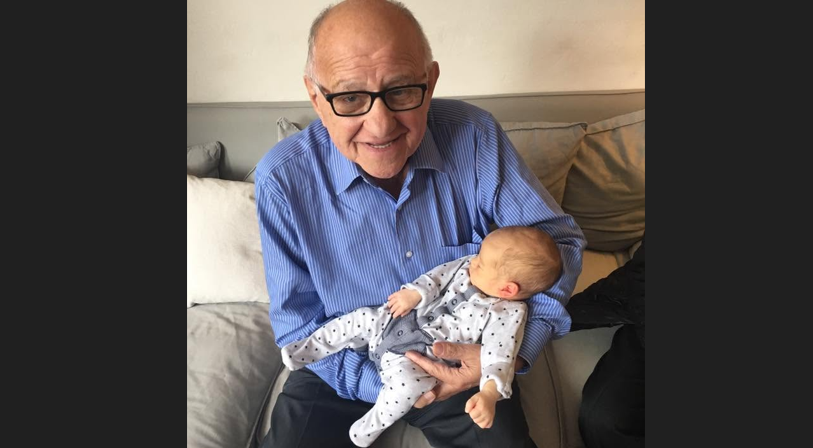
“We aren’t like other families” was a catchphrase of my grandfather’s, a direct rebuttal of Tolstoy that suggested we were somehow different in a way that was to be envied, perhaps having inherited some of his own special qualities via osmosis.
Isaac Richman, our son, certainly did, along with the survival instinct. Last week marked a decade since his birth, a moment preceded by my wife’s waters breaking at the 29-week stage in a crowded Dalston food court. Kate turned to me that night and quietly intoned, “Either I’ve just wet myself or we have a problem here.” It was the latter and we spent the following weeks at the Whittington Hospital in Archway.
When I left the hospital for the first time with my father, we turned on the radio and I had my first contact with the outside world in what felt like millennia. It was Bob Dylan, an important artist for us, singing Frank Sinatra, an important artist for Zigi. The song was Young at Heart, the soundtrack to the first dance at our wedding and the words had never felt more apposite:
“And if you should survive to 105,
Look at all you’ll derive out of being alive!


And here is the best part, you have a head start
If you are among the very young at heart.”
Kate stayed at the hospital for a week before being discharged and told she could remain at home. That plan lasted precisely one day before there was some bleeding in the night and we spent our first wedding anniversary in hospital. Kate kept asking, “Why?” As a Jew descended from survivors, my question was, “Why us?”
At 1am on the day our firstborn would arrive, I received a text informing me that Kate’s contractions had started. I rushed to hospital and spent the day trying to comfort my wife as she endured hours of pain. The key line from Kate during that period was, “Next time we’re adopting.” The only respite came when we listened to Sinatra’s original version of Young at Heart on my phone and cried.
Finally, at 6.30pm, it was time. The room was packed and people just kept joining, like the crowded cabin scene in A Night at the Opera. The first thing the doctor told us from her vantage point (I was reliably informed for a father it was better to stand at slip than mid-off during delivery) was that he had lovely dark hair. Ever the diplomat, I blurted out “Yes Kate, you were worried he’d be ginger!” Another doctor in the corner, a redhead, said, “There’s nothing wrong with that, it’s original” and I realised that this childbirth was now more Curb Your Enthusiasm than ER. An hour later, he was with us. I was asked to cut the umbilical cord and apparently succeeded despite my F in Design and Technology at school.
When I spoke to my grandfather on the phone that night, Isaac’s great-grandfather and my great grandfather, he was overwhelmed. Zigi told me, between sobs, that I couldn’t imagine what it meant for a holocaust survivor to have not just children, not just grandchildren but great-grandchildren.
When he heard about the pregnancy, one of my friends told me he hoped our son would have my wit and eyes and Kate’s everything else, something which turned out to be closer to a prophecy. Isaac’s obsessions over the last decade have included but are not limited to diggers, Lego, rock and roll, magic, Star Wars and cricket. And all the while he has displayed a wisdom beyond his years that has rightfully earned him the nickname, “Wiseaac”.
The meaning of the name Isaac is “He will laugh”, a prescient choice for a child who would spend his first few weeks in hospital breathing via tubes but ultimately end up embodying the idea that laughter is the shortest distance between two people. It certainly was when Isaac and his great-grandfather were together in a room for the six and a half glorious years they were together on this planet.
The middle name has meaning too. My grandfather was reduced to the number 84303 in Auschwitz and so his name mattered and matters. Our firstborn child arrived early in the summer of 2016 and we broke with Ashkenazi Jewish protocol and honoured a living relative. My son has just turned ten and his name is Isaac Zigi.

Keep community journalism free.
Jewish News is free for everyone. No paywall. No barriers. Just trusted journalism for anyone who wants to stay connected to Jewish life in Britain.
If you value that, please support us.
From as little as £5 a month, you can help keep our journalism free and accessible to all.
Every day, we report on the issues that matter to our community. We celebrate achievements, support charities, challenge antisemitism and ensure Jewish voices are heard more widely.
From as little as £5 a month, you can help us continue to:
- Report on the stories shaping Jewish life in the UK and beyond
- Bring our community together through shared stories, events and campaigns
- Celebrate the people, culture and moments that define our community
- Support organisations doing vital work across Jewish Britain
You can make a one-off donation or become a regular supporter. Every contribution helps keep our journalism free, independent and accessible to all.
If everyone who values Jewish News gave a small amount, it would make a real difference to our future.