Prefer Jewish News on Google

What ‘anti-Zionists’ are being told about Zionism on university campus
Recently, shocking footage emerged of an extreme lecture on 'the birth of Zionism', which took place on UCL's campus. The student behind that video now writes about the experience
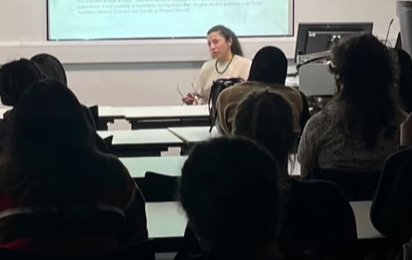
Antisemitism remains a serious issue across the United Kingdom, and university campuses are no exception. A recent lecture at University College London underlined this concern in a way that was both unexpected and deeply troubling. The speaker, Dr Samar Maqusi, a former research fellow at UCL, delivered remarks that were not only inaccurate but also openly discriminatory.
My girlfriend and I arrived prepared for a challenging session. We knew the society that had invited the speaker, and we were aware of Dr Maqusi’s public positions. Even so, we expected a university of UCL’s calibre to ensure professionalism, accuracy and academic integrity.
The lecture was titled “The Birth of Zionism”, but what followed bore little resemblance to a serious or nuanced historical study. The speaker began by claiming that Jews controlled media and financial systems in the nineteenth century and that this supposed influence laid the groundwork for the creation of Israel. This was presented as history, yet it reflected long standing conspiracy theories rather than scholarship.
Her account of the Damascus affair of 1840 was even more disturbing. She repeated the accusation that Jews murdered a Christian priest and used his blood for Passover bread. There was no reference to the brutal torture inflicted on the Jewish community or to the long record of blood libel myths that have caused immense suffering.
The lecture continued with mistranslated Israeli recruitment posters, used to support a claim of a settler colonial project. Key events in Jewish history were dismissed or warped. The Shoah was not mentioned at all. The long record of persecution of Jews across Europe received the same silence. The Dreyfus affair was presented as if Alfred Dreyfus had indeed been guilty, with no reference to his full exoneration in 1906. This omission distorted one of the most significant political scandals in modern French history.
The reaction within the room was just as striking. No one questioned the claims or asked for clarification. The audience appeared fully supportive. Instead of engaging critically, they seemed to welcome the narrative and reinforce their own assumptions. A room that should have encouraged enquiry became a space where misinformation was greeted with applause.
The experience was shocking. It was alarming to see a lecturer present crude distortions, and even more alarming that such a lecture could take place within a leading British university without challenge.
How could someone who relies on such material hold a teaching post at an institution known for academic excellence? And how can students sit in silence while discriminatory myths are presented as fact? The absence of critical thought and the lack of professional oversight were impossible to ignore.
I recorded the lecture and submitted the footage to StandWithUs UK, where I serve as an Emerson fellow. The organisation responded quickly and responsibly, alerting the media and raising wider awareness. Their support was invaluable, but the incident itself remains a stark warning.
Antisemitism does not disappear. It may remain out of sight for a time, yet it endures beneath the surface. We say never again, but moments like this show how easily prejudice can reappear when vigilance fades.
Universities carry a duty to protect the integrity of their teaching and the safety of their students. This incident is a reminder that this duty must be taken seriously, and that silence only allows discrimination to grow.
Mark Ben Mikhelson is a StandWithUs Emerson Fellow and Vice-President of the UCL Friends of Israel Society

Keep community journalism free.
Jewish News is free for everyone. No paywall. No barriers. Just trusted journalism for anyone who wants to stay connected to Jewish life in Britain.
If you value that, please support us.
From as little as £5 a month, you can help keep our journalism free and accessible to all.
Every day, we report on the issues that matter to our community. We celebrate achievements, support charities, challenge antisemitism and ensure Jewish voices are heard more widely.
From as little as £5 a month, you can help us continue to:
- Report on the stories shaping Jewish life in the UK and beyond
- Bring our community together through shared stories, events and campaigns
- Celebrate the people, culture and moments that define our community
- Support organisations doing vital work across Jewish Britain
You can make a one-off donation or become a regular supporter. Every contribution helps keep our journalism free, independent and accessible to all.
If everyone who values Jewish News gave a small amount, it would make a real difference to our future.