Prefer Jewish News on Google

What happens in Israel this year could revive or ruin Liberal Zionism
This year's Israeli election is likely to mark a watershed moment for a section of Diaspora Jews, although their feelings will have no real impact on how Israel votes

One of the most beguiling but ultimately fruitless questions to consider in any field is “what if?” What if I had won that prize? What if I’d said this instead of that? What if I’d turned left rather than right?
In history, or politics, the what ifs are endless. What if JFK hadn’t been shot? What if the UK hadn’t gone into Iraq with the US? What if Donald Trump hadn’t been comprehensively humiliated at the 2011 White House Correspondent’s Dinner? We might guess at some consequences, but we can never know the full alternative future.
When it comes to Israel, however, the what ifs can be somewhat harder to brush aside, at least for me.
What if Merav Michaeli, then leader of Israel’s Labor Party, had agreed to a 2022 coalition with Meretz? Michaeli bridled at the proposition – and it’s hard for me to blame her, as I have little love for Meretz. But a combined vote for a Labor-Meretz bloc could have won a larger number of seats than the paltry four Labor ended up with – and in the process, could have blocked Benjamin Netanyahu from forming a coalition with various repulsive far-right nationalist parties, who had shown few similar qualms about coming together for the sake of the election. Could history have turned out differently – for the better, or in some ways, for the worse? (Labor and Meretz have since merged to form ‘The Democrats’ under Yair Golan).
That example is currently on my mind because this year, by the end of October at the latest, Israel will once again hold Knesset elections. And I believe that for a significant number of Liberal Zionists, the result will permanently affect their relationship with the country.



The thought process I have heard elucidated goes something like this.
The coalition of the right and the far right, as created by the 2022 election, was an aberration that a few thousand votes the other way could have prevented. Since then, Israel has seen a constitutional crisis because of attempts to weaken the power of the judiciary, followed by the most devastating tragedy since the founding of the state. That was followed by a bitter war which, as time went on, became increasingly controversial, both within Israel itself and internationally. Sanity must be restored, and this can only happen if Netanyahu and his allies lose the next election, which will allow a reset of Israel’s relationship, not just with the Jewish diaspora but the entire world.
In some ways I find that argument compelling. In others, however, I find it extraordinarily naïve. After all, those who hate Israel and seek its destruction will do so whether the prime minister is Netanyahu, Naftali Bennett, Yair Lapid or Mahatma Gandhi.
There is also the point that – how does one put this politely – there is little, if anything, to suggest that the average Israeli citizen, when it comes time for them to cast their vote, cares in the slightest about what Diaspora Jews may think of their choice.
But the argument about what this Israeli election must do also fails to acknowledge the reality on the ground – that four years on from that election, Israel’s political situation remains as volatile and uncertain as ever.
Take the idea of Netanyahu receiving a pardon from President Herzog in his seemingly never-ending corruption trial, as Donald Trump has pushed for. Polling within Israel shows that just over 50% are opposed to a pardon, while more than 40% back it, with just a small percentage saying they don’t know.
There is little, if anything, to suggest that the average Israeli citizen, when it comes time for them to cast their vote, cares in the slightest about what Diaspora Jews may think of their choice.
Or look at the general polling regarding political support. Likud currently has 32 seats in the Knesset – its polling numbers show its predicted seats at an election hovering around the 30 mark – sometimes higher, sometimes lower. If the projected seat numbers for Bezalel Smotrich’s party are slightly lower, the ones for Itamar Ben Gvir’s are slightly higher.
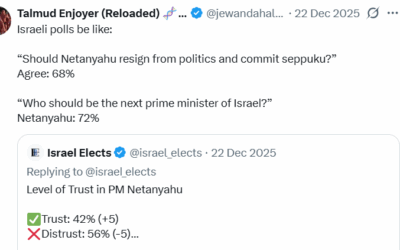
The backing for strictly Orthodox parties like Shas and UTJ remains largely static. So despite everything that has happened over the last few years, there is a significant chance that Netanyahu – who is, lest we forget, the most successful politician in Israel’s history – will again form a coalition. As one caustic (right wing) Anglo-Israeli commentator put it recently on social media: “Israeli polls be like: ‘Should Netanyahu resign from politics and commit seppuku?’ Agree: 68%. ‘Who should be the next prime minister of Israel?’ Netanyahu: 72%.”
And so, what will such liberal Zionists do if the unthinkable indeed comes to pass, and Bibi yet again forms a coalition? Some will find a different rationale which will allow them to maintain their support for a country which they feel increasingly at odds with politically, if not emotionally. A few may go charging off full-tilt into the quagmire of explicit anti-Zionism.
But far more, I suspect, will engage in quiet quitting – stepping back from open support, pruning their donations further, deciding, when friends or colleagues criticise Israel, just to keep their heads down and accept that criticism without reproach. Right-wing Zionists will scorn such behaviour – for them Israel is family, and you don’t quit on family, even if you argue with them incessantly. But can Israel really afford to lose more external Jewish backing, when it seems to haemorrhage support from so many other places?
Whatever happens, by the end of this year we will have a whole new range of ‘what ifs’ to ponder, however much we might try to avoid thinking about them.

Keep community journalism free.
Jewish News is free for everyone. No paywall. No barriers. Just trusted journalism for anyone who wants to stay connected to Jewish life in Britain.
If you value that, please support us.
From as little as £5 a month, you can help keep our journalism free and accessible to all.
Every day, we report on the issues that matter to our community. We celebrate achievements, support charities, challenge antisemitism and ensure Jewish voices are heard more widely.
From as little as £5 a month, you can help us continue to:
- Report on the stories shaping Jewish life in the UK and beyond
- Bring our community together through shared stories, events and campaigns
- Celebrate the people, culture and moments that define our community
- Support organisations doing vital work across Jewish Britain
You can make a one-off donation or become a regular supporter. Every contribution helps keep our journalism free, independent and accessible to all.
If everyone who values Jewish News gave a small amount, it would make a real difference to our future.