Prefer Jewish News on Google
When everything shattered – and what we built from it
October 7 split Hen Mazzig’s life in two. What followed – from raw grief to a Greek wedding – was a lesson in rebuilding
Some years can split a life apart. Mine split on 7 October, 2023.
The fracture wasn’t only from the brutality of the massacre; it was the aftermath, when the public response revealed how thin the world’s empathy for Jews had become. Facts were treated as inconveniences. Grief was interrogated. The dead were discussed with a conditional grammar. I spent weeks talking on television, briefing officials, speaking to families and carrying a private collapse that I didn’t have the luxury of slowing down to name.
During that same period, I was preparing for my wedding. The contrast bordered on absurd. I would leave meetings with hostage families and walk straight into conversations about seating charts. I’d record commentary on mass violence and then answer questions about linen colours. Something in me couldn’t reconcile those worlds. I wasn’t supposed to. Life after an atrocity is never coherent. It is assembled.
The assembling began long before the wedding day. For months, I watched families of hostages show a clarity of purpose the rest of us struggled to imitate. They didn’t fall into despair. They held their fear with discipline. They demanded the return of their loved ones with a steadiness that cut through every political performance around them. Their determination forced me to examine my own. If they could remain clear while living through the worst hours of their lives, I had no excuse to become smaller than the moment.
This year saw all the living hostages returned home, gaunt with hunger but eyes bright as they hugged their loved ones for the first time in a very long time. This year also saw burial after burial, as family members finally got the chance to give a final goodbye. The endless videos and stories shared online made visible a truth the world keeps trying to forget: Jews fight for life. Jews return their dead. Jews take responsibility for one another across impossible distances. That ethic is what held me upright this year. It’s also what formed the spine of my wedding.


My friend, New York Times bestselling cookbook author and chef Adeena Sussman, said something to me the night of the wedding that exposed a dimension I hadn’t fully understood. She told me that the weekend felt like “group therapy disguised as simcha”, that people didn’t only celebrate us, they needed the celebration for themselves. After a year defined by grief, shock, and moral disorientation, the wedding became a corrective. A recalibration. A reminder of what unbroken life looks like.
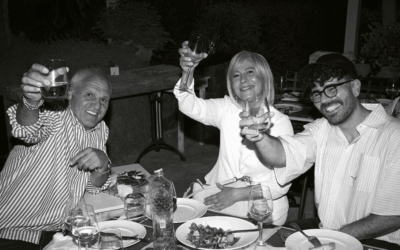
We chose Greece for reasons that were both practical and symbolic. It sits between Israel and the United Kingdom, between where our families live and where our lives have stretched. It is a literal midpoint, but it also functions as a metaphor for the life we are building, suspended between cultures, histories and expectations. Greece isn’t neutral. It’s layered. Ancient. Weathered. A place shaped by fractures and still standing. That felt appropriate for a Jewish wedding.
Greece isn’t neutral. It carries the memory of the Greek empire that once tried to crush Jewish practice, erase Jewish particularity and force Jews into a cultural mould that was not theirs. The empire that banned brit milah. The empire that outlawed Torah study. The empire that tried to overwrite a people. The old struggle between assimilation and identity was born on that soil. Standing there to build a Jewish wedding felt like a quiet corrective. The same place that once tried to extinguish Jewish difference became the place where a Jewish wedding had a simcha with full visibility and without apology. History bends strangely. Sometimes you return to the site of attempted erasure to assert continuity. Sometimes the most powerful act is simply being there and living.
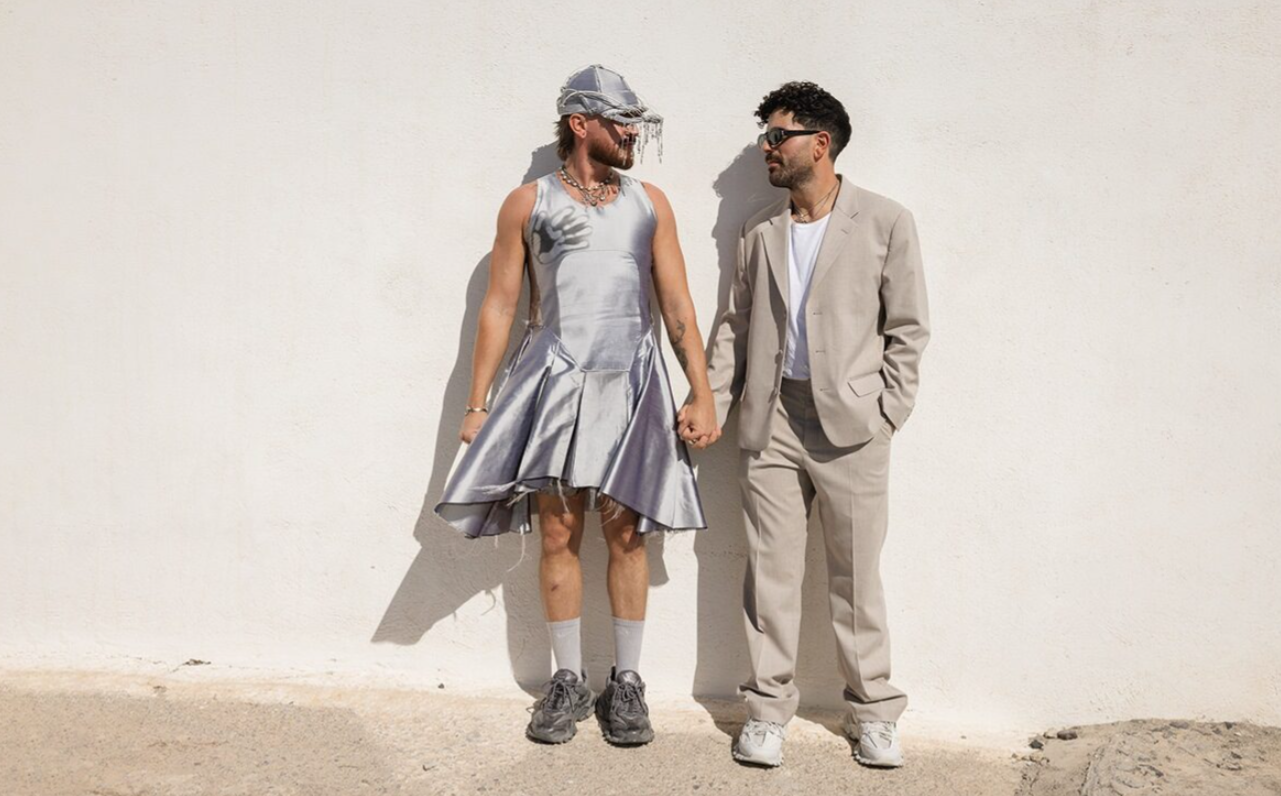
The wedding began with a Friday night Shabbat dinner. The vinery where we hosted it was full of people who had lived their own version of the past two years, carrying different forms of exhaustion. Marc, my husband, had chosen almost every element of the weekend: the poolside ceremony on Saturday, the colours our mothers wore, and the palette for the guests. He wanted the aisle to feel like a catwalk, not as a spectacle but as an intention. Each person who came forward to give one of the seven blessings walked that path like they were stepping into a story larger than themselves. A female rabbi led the ceremony. It mattered to us that the ritual acknowledged the world as it is, not the world as tradition once insisted it must be.
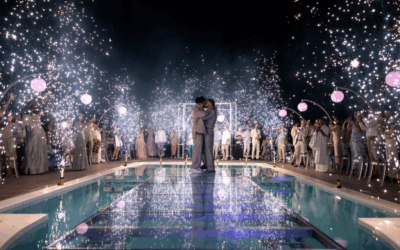
Marc designed his suit with a tailor in London and kept a second look secret from me. It was a dress created by the artist and designer Nicole Zisman, with a hand-tan mark traced across the chest and back, a deliberate play on his fashion instincts and on the idea of what a groom is allowed to be. My own suit was Maison Margiela, seams exposed and inside-out, because Judaism at its best has always been an inside-out tradition. It asks you to examine the internal first and let the external follow.
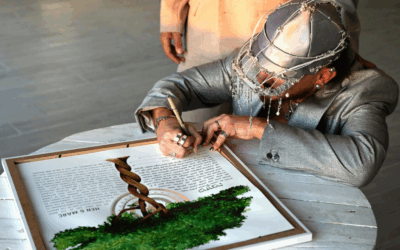
We both smashed glasses. We both meant it. The shattering felt like an honest acknowledgment of the year we had survived, and a reminder that we will never forget Jerusalem. Then the lead singer of the Yemenite sisters trio A-WA, Tair Haim, performed live, pulling the entire wedding into a different emotional register. The food was Middle Eastern with a Greek flair. Instead of a cake, we served a baklava tower. Fireworks closed the night. None of it was designed to distract from the world. It was designed to show that life without joy is not life.
The next morning, 80 of our closest friends joined us for an island-hopping cruise around Santorini. It wasn’t extravagance. It was continuity. People needed a space where the past two years weren’t the entire story.
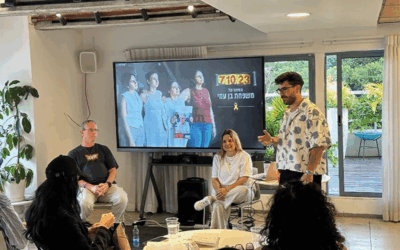
This week, at the Tel Aviv Institute lab, I met Raz and Ohad Ben Ami, both survivors of Hamas captivity. They were kidnapped together. While they were held, Ohad protected Raz. When she returned to Israel without him, she refused to let the country forget his name. She went on every stage, spoke from every rooftop, fought until the day he came home. Their story isn’t sentimental. It is structural. It explains how people survive what isn’t survivable. Someone holds the line for you until you can stand again.That is the kind of marriage I want to build.
 The past two years have changed all of us. They have changed me. I’ve watched what the stress, fear and public scrutiny have done to Marc. I’ve watched what it has done to our lives. I don’t want a marriage that performs resilience. I want one that practices it. I want to be the person who protects him in the ways the world will not. I want to be the husband who holds the line when he can’t.
The world keeps trying to shrink Jewish life to the dimensions of our trauma. This year taught me that Jewish life is built in the aftermath of trauma, not in submission to it. My wedding wasn’t an escape from October 7. It was the reconstruction project that followed. It was the decision to build something deliberate inside the wreckage. The hostages came home. One still needs to be returned. The rest of us now have the task of choosing what we build next.
I am committed to building a Jewish home filled with love and acceptance.
I am committed to joy that no one can take away.

Keep community journalism free.
Jewish News is free for everyone. No paywall. No barriers. Just trusted journalism for anyone who wants to stay connected to Jewish life in Britain.
If you value that, please support us.
From as little as £5 a month, you can help keep our journalism free and accessible to all.
Every day, we report on the issues that matter to our community. We celebrate achievements, support charities, challenge antisemitism and ensure Jewish voices are heard more widely.
From as little as £5 a month, you can help us continue to:
- Report on the stories shaping Jewish life in the UK and beyond
- Bring our community together through shared stories, events and campaigns
- Celebrate the people, culture and moments that define our community
- Support organisations doing vital work across Jewish Britain
You can make a one-off donation or become a regular supporter. Every contribution helps keep our journalism free, independent and accessible to all.
If everyone who values Jewish News gave a small amount, it would make a real difference to our future.