Prefer Jewish News on Google
Rabbi and Imam podcasters take message of unity to London audience
Jewish and Muslim allies bring message of dialogue to JW3
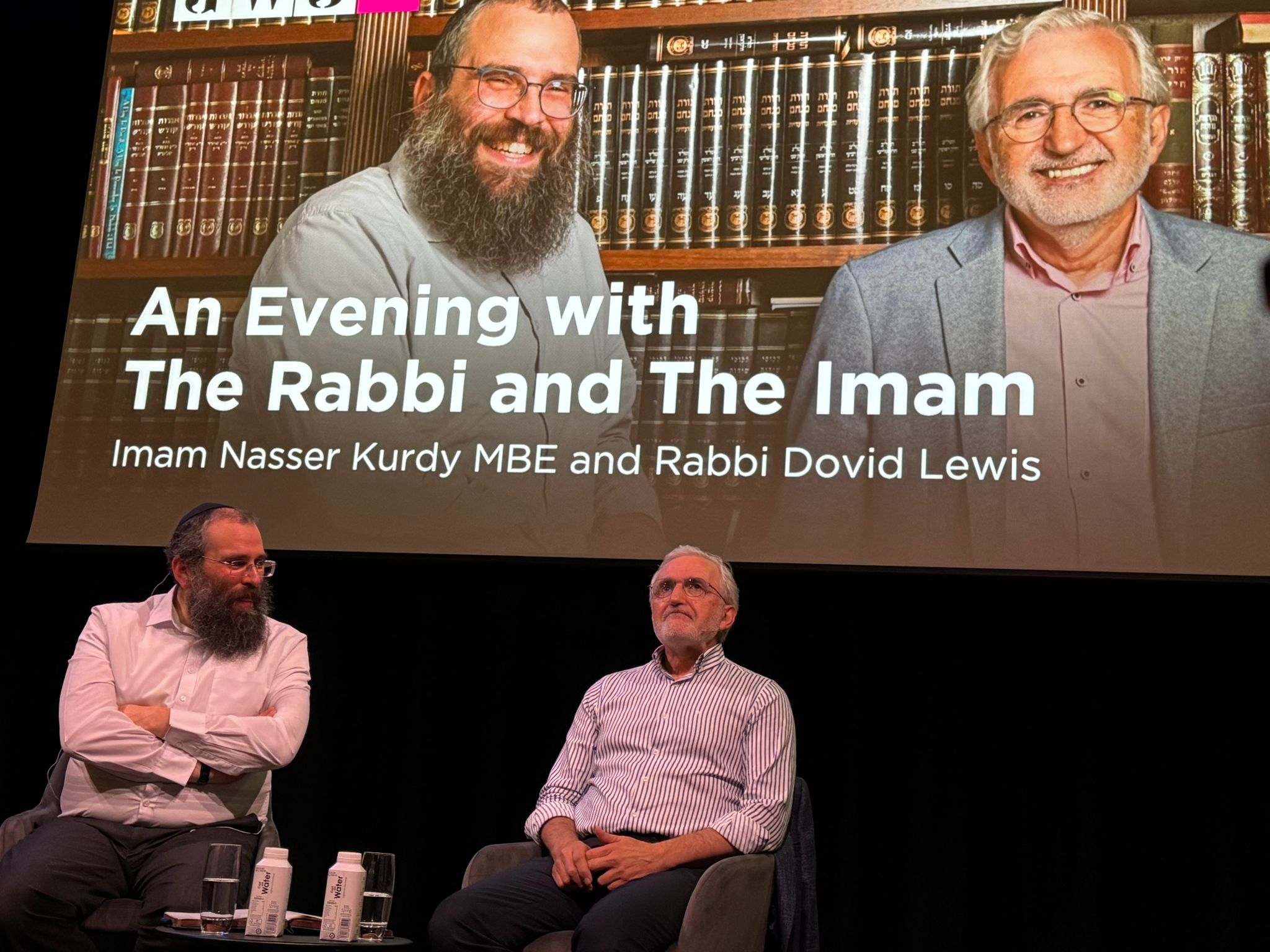
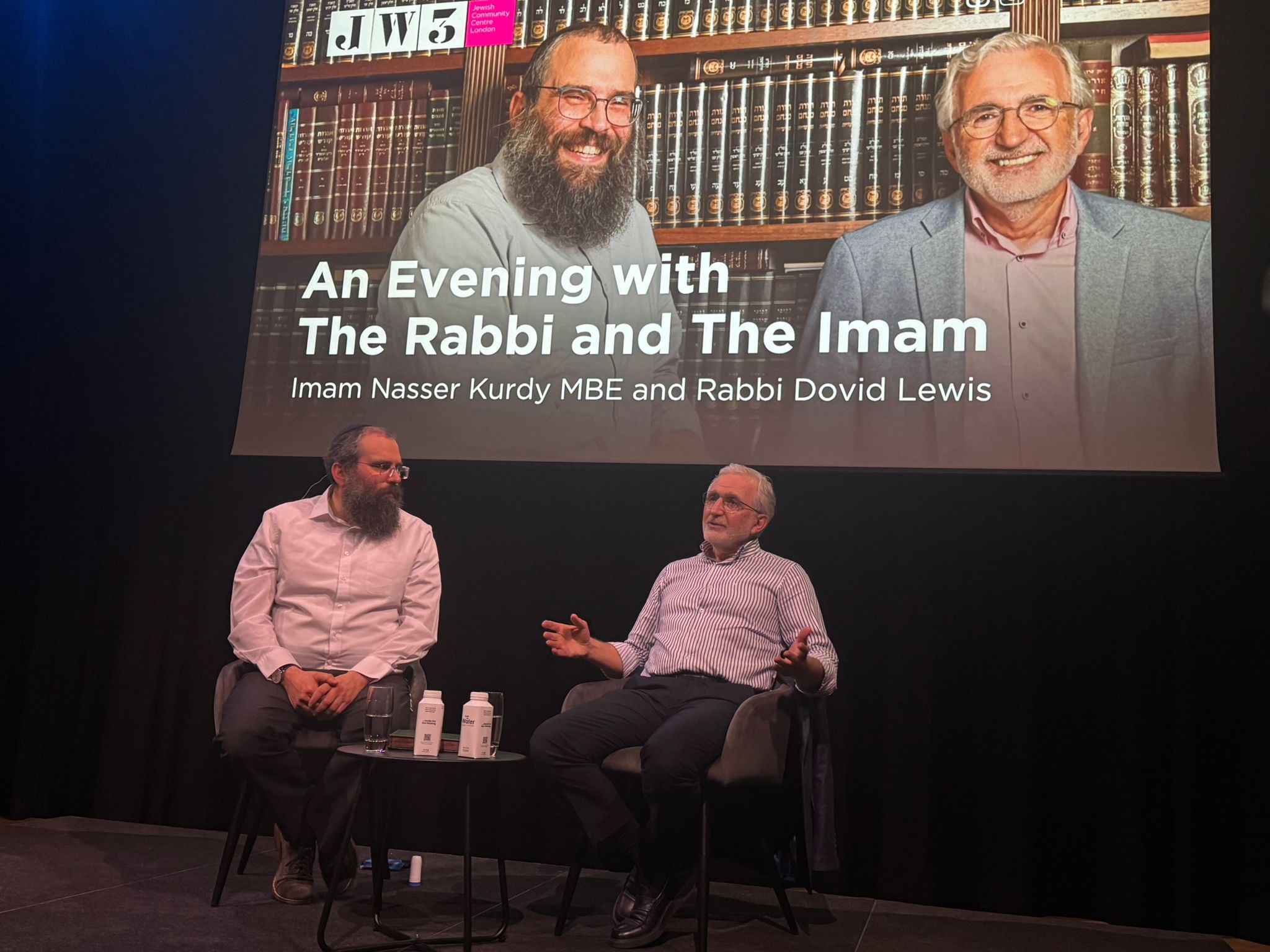
They are, by their own admission, an unlikely odd couple — Imam Nasser Kurdy and Rabbi Dovid Lewis. But thanks to Mark Schweiger of Bowdon Synagogue, “The Rabbi and the Imam and the power of dialogue”, a bi-weekly podcast, has brought their message of understanding to more than 20,000 school and college students in the Manchester area. On Sunday night, it was the turn of a JW3 audience in London to hear their impressive and thought-provoking message.
Both men, it was clear from their body language, are close friends — reflected in their cheerful ribbing of each other, but also in the spontaneous and obviously genuine warm hug with which they ended their presentation.
Mark Schweiger said that it was his mission in the podcast to show “that a Jew and a Muslim can stand side by side, under a shared banner of humanity, empathy and unity. Together, we can model how to have difficult conversations, how to disagree… and to recognise each other’s struggle with compassion”.
The Imam, Nasser Kurdy, is by profession an orthopaedic surgeon who practises in south Manchester, and has served as a lay imam at Altrincham Muslim Association for the past two decades. His mosque is near three local synagogues and his interest in interfaith work led him to become friends with both Rabbi Lewis, and Rabbi Amir Elituv who leads the Sephardi community.
Syrian-born, he has lived in Kuwait and Lebanon before coming to the UK: and he told the JW3 audience (which included a number of Muslims and Christians) that though he himself is “a very devout Muslim”, many members of his family on his mother’s side are Aleppo Christians, so he is accustomed to reaching across the faith divide.


Rabbi Dovid Lewis, meanwhile, is Manchester born and bred, and serves as the rabbi of the South Manchester orthodox community at Bowdon Synagogue.
Each man acknowledged that theirs was not a “hearts-and-flowers” conversation, but one which depended on “equality of humanity, of empathy, and of respect” with an emphasis on “the voice of reason, not treason”. Both spoke of the importance of “listening” to the other, and of admitting that — particularly in most recent difficult times — how vital it was to admit of Jewish and Muslim pain on an equal footing.
Rabbi Lewis said he “did not want to play the numbers game” when it came to discussing the deaths of people on either side of the conflict. Each death, he reminded the audience, was that of a loss to someone’s family — “it won’t say on the gravestone how that person died”.
Imam Kurdy, for his part, said that learning about the concerns and hopes of the Jewish community had taken him “out of my comfort zone — only to find myself in a comfortable zone.” He stressed that it was necessary “to be curious” about each other and to listen as much as possible to understand what was causing pain to both Jews and Muslims.
Neither man claimed to be completely representative of their communities, but both hoped and believed that their message of dialogue was getting through — even though not every Jew, or every Muslim, was ready to go public with their support.
For his part Rabbi Lewis says the dialogue has enabled him “to become a better Jew and a better Zionist” by spending time with his Muslim friend. He was one of the first people the Imam contacted to tell him of the birth of his new grandchild, and the rabbi was happy to wish him “mabrouk” — mazaltov. The Imam, meanwhile, has learned some Hebrew phrases and says he has a better understanding of some of the issues raised by the Jewish community.
Imam Kurdy has had an all-too unpleasant confrontation with violence, when he was attacked and stabbed in the back of his neck while entering his local mosque in 2017. After his recovery, he published a book on how and why he forgave his attacker — and his appeal for calm and understanding has bolstered his work in countering hate and extremism.
To their critics, both men said, “the central question is, why are you not prepared to listen?” Each side had the right to present their argument, but dialogue could only take place if there were equality of respect on both sides.
Jewish News was media sponsor for the event.

Keep community journalism free.
Jewish News is free for everyone. No paywall. No barriers. Just trusted journalism for anyone who wants to stay connected to Jewish life in Britain.
If you value that, please support us.
From as little as £5 a month, you can help keep our journalism free and accessible to all.
Every day, we report on the issues that matter to our community. We celebrate achievements, support charities, challenge antisemitism and ensure Jewish voices are heard more widely.
From as little as £5 a month, you can help us continue to:
- Report on the stories shaping Jewish life in the UK and beyond
- Bring our community together through shared stories, events and campaigns
- Celebrate the people, culture and moments that define our community
- Support organisations doing vital work across Jewish Britain
You can make a one-off donation or become a regular supporter. Every contribution helps keep our journalism free, independent and accessible to all.
If everyone who values Jewish News gave a small amount, it would make a real difference to our future.