Prefer Jewish News on Google
YouTuber who approached Jews in Golders Green about Gaza loses libel case against Douglas Murray
Mohammed Hijab had brought a defamation suit against the writer and the Spectator over a 2022 article focusing on his actions during 2022 riots in Leicester
A social media influencer notorious for approaching strictly Orthodox Jews in Golders Green on a Shabbat to quiz them about Israel has lost a defamation case against The Spectator magazine and its associate editor Douglas Murray, with the judge ruling that he had “lied on significant issues”.
Mohammed Hegab, who has 1.3 million followers on YouTube, where he operates under the name ‘Mohammed Hijab’, had brought the case against Murray and the Spectator in relation to a September 2022 article in the magazine. The piece in question focused on Hegab’s role during rioting that broke out that month between Muslims and Hindus in Leicester, stating that Hegab had given a speech to a group of Muslim men – many wearing balaclavas, masks, hoods or caps, in which he ridiculed Hindus and their belief in reincarnation. Hegab had argued that he was specifically referring to Hindutva – Hindu nationalists – rather than Hindus as a whole. But the judge found that it was “substantially true” to say that he was referring to Hindus, saying “it was them that he was ridiculing.”
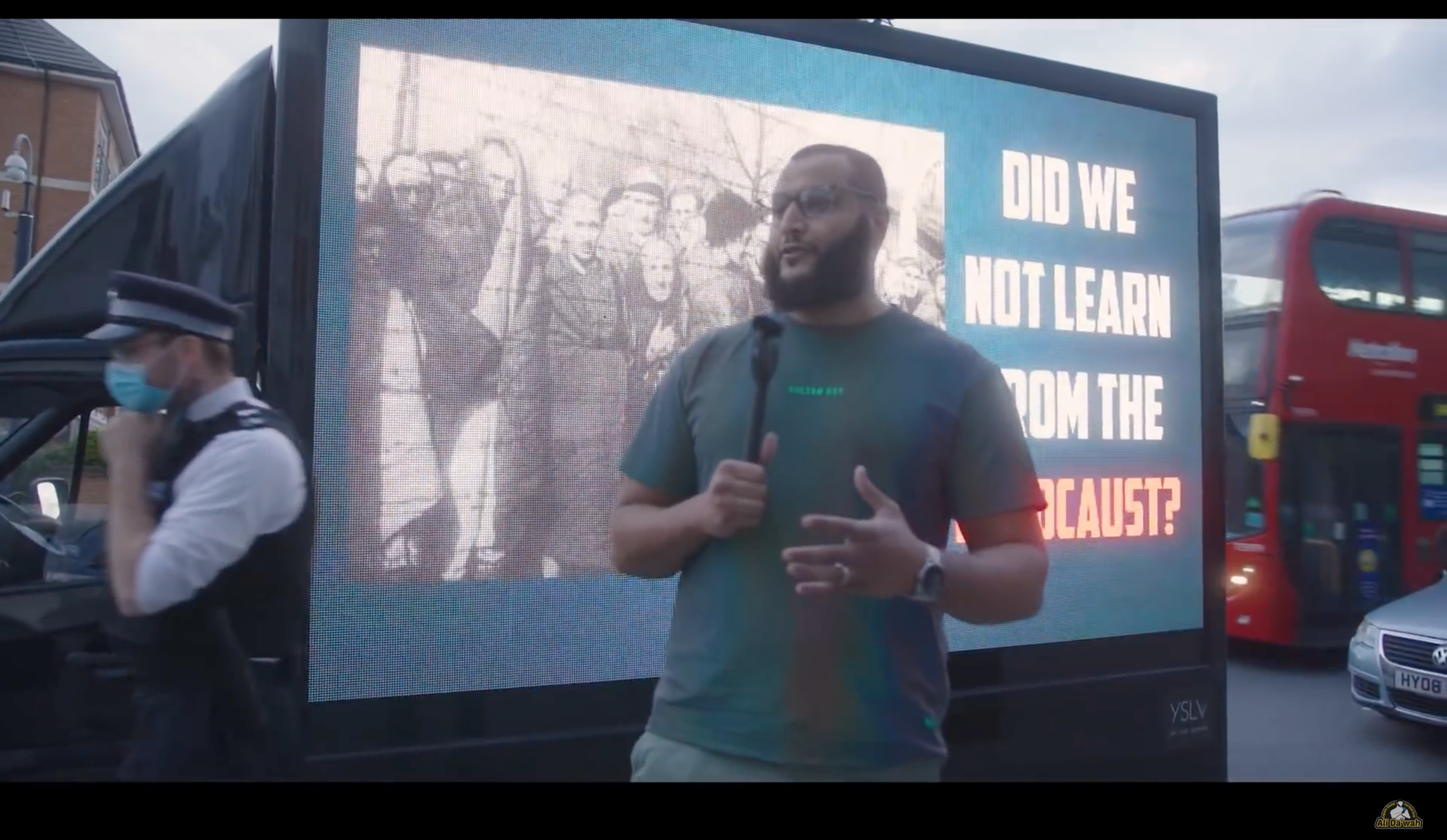
The case – which Hegab brought, claiming that the article had caused him to lose tens of thousands in contracts – also included significant discussion of Hegab’s actions in May 2021, when he and another YouTuber published videos of themselves on Golders Green road on Shabbat, approaching Orthodox Jews and asking them to condemn Israel’s actions. In Hijab’s video, he was pictured next to a van displaying messages relating to the Israeli-Palestinian conflict, as well as messages invoking the Shoah, including the words “did we not learn from the Holocaust?” against the backdrop of survivors standing behind barbed wire.
During the case, when questioned by Murray’s lawyer, Hegab stated: “I wasn’t paying any attention to it being the Sabbath. It wasn’t at the forefront of my mind.”
He also claimed that photos showing him next to a van covered with images of dead or wounded Palestinian children, together with a Holocaust image, were not of his making, sating: “It was not my van. I’m not responsible for everything that takes place in the perimeter of where I am standing.”


He later told Murray’s lawyer that he had chosen to go to Golders Green “because I was told that if you want to find the Zionists, you should go to Golders Green”, adding that “I can acknowledge that [going there] was an injudicious and provocative thing to do, but I reject the allegation that I was stoking antisemitism. I wouldn’t go back to Golders Green to do the same thing again.”.
However, the judge, Mr Justice Johnson, completely dismissed Hegab’s claim against The Spectator and Murray. Referring to Hegab, the judge stated that “As a witness he was combative and constantly argumentative. He sought, at every turn, to debate with counsel, responding to questions with (rhetorical) questions of his own, arguing his case rather than giving straightforward responses, and denigrating the character of the second defendant to whom he bears palpable personal animosity. I am satisfied that he lied on significant issues, with the consequence that his evidence, overall, is worthless. Specifically, I am satisfied that he lied in respect of the event at Golders Green, the counter-protest at the rally for Israel, the seminar on Hinduism at the Sapience Institute, his repudiation of vigilantism, his evidence as to the involvement of the Hindutva, his evidence about his choice of language in his speech, and his evidence in support of his claim for financial losses.”
Specifically regarding Hegab’s actions in Golders Green, the judge found that “the video shows that the claimant was using the van as a prop. When this was put to him, he denied it: ‘how could I use it? It’s not mine… it’s not my van; it’s nothing to do with me… I didn’t even know where that van came from.’ Later he said (in respect of the images displayed on the van) ‘I don’t know anything about what is going on the van.’ The denial that he was using the van as a prop, and his assertion that the van had nothing to do with him, was untrue. The claimant was indeed using the van as a prop to provoke passersby and to elicit a reaction. That is all demonstrated beyond argument from the video evidence.
“The claimant also said that he was not, at the time, aware of the Holocaust image. Again, that is not credible. He was standing in front of the van for a substantial period of time both at Golders Green and at the BBC, and this was one of a relatively small number of images that were shown in a loop. Although, for most of the time, he was not looking directly at the van, he was clearly aware of it, and he was referring to the imagery that was displayed on it. At one point he is directly looking at the van when the Holocaust image is (albeit momentarily) shown. Given that (contrary to his denial) he was using the van as a prop, it is an irresistible inference that he was aware of the images that were being displayed.
“Moreover, the claimant’s evidence that he attended in good faith to engage in a debate with “Zionists” is not credible. His conduct was grossly offensive and disingenuous. It was designed to cause an adverse reaction and to elicit material for his social media channels. The people who he engaged in conversation appeared (from the clothing they were wearing on what was the Sabbath) to be Jewish, but the claimant was in no position to know their political views or their attitude towards the conduct of Israel’s military activities in Gaza. He sought to portray their disinclination to speak to him discreditably. It was nothing of the sort. It was an entirely understandable reaction from individuals who were going about their daily business (in some cases with their children) and who, contrary to the apparent attitude of the claimant, were under no obligation to engage with him.”
Having lost his defamation case, as The Spectator put it in its summing up of the proceedings, “Hijab himself is on the hook for a lot of money… For a long time, Mohammed Hijab has bullied the British press, threatening publications and outlets who crosses him with crushing lawsuits. The Spectator, rightly, did not bow to his pressure.”

Keep community journalism free.
Jewish News is free for everyone. No paywall. No barriers. Just trusted journalism for anyone who wants to stay connected to Jewish life in Britain.
If you value that, please support us.
From as little as £5 a month, you can help keep our journalism free and accessible to all.
Every day, we report on the issues that matter to our community. We celebrate achievements, support charities, challenge antisemitism and ensure Jewish voices are heard more widely.
From as little as £5 a month, you can help us continue to:
- Report on the stories shaping Jewish life in the UK and beyond
- Bring our community together through shared stories, events and campaigns
- Celebrate the people, culture and moments that define our community
- Support organisations doing vital work across Jewish Britain
You can make a one-off donation or become a regular supporter. Every contribution helps keep our journalism free, independent and accessible to all.
If everyone who values Jewish News gave a small amount, it would make a real difference to our future.