Prefer Jewish News on Google
300 Nova festival massacre survivors remain in a ‘very bad condition’
Exclusive: Ofir Amir, co-founder of the Nova music festival and one of the driving forces behind the foundation supporting its 3,500 survivors, speaks about life alongside trauma
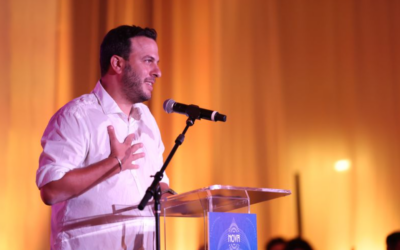
Ofir Amir, co-founder of the Nova music festival, miraculously survived the 7 October massacre. While recovering from surgery on his bullet-pierced legs, he and the other Nova producers found themselves delving into the world of therapy, attempting to create an immediate communal support system for survivors. This marked the beginning of the Tribe of Nova Foundation, which now supports around 3,500 survivors and hundreds of bereaved families.
“In general, you can see that people want to get back to life — to study, evolve and grow,” Amir tells Jewish News at the Nova festival exhibition in London. “But, of course, there are also other cases. Around 300 people are in a very bad condition. When you mix trauma and substance abuse at such a young age, it is a bad combination. Right now, we have 150 survivors in rehabilitation centres specialising in trauma and substance abuse, both in Israel and around the world,” he explains.
The foundation runs more than 50 programmes tailored to the different profiles and needs of survivors. Amir describes the fragility of those dealing with severe post-traumatic stress disorder (PTSD). “You think you are having a good week — the sun is shining and life goes on — but then there is one reminder of what we have lost and what has happened to us. Usually, the bad things happen at night or at weekends, when they are alone. Our social workers work 24/7,” Amir says.
“Unfortunately, six months ago, a good friend of mine, Roi Shalev, committed suicide,” Amir adds sombrely. Shalev’s suicide, exactly two years after the massacre, shook not only the Nova community but the entire country, as his story resonated around the world. On 7 October, Shalev was shot and witnessed the murder of his girlfriend and his best friend. His mother later took her own life following the traumatic events. Shalev was an active member of the Tribe of Nova Foundation and participated in international delegations accompanying the Nova festival exhibition. He gave media interviews and appeared smiling in photographs, becoming a powerful symbol of resilience.
Amir describes the survivors’ continuing battle: “Unfortunately, we hear only about the bad things that happen in the media. You never hear about the other 50 people who were standing on a roof, ready to jump, whose lives were saved by the foundation and its social workers.”



When the music stopped
“It took me time to understand what trauma is,” Amir admits. “You become ill without actually being ill. It is something inside you. You cannot get out of bed, and you do not understand why. The work at the exhibition and the foundation definitely helps. I have learned that giving to and helping others also helps me,” he says.
But before Nova became a healing community associated with the deadliest attack on a music festival in history, it was all about music and joy. Amir and his friends founded the community ten years ago, beginning with small raves and daytime parties.
“7 October was our biggest festival. On 6 October, it felt as though our dream had come true. We had more than 4,000 attendees, including 300 people who had come from around the world, and DJs from eight different countries. The Nova festival was a big deal for us. We also collaborated with Universo Paralello, the biggest festival in Brazil, and brought it to Israel. We had worked for almost six months to create it,” Amir recalls.
“I remember the moment I arrived; it was pure happiness. As soon as you walked into the festival, you could feel the joy. It was a festival for everyone who shared our values of dancing, freedom and mutual respect. You could see how comfortable everyone felt, especially the women. It was always important to us that the dance floor was a safe place — somewhere you could be whoever you wanted to be, and no one would judge you, you would be loved simply for being who you are,” he says.
“At 6:29 I was standing next to the main stage with a friend when we suddenly heard a noise. We looked up at the sky and saw thousands of rockets being fired at us. At first, you see something like that and simply do not want to believe it. Very quickly, the police arrived and told the DJ to turn off the music and announce that the festival was over.
“For the next two hours, we heard noises and received reports about shootings on the roads. We saw injured people returning to the festival site. Even then, you did not want to believe that something like this was happening.
“At about 8:15 I finally understood that it was real. There were hundreds of terrorists surrounding us from every direction, arriving in pickup trucks and firing heavy machine guns into the crowds. First, they killed the police officers who were blocking the main roads, and then they entered the festival area.
“My friends and I ran in the opposite direction, jumped into a car and tried to save as many people as we could. There were seven of us in the car. We decided to drive through the open fields, but moments later we saw five terrorists waiting for us. They immediately opened fire.
“I was hit. A bullet went through the car door, into my right leg and then into my left. When I was shot, I was speaking to my wife on the phone. She was nine months pregnant at the time. My first thought was to call her back and make sure she had not heard all the noise. So I called her, and from that moment on, I began lying to her. I did not want her to worry in her condition.
“The driver managed to get us away from the terrorists, but we were shot at several more times. Eventually, we decided to hide among the trees.”
Amir’s friends pulled him and another friend from the car, both wounded and unable to walk. Amir waited four hours to be rescued, during which time his friend died. “The only thing that kept me going was my wife and our unborn child”, he says. Eventually, a group of civilians searching for survivors found Amir and took him to hospital.
Stronger together
The hospital managed to save Amir’s leg, and four weeks later his daughter Eliana (“God has answered” in Hebrew) was born. “She and my wife are my brightest light and give me strength,” Amir smiles.
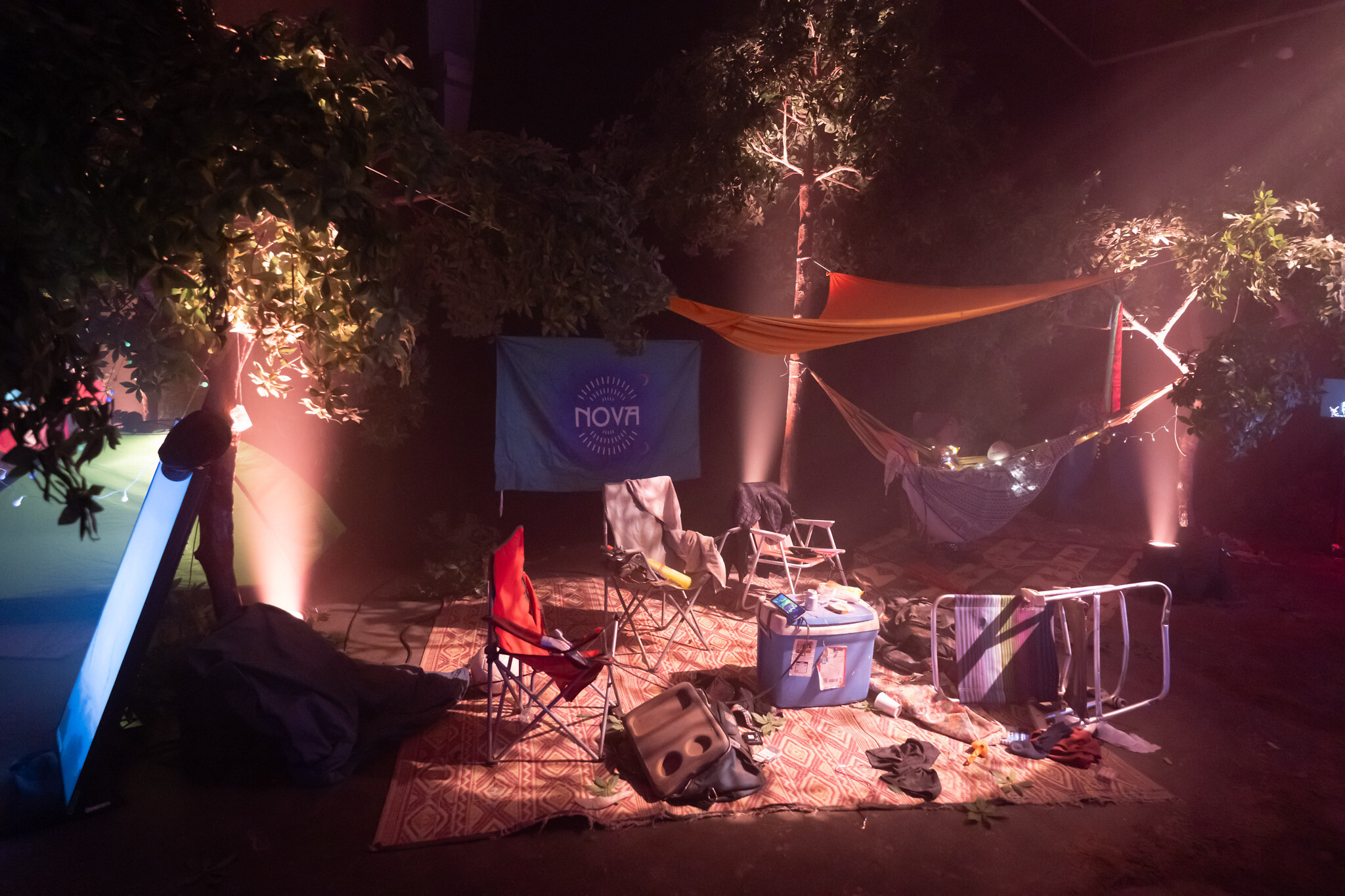
But as more horrors and scale of death were revelled, the surviving producers felt compelled not only to establish the Tribe of Nova Foundation, but also to create an immersive exhibition. “The idea came two weeks after the attack; we felt the urge to commemorate our friends, to honour our loved ones. The exhibition is not about a country, religion or taking sides. It’s about what happened at a music festival,” he remarks. 06:29AM – The Moment Music Stood Still is on display in London until 5 July; all net proceeds from ticket sales also go directly to the Tribe of Nova Foundation.
For Amir it is also important to show the brighter side of life. The exhibition itself, he points out, starts and ends on a positive note; the last room is the healing area, where visitors can meet survivors and bereaved families. “You will go home with this feeling of hope and strength and see the resilience in their eyes”, he says.
“There are also amazing stories of people who grow out of the trauma,” he adds. “There are survivors who met during one of our activities and are now married and have children. There are many stories of young students who managed to return to university and others who went back to work.”
“We know the situation here and how antisemitism is rising. We hear about the attacks in Golders Green and the ambulances being set on fire,” he says.
“What happened on 7 October did not happen only to us. It also happened to Jews around the world. Later, I realised that it happened to anyone who shares our values, whether they are Jewish, Christian or Muslim. If you believe in human rights, equality and kindness, then it happened to you too.
“But it is still up to us, the Jewish people, to fight for the future and to educate. I am a third-generation descendant of Holocaust survivors. It is now our responsibility to remind people what hatred and antisemitism can lead to. This exhibition will not eliminate antisemitism. Antisemitism did not begin on 7 October — it simply revealed itself. It had been there for a long time. But together, we are strongest.”
The Nova Exhibition is open in Shoreditch, London for six weeks until 5 July. Tickets and more information at novaexhibition.com. Net proceeds will go towards supporting Nova Music Festival survivors and bereaved families.

Keep community journalism free.
Jewish News is free for everyone. No paywall. No barriers. Just trusted journalism for anyone who wants to stay connected to Jewish life in Britain.
If you value that, please support us.
From as little as £5 a month, you can help keep our journalism free and accessible to all.
Every day, we report on the issues that matter to our community. We celebrate achievements, support charities, challenge antisemitism and ensure Jewish voices are heard more widely.
From as little as £5 a month, you can help us continue to:
- Report on the stories shaping Jewish life in the UK and beyond
- Bring our community together through shared stories, events and campaigns
- Celebrate the people, culture and moments that define our community
- Support organisations doing vital work across Jewish Britain
You can make a one-off donation or become a regular supporter. Every contribution helps keep our journalism free, independent and accessible to all.
If everyone who values Jewish News gave a small amount, it would make a real difference to our future.