Prefer Jewish News on Google

At a Paris conference: funded diplomacy and the illusion of representation
Are Civil Society Organizations Becoming Political Parties Without Accountability or Elections?
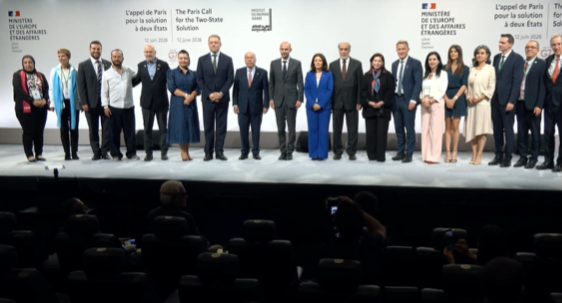
When the French Ministry for Europe and Foreign Affairs hosted a conference in Paris bringing together dozens of Palestinians and Israelis under the banner of supporting peace and the two-state solution, the image appeared positive and encouraging. France, like other countries friendly to the Palestinian people, continues to seek ways to preserve a political horizon at a time when war, extremism, and despair are growing. Engaging civil society organisations in discussions about the future of the region is, in principle, a legitimate and worthwhile objective.
Yet behind this image lies a phenomenon that has been steadily expanding in recent years: the rise of a class of non-governmental organisations that, in some cases, has moved beyond the natural role of civil society and gradually begun acting as a substitute for political parties and national movements. A significant part of this development has been encouraged by a Geneva-based European NGO network that has promoted an expanded political role for civil society organisations, raising important questions about representation, legitimacy, and accountability.
Over many years of political division, institutional paralysis, the absence of elections, and the decline of democratic life, Palestinian political parties and factions have lost part of their vitality and their ability to attract younger generations. Their diplomatic, intellectual, and media presence on the international stage has also diminished, distancing them from many of the discussions taking place about the future of the Palestinian cause.
As organised political action receded, a number of non-governmental organisations succeeded in building extensive relationships with donors, diplomatic missions, and international institutions. It was entirely natural for these organizations to play an important role in development, human rights, community dialogue, and capacity-building. However, some of them gradually moved beyond their civic role into an undeclared political one. Individuals associated with this sector began speaking on behalf of Palestinians at international conferences, participating in the drafting of political initiatives, sitting at unofficial negotiating tables, and being presented to foreign governments as representatives of Palestinian society.
Over time, a new class of unelected political elites emerged. They became comfortable with diplomatic invitations, accustomed to international conferences, and increasingly attracted to the ceremonies, protocols, and prestige that accompany them. Some of these individuals now travel more frequently between Paris, Brussels, Geneva, and Washington than between Nablus, Hebron, Gaza, and the Palestinian refugee camps. Because the international community often seeks familiar and readily available partners, the same faces appear at the same conferences, delivering the same messages and receiving the same funding year after year.

Perhaps the clearest example of this reality is the recent allocation of approximately €18 million through a French government agency to a select group of organisations operating in this field. The issue here is not opposition to supporting civil society or funding initiatives that promote dialogue and peace. Such support can be legitimate and beneficial when it is guided by transparency, accountability, and fairness. But Palestinians have every right to ask: How were the beneficiary organizations selected? What criteria were used? What measurable impact have these institutions achieved within Palestinian society over the years? And why do the same organizations and the same names repeatedly appear in most international funding programs?
More importantly, how can millions of euros be directed into a sector that claims to represent Palestinian society while that same society remains largely unaware of how these funds are spent, who receives them, and what results they produce? Some organisations operating in this field manage annual budgets larger than those of active political parties and movements. Some senior officials receive salaries and benefits exceeding those of Palestinian ministers and public officials. While Palestinian teachers, workers, and public employees struggle to meet basic needs, a financially comfortable professional class has emerged around parts of this sector, one whose sustainability often depends more on the continuation of foreign funding than on any measurable social impact within Palestinian society.
The issue is not only one of legitimacy, but also of accountability. No one elected these organisations. No one authorized them to speak on behalf of Palestinians.
No organisation, regardless of its valuable contributions, can claim to represent an entire people or replace political parties, national movements, and representative institutions. Political parties, despite their many shortcomings, remain accountable to their constituencies and are expected to justify their decisions and positions. Parts of this emerging sector, however, have managed to combine political influence with an absence of popular accountability. This reality makes a serious national conversation about transparency both necessary and overdue.
If some of these organisations wish to play a direct political role, and if they seek recognition as partners in shaping public policy and representing Palestinian society, then Palestinians have the right to know more about them. Where does their funding come from? Who sits on their boards of directors? How are decisions made? Who determines their political priorities? And what mechanisms exist to ensure accountability to the society they claim to represent?
Foreign funding is not a crime. Civil society work is not a crime. Engagement with the international community is not a flaw. But political activity without transparency, claims of representation without public authorisation, and demands to influence the future of the Palestinian people without being subject to public scrutiny are matters that deserve serious debate.
The Palestinian cause does not need to replace one elite with another. It does not need to replace political movements with NGOs, nor transfer national decision-making from political institutions to donor-funded project offices. What Palestine needs today is the revival of politics itself.
We need free elections, modern political parties, new leadership, accountable institutions, and a strong, independent civil society that performs its natural role of oversight, public education, and rights advocacy—not one that becomes a substitute for political life. Democracy cannot be built through projects. Representation cannot be granted through diplomatic invitations. Legitimacy is not issued by European embassies.
Every civil society organisation has the right to advocate for its ideas and initiatives. But no one has the right to demand a political and representative role without first accepting the principles of transparency, accountability, and public oversight that govern democratic political life. Palestinian democracy cannot be built by replacing political parties with NGOs, just as a state cannot be built by replacing citizens with donors.
Politics should be shaped by representatives of the people, not by project managers. Legitimacy is granted by voters, not by funders. And the future of Palestine must be determined by Palestinians through their elected institutions—not through funding networks and international conferences, regardless of how well-intentioned their organisers may be.
Samer Sinijlawi is a Palestinian political activist and reform advocate. A lifelong Fatah member, he has become a prominent voice for democratic renewal, national elections, and institutional reform. He is among the founders of New Path (Masar Jadid), a new Palestinian political movement seeking to build a modern, accountable, and democratic political alternative

Keep community journalism free.
Jewish News is free for everyone. No paywall. No barriers. Just trusted journalism for anyone who wants to stay connected to Jewish life in Britain.
If you value that, please support us.
From as little as £5 a month, you can help keep our journalism free and accessible to all.
Every day, we report on the issues that matter to our community. We celebrate achievements, support charities, challenge antisemitism and ensure Jewish voices are heard more widely.
From as little as £5 a month, you can help us continue to:
- Report on the stories shaping Jewish life in the UK and beyond
- Bring our community together through shared stories, events and campaigns
- Celebrate the people, culture and moments that define our community
- Support organisations doing vital work across Jewish Britain
You can make a one-off donation or become a regular supporter. Every contribution helps keep our journalism free, independent and accessible to all.
If everyone who values Jewish News gave a small amount, it would make a real difference to our future.