Prefer Jewish News on Google

After Abbas: Trump’s results-based approach and a new Gaza
Mahmoud Abbas's legacy will be three structural disasters: public debt, hundreds of laws passed by presidential diktat and the staggeringly corrupt sale of state land
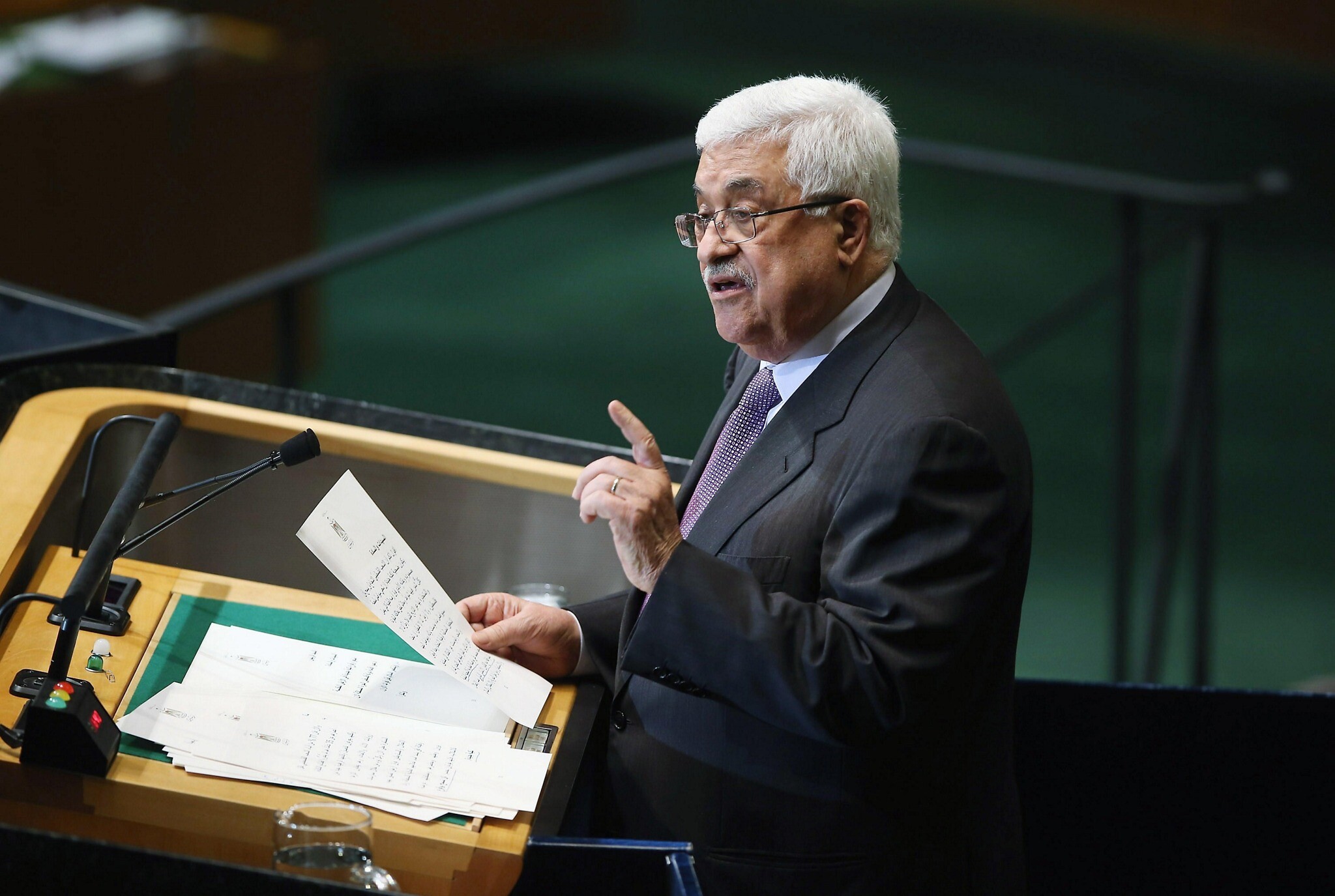
The post-Abbas era has effectively begun, whether those still invested in preserving the status quo choose to acknowledge it or not.
Political gravity has shifted away from Ramallah and toward Gaza, where the real questions of governance, reconstruction, security, and the future are now being addressed. The US administration and members of the Board of Peace are engaging with the Gaza Committee – not with a presidential authority that has lost its capacity to act. Only a handful of slow-adapting actors, particularly some European states and one Gulf country, continue to treat Mahmoud Abbas as part of the solution rather than as a central obstacle.
The recently proposed constitutional draft from Abbas arrives twenty-one years too late. It should have marked the beginning of a political era, not a last-minute manoeuvre in stoppage time. The same is true of the so-called Palestinian National Council elections: like previous initiatives, they are designed less to reform than to reassure external actors that the current leadership still holds the keys to change despite overwhelming evidence to the contrary.
What Palestinians are waiting for is not another procedural gesture, but a single presidential decree: one that sets a clear date for presidential and legislative elections and announces Abbas’s retirement from political life. This is the minimum act of national responsibility required at this historic moment.
Yet several influential international actors, including China, the European Union and some of its member states, and Saudi Arabia, continue to argue that the greatest danger facing Palestinians today, even after a war that erased Gaza from the map and killed nearly 100,000 people over roughly twenty-eight months, is the potential collapse of the Palestinian Authority in Ramallah. Their conclusion is that preserving the PA as it exists must be the priority.


What this view fails to grasp is the critical distinction between the institutions of the Palestinian Authority, which must be preserved, and its current leadership, which—through corruption, paralysis, and ineffectiveness—has become the primary threat to those institutions themselves. The only path to saving the PA’s institutional framework is to force a change in leadership. The only legitimate mechanism for doing so is through accelerated presidential and legislative elections.
These same states often claim that Palestinian elections are an internal matter in which they cannot intervene. This raises an unavoidable question: are the Palestinian school curriculum and prisoner payments also internal affairs as well? And if so, why is intervention permitted in those politically sensitive but unpopular issues, while international actors refuse to engage on elections – a demand supported by approximately 85 percent of the Palestinian public?
Yes, the post-Abbas era has begun. But the bad news is the legacy he leaves behind after 21 years in power, a legacy defined by three structural disasters.
First, a public debt exceeding $16 billion, entirely owed to domestic Palestinian sources: local banks, suppliers, pension funds, and unpaid salaries. This debt cannot be ignored or postponed. Even if 3 percent of Palestinian GDP were allocated annually to repayment, it would take decades to settle, condemning generations to inherited insolvency.
Second, roughly 400 laws enacted by presidential decree in the absence of a functioning parliament. Reviewing, correcting, repealing, or replacing this distorted legislative framework will require years of intensive parliamentary work, likely one to two full legislative terms devoted almost entirely to undoing past damage rather than legislating for the future.
Third, the sale of thousands of dunams of state land in the West Bank through so-called “allocation decisions,” representing one of the largest corruption schemes carried out beyond public scrutiny—a structural crime whose consequences are extraordinarily difficult to reverse.
This Palestinian reality cannot be separated from a broader transformation in the global order. What many policymakers now describe as the “collapse” of the international system did not occur suddenly. It marks the end of an illusion. For decades, the rules-based order failed to deliver security, accountability, or stability to large parts of the world, especially the Middle East.
That system was presented as universal, but in practice it was selective. International law was enforced unevenly, resolutions passed without consequence, and accountability depended more on power than on principle. For societies living amid conflict, this was not an academic critique. It was lived experience, measured in unresolved wars, managed crises, and promises that never materialised.
Today, this reality is no longer whispered. What is emerging is not chaos, but a different governing logic, explicit about power and sceptical of process for its own sake. President Trump’s approach to international engagement reflects this shift: rejecting performative multilateralism in favour of leverage, authority, and measurable outcomes. This is not ideology; it is method. Clear responsibility. Defined incentives. Consequences for failure. Results over declarations.
For decades, the Middle East was managed through statements rather than solutions. Extremism was condemned but not dismantled. Reconstruction was promised but not governed. Conferences multiplied while institutions remained weak, corrupt, or absent. The outcome was neither peace nor justice, but repetition.
Across the Middle East, attention has turned to Washington, D.C., including when on 19 February the Board of Peace convened for the first time. Expectations are measured but real. This initial meeting tested whether the shift from declarations to governance can translate into action – through concrete steps such as allocating resources, defining the legal and regulatory framework for implementation, completing outstanding appointments within the Board of Peace, the Executive Board, and the NCAG, clarifying the countries contributing to the International Stabilisation Force, and setting a clear timetable for its deployment into Gaza. Whether this moment marks the beginning of a functioning governing architecture, or another missed opportunity, will be judged not by statements, but by decisions taken.
Gaza illustrates this reality with brutal clarity. It is not a slogan or a theory. It is two million people living amid devastation, where every delay carries a human cost and every failure deepens despair. In such conditions, intentions are irrelevant. Governance is everything.
A governance-first model—centred on security, institutional authority, economic functionality, and accountability, is not a political preference. It is a moral necessity. If this approach succeeds, it will not be because it sounded more compassionate, but because it delivered tangible results: salaries instead of slogans, schools instead of speeches, and security rooted in stability rather than perpetual force.
For Israelis, this shift means a neighbouring entity governed by institutions rather than militias, and a form of security more durable than endless crisis management. For the broader Middle East, it offers something long absent: proof that reconstruction can replace ruin, that governance can undercut radicalization, and that cooperation can be built on interests rather than illusions.
A system judged by results is not less moral. It is more serious. Dignity is not preserved by declarations, but by institutions that function and futures that can be planned. The era of comforting language without consequence is ending. What replaces it will be judged by what it delivers, not by what it promises.
For a region that has paid for failure in blood, that shift is not dangerous.
It is overdue.
Samer Sinijlawi is a Jerusalem-based Palestinian civic and political leader focused on governance reform and regional stability. Samer is “In conversation with Josh Glancy” at a major North London venue, 7:30pm on Sunday, 3 May. Book tickets here.

Keep community journalism free.
Jewish News is free for everyone. No paywall. No barriers. Just trusted journalism for anyone who wants to stay connected to Jewish life in Britain.
If you value that, please support us.
From as little as £5 a month, you can help keep our journalism free and accessible to all.
Every day, we report on the issues that matter to our community. We celebrate achievements, support charities, challenge antisemitism and ensure Jewish voices are heard more widely.
From as little as £5 a month, you can help us continue to:
- Report on the stories shaping Jewish life in the UK and beyond
- Bring our community together through shared stories, events and campaigns
- Celebrate the people, culture and moments that define our community
- Support organisations doing vital work across Jewish Britain
You can make a one-off donation or become a regular supporter. Every contribution helps keep our journalism free, independent and accessible to all.
If everyone who values Jewish News gave a small amount, it would make a real difference to our future.