Prefer Jewish News on Google
Behind the curtain: The astonishing art adorning our arks
The artists who shape the heart of synagogues around the world

Chana Gamliel is an artist whose works are exhibited in locations around the world and are seen by thousands on a daily basis – but you may never have heard her name. That’s because her creations are not signed, and don’t hang in museums. Instead, they take pride of place at the front and centre of synagogues – designed to draw the eye.
Every shul around the world, no matter its shape, size, or denomination, has something in common. The holy ark – Aron Kodesh, which contains the Torah scrolls, is at the front of the room, a focal point. And covering that ark will be a curtain – a parochet.
Some artists who work in parochet design are well known – the late Mark Podwal, the prolific author and illustrator whose work graces some of the world’s most famous synagogues including Temple Emanu-el and Prague’s Altneuschul, and Jeanette Kuvin Oren, whose many marvellous works include the designs in New York’s Central Synagogue. But Gamliel is something new. Her business, which is based in the heart of the charedi city of Bnei Brak, ironically caters almost exclusively for customers in the Anglosphere – the United States, Canada, and the UK, where her designs grace sites including Brighton BNJC, the Biala Bet Hamedrash in Stamford Hill, and other shuls from Edgware to Elstree. And unlike many others in the business, her creations – which besides parochet design also include mantels for Torah Scrolls and for bimah platforms – are made entirely in Israel, with all people involved in the design and creation being shomer Shabbat Jews.
For Gamliel, her passion for design started early – in fact, it ran in the family. She grew up in Montreal, with a Moroccan-Sephardi father and an Ashkenazi mother.
“A lot of Moroccan Jews there at the time were in some way involved in the fashion industry; factories, designing, importing”, she tells me.



“My grandfather was a fashion designer and my father imported luxury fabrics from Italy. When I was a little kid, he would give me samples of all these luxury fabrics and I made dresses for my Barbie dolls.”
She laughs. “I had a huge collection”, she says, referring to the fabrics. “Not as big as today, but I had a very big collection for a 5-year-old.”
She came to Israel for seminary, and decided to stay, studying graphics design. At the end of her course, she sent her resume to different Israeli companies.
“The only place that got back to me was this parochet factory. I came the next day; they hired me on the spot. And that’s where my eyes were opened to this particular industry.”
She soon felt that she wanted to change the way people approached that field.
“For a graduate, the cool thing is to make websites, or work for magazines or catalogues…Judaic art didn’t receive the respect that I felt it deserved from the graphics community.”
Subsequent jobs – where she would be introduced to social media, Google ads, and blogging – further cemented her resolve. She shows me the product webpage of an online Judaica store she worked at. Run-of-the-mill products were relatively cheap, whereas those connected to a specific artist were often valued significantly higher.
“I realised that if I wanted to do things right, I had to accentuate the fact that what I do are works of art – months of crazy work, lots of it highly specialised, done by craftsmen – it requires a big budget.”
Having decided to strike out on her own in the late 2010s, her first major solo project was in England – for the Biala Chassidic dynasty’s Stamford Hill synagogue. With 3.8 million stitches and 1,500 Swarovski crystals, the result was staggering, with people travelling to London making a point of praying at the synagogue to see it for themselves. Six years and many different designs later, it remains Gamliel’s favourite parochet.
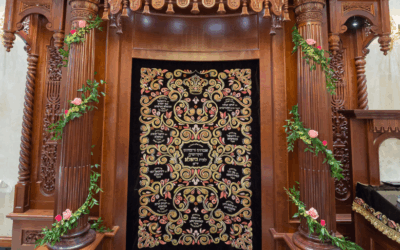
“When [Biala] said ‘let’s go for it’, I had to frantically try to find embroiderers who could do such a large-scale project. I was so determined it was going to work out – and it did. Just amazing.”
She now focuses on dozens of projects simultaneously – “we work with usually 3 or 4 embroiderers, with different specialties, at any given time, 2 in-house workers and a few seamstresses, and maybe ten different graphic designers and artists.”
The process itself can take up a few months – or even longer.
“People will reach out with a vision – they’ll have all kinds of interesting things in mind…then I usually zoom with the customer. I try to get as many people on the call as possible, like the Rabbi, the donor, the Rabbi’s wife – the Rabbi’s wife loves being included! I try to include everybody – the interior designer, the executive director. We have a lot of people there. Everyone has an opinion. I like listening to everybody’s opinion and taking something from everybody, so that everybody feels heard.”
A valuable lesson was learned in a previous role, when a customer reached out for a parochet, having saved for 8 years for a design to honour his father and surprise his synagogue, ultimately choosing a dual lion motif. He hung it up early one morning – only for the rabbi to enter and inform him that lions were not permitted on a parochet in Sephardi synagogues (the story ended well, with Gamliel’s previous boss agreeing to substitute another design, with flowers instead of animals).
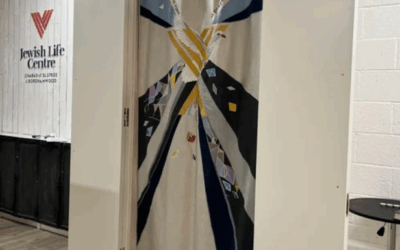
Gamliel will also try and ensure that any specific connection to the place, or to the person the parochet is being dedicated to, is included in the design. For the BNJC in Brighton, the parochet design contains a tree of life with several birds – one of which looks rather like a seagull – closely associated with both the town and the local Premiership football club owned by the BNJC’s driving force.
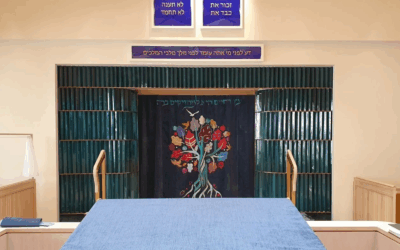
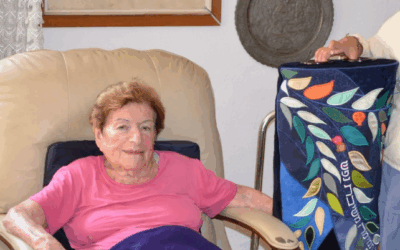
Others can be far more emotional – a recent design honoured a fallen soldier who had been a remarkable artistic talent – his own designs were incorporated into the parochet itself. Gamliel also designs mantels for torah scrolls, and was contacted by a Holocaust survivor, who wanted to honour family members she had lost in the Shoah.
“She gave me the list of her and her husband’s closest relatives; she said, ‘it’s not even everybody’”, Gamliel says.
“She turned 98 and she was like ‘I have to do this before it’s too late’. We worked really hard, around the clock, to get it done.”
Not all requests can be accommodated, however – sometimes rabbinical guidance is sought. Gamliel recalls some different examples from her previous jobs – a tragic case of a boy who had died young and whose family wanted a basketball on the parochet, a man mourning his wife who wanted one of her evening gowns incorporated into the parochet design, a young kabbalah enthusiast who wanted the 72 letter name of God, known as the Shem Hameforash, etched into the fabric. The rabbinical response in all three cases was no.
“We always manage to do it in a very respectful way”, Gamliel says. “You have to be very sensitive to people’s feelings.”
Often Synagogues will request two versions of a parochet – one for use during the regular year, another for the High Holiday period. Sometimes what starts off as a request for one can turn into more – Gamliel describes how one synagogue ended up ordering six different sets, “because they had a lot of cool ideas”.
Works of art – particularly something which can take months of effort and painstaking work to create – do not come cheap. There are a variety of factors involved, as Gamliel details on her website. There’s the design – “is it complicated? Full of details? A design from…[the] online collection or brand new?” There’s the embroidery technique used – “applique fabrics [a piece of fabric cut around in a certain shape and embroidering around the edges]? Textured embroidery? Machine embroidery? Hand embroidery? 3D gradient embroidery?” And then there are the embellishments – in particular, Swarovski crystals, which some communities are particularly interested in adding. All in all, “a parochet can typically range from $7K-$18K, depending on all the above factors.” Gamliel says that “in the past year or so, the particular designs people have been choosing end up costing around $12,000.”
Besides her own designs, Gamliel works with some of Israel’s leading Judaic-conceptual artists, like Yoram Ra’anan, Chaya Berlin and Tehilla Zion – offering designs where their works can be 3-D printed onto satin to create a stunning design – and which often cost less, given they don’t need to be designed from scratch and are less labour-intensive to create.
The ultimate aim is to create something that not only has pride of place in a Synagogue but encourages onlookers to feel inspired as a result.
“I work with people across the religious spectrum of Jewish life. Everyone tells me they feel the kedusha – the holiness – in the products – because I make such a point that they should be made in Israel, by Jews, not working on Shabbat or the chagim”, she says.
“It’s crazy – people whom you would never think would say such words tell me that they feel a holy aura emanating from them.”
Chana Gamliel’s website can be viewed here.

Keep community journalism free.
Jewish News is free for everyone. No paywall. No barriers. Just trusted journalism for anyone who wants to stay connected to Jewish life in Britain.
If you value that, please support us.
From as little as £5 a month, you can help keep our journalism free and accessible to all.
Every day, we report on the issues that matter to our community. We celebrate achievements, support charities, challenge antisemitism and ensure Jewish voices are heard more widely.
From as little as £5 a month, you can help us continue to:
- Report on the stories shaping Jewish life in the UK and beyond
- Bring our community together through shared stories, events and campaigns
- Celebrate the people, culture and moments that define our community
- Support organisations doing vital work across Jewish Britain
You can make a one-off donation or become a regular supporter. Every contribution helps keep our journalism free, independent and accessible to all.
If everyone who values Jewish News gave a small amount, it would make a real difference to our future.