Prefer Jewish News on Google

British Jews have come late to the art of protest – but it is vital they learn it
We live in an era where the popularity of a cause is increasingly gauged by whether those who support it are willing to go out on the streets and make their stance known
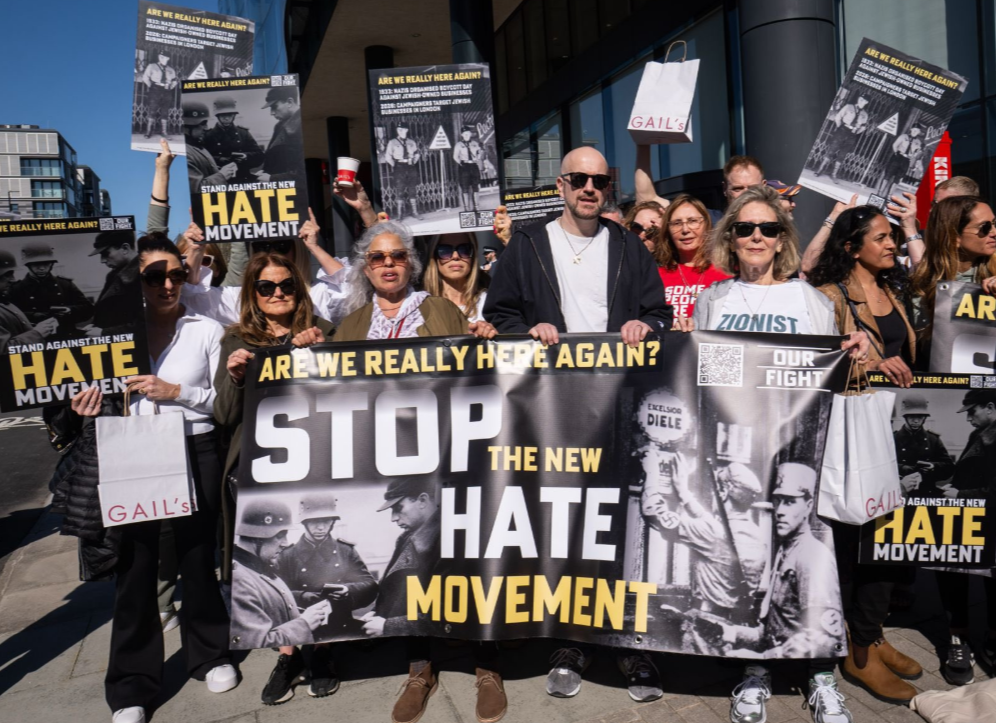
Yesterday a demonstration took place in the Kings Cross area of London which must have looked extremely bizarre to anyone unaware of the context. Scores of Jews and allies, wielding coffee cups and bags from Gail’s bakery, queued up outside the offices of The Guardian, desiring to drop off pastries and challah for the paper’s editor. The words “a small act of petty symbolism” featured widely on the bakery paraphernalia – a reference to a Guardian column last weekend which had used those words to describe repeated vandalism of a branch of Gail’s due to its perceived connection to Israel.
Voices that I admire have politely expressed their reservations around this protest, including for this very paper. Accusations that those who took part in this were, perhaps, “slightly losing the plot” and engaging in an “increasingly shrill form of activism, [which] does not fit well with the traditions of Anglo-Jewry”.
I respect that view, as I do the person who made it. But I find myself concurring with the proposition, put forward in that same column, that “maybe this outlook is wrong and out of date”. Without literally ascribing to an “adapt or die” philosophy, I believe that the protest outside the Guardian was indicative of an ongoing, now decade-old shift within the British Jewish community – one which was, in fact, long overdue.
The period from 2015-2020 can be described in various ways, but for many British Jews it will always be thought of as the Corbyn era. For half a decade, one of the traditional parties of government in this country was led by a man whose views on a range of issues…were not compatible with those held by many British Jews, to put it mildly. Venomous antisemitism was rife within the Labour party, but almost as bad were the many, many people who had proudly flaunted their anti-racist credentials who suddenly seemed keen to ignore, downplay or excuse anti-Jewish racism.
It was a difficult time for British Jews. But the irony – and many of us still find it difficult to see the word ‘irony’ without thinking of that incident – is that it also led to an awakening. For the first time in many, many years, Jewish people here – of all ages, and of widely varied levels of religiosity – began to think about how and why their voices were being ignored by so many people, and what they needed to do to ensure they were heard.

Next week marks eight years since the “Enough is Enough” demonstration against antisemitism, held outside the Houses of Parliament. In numerical terms, the demonstration was a small one – hundreds of people rather than thousands, although that number is more impressive when you take into consideration that it was organised at short notice at one of the busiest times of the Jewish calendar (four days before Pesach). But the psychological impact was far larger. Speaking frankly, mainstream British Jews did not do protesting before that point. Sure, there were occasional ‘we support Israel’ events, but these were general in scope and not in response to any specific actions from the British government or opposition of the day. Far easier and more diplomatic to approach politicians through communal organisations dedicated to such advocacy, urbanely making the case for a specific policy. Shouting was counterproductive when direct, polite conversations could be arranged.
The Corbyn era showed that such a strategy could not always be relied on. Communal organisations, despite grave misgivings, did initially seek to work with Jeremy Corbyn, seeing it as important to make the attempt to put their concerns across to a man who, after all, had a chance of becoming Prime Minister. But by 2018, such efforts had long since collapsed amidst the tidal wave of antisemitism from those who simultaneously vociferously expressed support for the Labour leader. It was the Board of Deputies and the Jewish Leadership Council, working together, who called that “Enough is Enough” demonstration, and it was the start of a new chapter in the history of the British Jewish community.
For the next couple of years after the December 2019 election defeat for Corbyn and his subsequent departure as Labour leader a few months later, the world went through the general crisis of a pandemic. Specific perceived danger for British Jews died down somewhat – only to roar back tenfold on 7 October 2023.
What shocked so many of us was the gleeful exultation expressed on the streets of this country, even as the videos of terrorists carrying out atrocities flooded social media. The surge in antisemitism in the immediate aftermath of 7 October was celebratory in nature.
In the weeks and months following that terrible day, British Jews would mobilise in a way which they had arguably not done for almost 80 years. Vigils, initiatives – and groups, set up specifically to try and counter hate and to fight back against something deeply sinister.
Let us return to Gail’s, and the Guardian. The column in question was a poorly written one, a clumsy attempt to shoehorn the Israeli Palestinian conflict into a North London street. But it was indicative of a larger problem. No-one at the paper – the writer himself, whichever staffer edited it, the comment editors themselves – appeared to pick up on why it was so problematic. There appeared to be no attempt to consider, for example, the symbolism of broken glass and daubed messages of hate for Jews. Any microaggression spotters and sensitivity readers at the publication appeared to be on holiday. And that, as far as many British Jews are concerned, is par for the course from a paper which appears to have an obsession with Israel above and beyond regular reporting, and which is the go-to publication for anyone with a bone to pick or a grudge to unload with regards to the world’s only Jewish state. In some ways, the question is not why such a protest took place now, but how it did not happen sooner.
Like it or not, many British Jews feel that they have no choice but to now be terminally online. It is tempting – so unbelievably tempting – to switch off the devices and hide away, in blissful ignorance of what is going on. But our opponents are not hiding. Disinformation, coupled with straightforward hate, is sweeping through society like a plague. I have not yet had the opportunity to read Howard Jacobson’s latest work. But its name, Howl, based as it is on the Alan Ginsberg poem of the same name, could not be more appropriate. “I saw the best minds of my generation destroyed by madness, starving hysterical naked”, the poem begins. It is hard to quantify the ‘best’ minds these days – but anyone reading this piece will be able to think of prominent people – philosophers, actors, artists, pundits, historians, athletes, politicians – who have been swept away by a tidal wave of propaganda which has left them almost unrecognisable to those who once knew them.
Do I agree with every belief and opinion aired by those who attend protests such as the one outside The Guardian? I very much doubt it. But that is hardly the point. To my own personal regret, the days of polite conversations are dying; we are in an era where the popularity of a cause is increasingly gauged by whether those who support it are willing to go out on the streets and make their stance known to all. British Jews will either adapt to this new reality or they will find their voices increasingly drowned out as a result.

Keep community journalism free.
Jewish News is free for everyone. No paywall. No barriers. Just trusted journalism for anyone who wants to stay connected to Jewish life in Britain.
If you value that, please support us.
From as little as £5 a month, you can help keep our journalism free and accessible to all.
Every day, we report on the issues that matter to our community. We celebrate achievements, support charities, challenge antisemitism and ensure Jewish voices are heard more widely.
From as little as £5 a month, you can help us continue to:
- Report on the stories shaping Jewish life in the UK and beyond
- Bring our community together through shared stories, events and campaigns
- Celebrate the people, culture and moments that define our community
- Support organisations doing vital work across Jewish Britain
You can make a one-off donation or become a regular supporter. Every contribution helps keep our journalism free, independent and accessible to all.
If everyone who values Jewish News gave a small amount, it would make a real difference to our future.