Prefer Jewish News on Google

Edwin Montagu feared Zionism would imperil British Jews. Was he right?
A century after he fought the Balfour Declaration, the Jewish aristocrat has become an unlikely hero of the radical anti-Zionist left. But how much of his gloomy prophecy has come true?
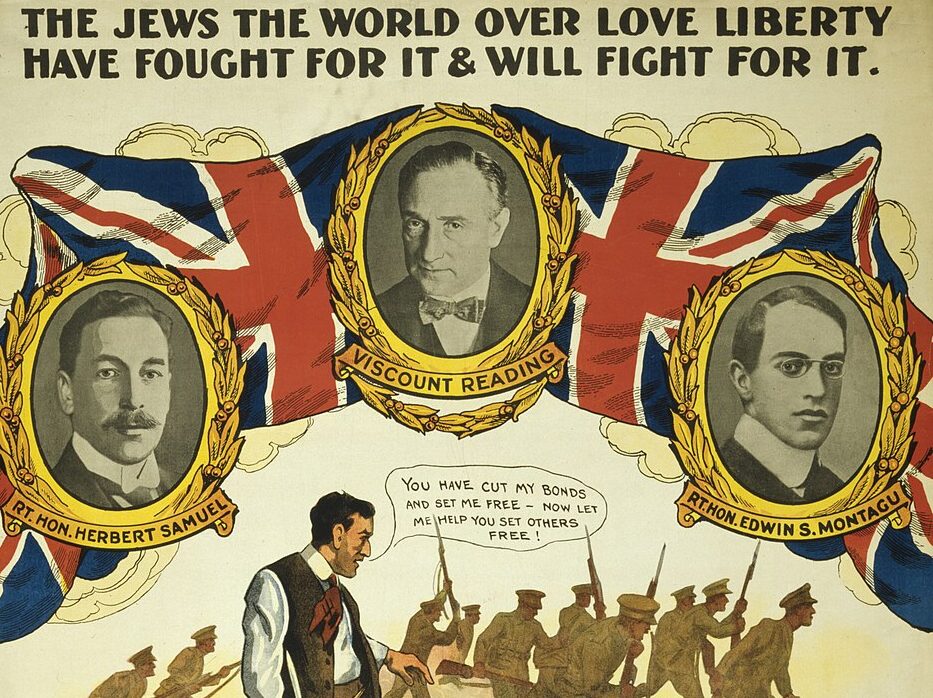
Was Edwin Montagu right about Zionism all along? This is the kind of question usually reserved for recondite Jewish history lectures, so I was surprised to hear it asked on the BBC Radio 4 Today programme last week.
The source was, of course, Zack Polanski, the Green party leader who was immediately chastised by his host Nick Robinson for veering off into a “student seminar”. In recent days, Montagu’s name has also been raised by pesky Israel obsessive Mehdi Hasan. Montagu is also the beneficiary of an entire chapter in the hot anti-Zionist book of the moment, Anti-Zionism: A Jewish History, by Benjamin Moser (whose surname surely wins this year’s nominative determinism award).
How funny, to hear these ardent leftists draw on the thoughts of a long dead Jewish aristocrat. Edwin Montagu, or Lord Swaythling to his peers, was monocle-wearing heir to a banking fortune, husband to an heiress and secretary of state for India and wartime munitions.
Not your archetypal working class hero.
Yet Montagu is back in fashion because he was the most prominent of the Jews who waged a campaign against the Balfour Declaration in 1917, expressing anguished concern that Zionism would make British Jews aliens in their own home. The man Herbert Asquith nicknamed “the Assyrian” has been exhumed and press ganged into the urgent mission of undermining the existence of the Jewish state.


Still, in the context of the Green Party’s ‘Zionism is Racism’ fatwa, this is an interesting moment to reassess Montagu’s thinking on Zionism for what it does (and doesn’t) reveal to us today. We might also rescue him from the semi-literate effusions of Comrade Polanski.
The man Herbert Asquith nicknamed “the Assyrian” has been exhumed and press ganged into the urgent mission of undermining the existence of the Jewish state
Edwin Montagu was the son of Samuel Montagu, a Liverpudlian banker whose vast pecuniary success led him to marry into the “cousinhood”, Anglo-Jewry’s tightly woven web of elite families. The son of a watch-maker, Samuel acquired all the trappings of the still regnant Jewish aristocracy: a smart townhouse in Kensington Palace Gardens, a large estate in Hampshire and ten children. His second son Edwin took after his father by following him into Liberal politics, but the pair had the kind of tempestuous relationship that will be familiar to many Jewish sons.
Edwin resented his father’s frumkeit and financial control, though he did eventually ask his wife Venetia Stanley to undergo a cursory conversion, allowing him to secure his inheritance (which was conditional on not marrying out).
As Chaim Bermant recounts in The Cousinhood, his meticulous chronicle of the Anglo-Jewish aristocracy, Montagu did everything in his power to become an English gentleman, hiring Sir Edwin Lutyens to renovate an Elizabethan country pile in Norfolk, that most goyish of counties. There, Bermant writes: “He hunted and fished, shot big game and little game, stalked and walked. Amid all the solid trappings of Olde Englande, it was easy to forget that here was a grandson of a bearded Hebrew from Liverpool.”
Even by the standards of the Cousinhood, Montagu was sweatily eager to assimilate, devoting his considerable intellect, charm and fortune to climbing the political ladder and washing off the smell of chopped liver. This yearning for acceptance informed his revulsion at the idea of a Jewish state. “All my life I have been trying to get out of the ghetto,” he fumed at the pro-Zionist David Lloyd George. “You want to force me back there.”
Montagu was deeply uncomfortable in his Jewish skin and this assimilationist anxiety was the engine of that era’s anti-Zionism. It was led by insecure patricians such as Montagu and Claude Montefiore, who feared that their hard-won and precarious position in the British establishment was imperilled by Jewish nationalism. Jewishness to Montagu was a religion and nothing more. It had to be, otherwise he could never consider himself a true Englishman.
Montagu knew little of Jewish faith or history and went out of his way to demonstrate his lack of ahavat yisroel. “I regard with complete equanimity whatever treatment the Jews receive in Russia,” he wrote to a friend in 1916. He thought a Jewish state would be a “Tower of Babel” and had no concept of the revival of Hebrew.
Yet whatever Montagu’s motivations, some of the arguments he made against Zionism do still resonate today. Others were drastically wrong. His famous memorandum The Anti-Semitism of the Present Government, which he circulated around the cabinet during the Balfour Declaration debates, is what Polanski and Hasan are using as evidence of Montagu being an early proponent of “Zionism is racism”.
‘Bigoted and narrow’
Montagu’s memorandum established four principles of anti-Zionism. Let us take them in turn.
– His first principle was that the Jews are not a nation, so that to say a “Jewish Englishman and a Jewish Moor are of the same nation” is no more true than it is to say that “a Christian Englishman and a Christian Frenchman are of the same nation”.
This argument shows a thin understanding of Jewish peoplehood and was effectively disproved by what came next. Nations, after all, are imagined communities. The Jews may have dispersed for long centuries, but they willed themselves back into nationhood.
– Second, Montagu argues that “when the Jews are told Palestine is their national home, every country will immediately desire to get rid of its Jewish citizens”. Then the Jews will all go to Palestine, “driving out its present inhabitants”.
His first assertion here is half true, in that life for Jews became unliveable across most of the Muslim world following the establishment of Israel in 1948, though it has always struck me as the height of victim-blaming to pin this on Zionism rather than the emergent antisemitism of Damascus, Cairo and Baghdad. His next point is also half true, in the conflict that birthed the state of Israel, many Palestinians left or were driven out of their homes. Many others were not, however, and two million Arabs live inside Israel today, albeit in imperfect circumstances.
– Montagu’s third point is that the historic Jewish claim on Palestine simply isn’t strong enough to merit its own state. “It is quite true that Palestine plays a large part in Jewish history,” he acknowledges, but so it also does “in modern Mahommedan history” and of course Christian history too. A religious test of citizenship, he argued, would reflect a “bigoted and narrow view of one particular epoch in the history of Palestine,” and “claims for the Jews a position to which they are not entitled”.
This is an intriguing argument which reflects the essential Palestinian objection to Zionism: yes, some Judeans who may (or may not) be your ancestors were here a long time ago, but that is ancient history and should not impede on the rights of those who have lived on the land for many centuries.
Is he right? This one really is subjective. The messianic Jewish desire to return to the land is unbroken in prayer and thought since the Roman expulsion. Following that expulsion, Jewish presence in Muslim and Christian lands was often subjective and precarious and became particularly so in the face of murderous, racialised 20th century anti-semitism. As George Eliot wrote, only with a homeland would “the outraged Jew have a defence in the court of nations, as the outraged Englishman or American”. Without that defence, the path to Auschwitz was open.
– “When the Jew has a national home,” Montagu worried in his final principle, “surely it follows that the impetus to deprive us of the rights of British citizenship must be enormously increased”. All Jews, he feared, “will become foreign Jews, inhabitants of the great country of Palestine”.
Crucially, Montagu didn’t live to witness the Holocaust, whose shadow looms over all the arguments that preceded it
This was wrong. It has proven perfectly possible for Israel to exist in tandem with Jewish life in the diaspora. Anglo-Jewish identity has been knotty and tense at times since 1917, but it has also proven sufficiently supple to absorb these complexities, which are far from anomalous in a country as diverse as modern Britain.
There’s a caveat here though, because this play isn’t finished. Israel’s unending war for survival demands fealty and sacrifice from Jews around the world, while also provoking, amplifying and revealing anti-semitism in the diaspora. As much of the world turns on Israel, many Jews in Britain increasingly feel like foreigners in their own land. Many speak of moving to Israel, others actually leave. A narrow version of Montagu’s gloomy prophecy is perhaps being realised.
Losing the argument
Would Montagu still have been anti-Zionist today? Would he have welcomed his role as Zack Polanski’s intellectual crutch? His particular brand of elite, neurotic, deracinated Jewishness has often found expression in anti-Israel politics and may well have done so today as well.
Once the Balfour Declaration had been passed in 1917, Montagu effectively gave up on his anti-Zionism. He’d lost the argument and moved on. But he would have likely have felt vindicated that some of his concerns about Zionism were realised, particularly if one views Israel through a critical lens. Crucially though, Montagu didn’t live to witness the Holocaust, whose shadow looms over all the arguments that preceded it. But what he really missed, alienated as he was from his own patrimony and obsessed by his own precarious Englishness, was the strength and profundity of Jewish longing, which had been sharpened by centuries of discrimination and sustained by millennia of prayer.
Montagu thought Zionism was anti-semitic because it meant that a British Jew could never escape the facts of his birth. But ironically the facts of his own birth tarnished his glittering political career. In 1917, he achieved his long-held ambition to become Secretary of State for India, the first Jew to hold the role. As secretary of state, he introduced the Montagu-Chelmsford reforms that devolved power to Indian administrators and set the subcontinent on the path to self-rule.
For this he was pilloried in openly anti-semitic terms by the Tory backbenches, who accused him of oriental treachery. The Tory peer Lord Winterton described him as a man “who has a natural sympathy with the East, based partly, I think, on his Jewish blood”.
In 1922, he was pushed out of the cabinet and then heckled out of his parliamentary seat. In 1924 Edwin Montagu died, aged just 45. His friend Duff Cooper reflected: “He was very nervous and absurdly pessimistic”.
Anti-Zionist he may have been, but Edwin Montagu was Jewish alright.

Keep community journalism free.
Jewish News is free for everyone. No paywall. No barriers. Just trusted journalism for anyone who wants to stay connected to Jewish life in Britain.
If you value that, please support us.
From as little as £5 a month, you can help keep our journalism free and accessible to all.
Every day, we report on the issues that matter to our community. We celebrate achievements, support charities, challenge antisemitism and ensure Jewish voices are heard more widely.
From as little as £5 a month, you can help us continue to:
- Report on the stories shaping Jewish life in the UK and beyond
- Bring our community together through shared stories, events and campaigns
- Celebrate the people, culture and moments that define our community
- Support organisations doing vital work across Jewish Britain
You can make a one-off donation or become a regular supporter. Every contribution helps keep our journalism free, independent and accessible to all.
If everyone who values Jewish News gave a small amount, it would make a real difference to our future.