Prefer Jewish News on Google
EU seeks to advance trade ban on Israeli settlements
Israel’s foreign minister accused the EU foreign policy chief of an 'obsessive campaign against Israel'
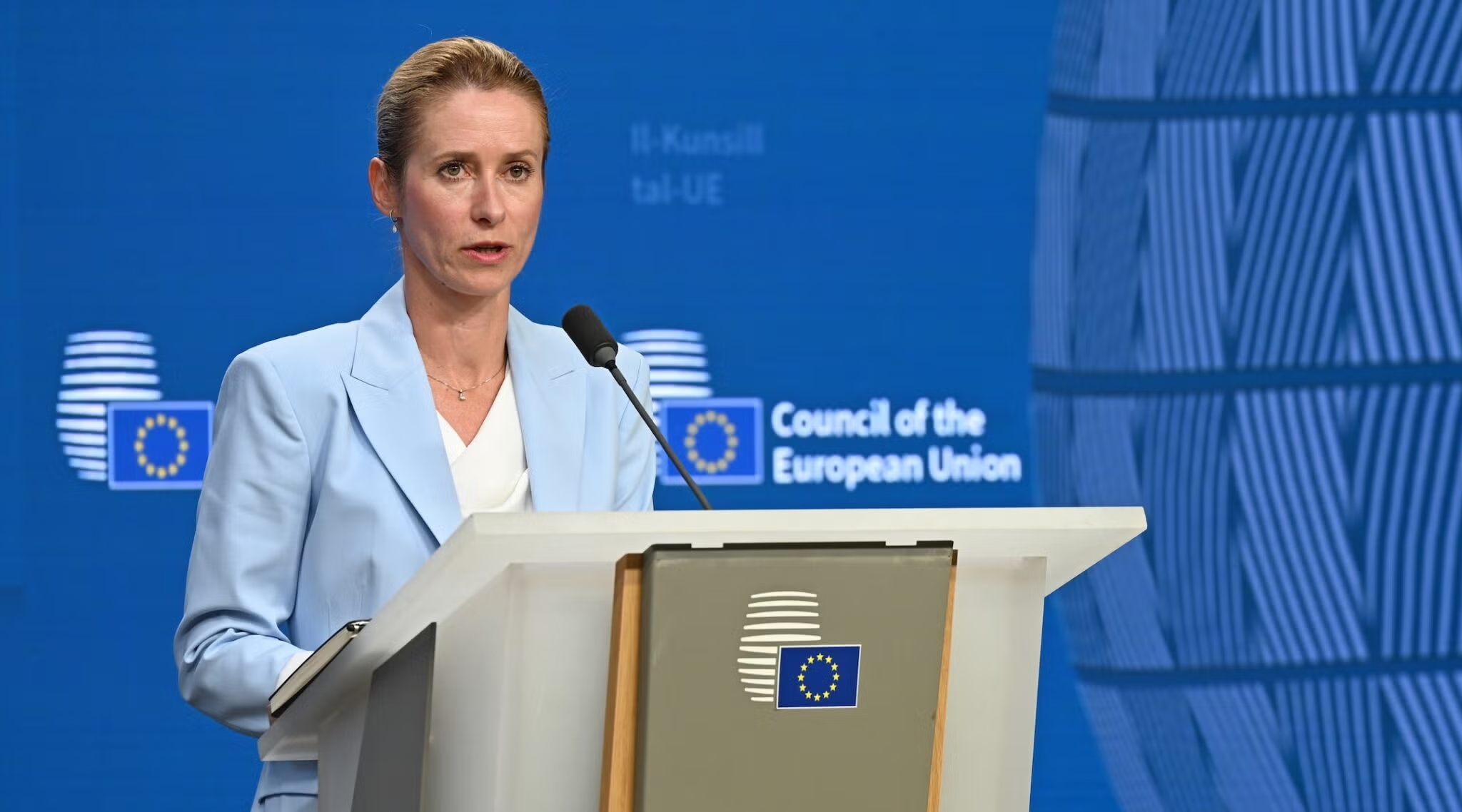
The European Union could be leaning toward banning trade with Israeli settlements in the West Bank.
Foreign ministers debated various tactics to respond to the settlements on Monday at their monthly council meeting in Brussels, against the backdrop of rising violence by settlers and efforts by the Israeli government to expand settlements in Palestinian territories.
In a press conference following the meeting, the EU’s foreign policy chief, Kaja Kallas, said one possibility had stood out.
“The option that got the most support was banning the trade with illegal settlements,” she said. All 27 member states consider Israeli settlements in the West Bank to violate international law.
Kallas added, “We tasked the ambassadors to take this work forward, and probably will also have an extraordinary meeting on this.”



No decisions have yet been made, and the path forward is uncertain. Some EU member nations favour aggressive action against the settlements, while others are unlikely to back any measures that take aim at Israel. A number are in the middle and have not decided whether they support trade bans.
The level of agreement between European governments needed to enact a partial or full trade ban on Israeli settlements remains an open question. Kallas said it was the European Council’s legal opinion that voting on trade issues called for a qualified majority, meaning that 15 out of 27 states would have to vote in favour, representing at least 65% of the EU population.
But she also acknowledged that legal experts disagreed about how much backing was needed for a trade ban. “You can always find different lawyers who come up with different ideas,” she said.
Israel’s Foreign Minister Gideon Sa’ar accused Kallas of an “obsessive campaign against Israel” in a post on X. “There was no consensus. There was no qualified majority. In fact, there was no majority at all,” he wrote, adding, “Tricks like this do nothing to advance our shared interests.”
The EU has hotly debated measures against Israel as settlements in the West Bank have expanded and settler violence has sharply intensified over recent years. The Israeli NGOs Peace Now and Kerem Navot said in a report last week that “the current Israeli government has advanced de facto annexation of the West Bank at an unprecedented pace.”
The ministers considered measures including a stricter export licensing system, higher tariffs and a partial or outright ban on goods produced over the pre-1967 lines. The options were first presented in a paper last week by the European Commission, the EU’s executive branch, as pressure mounted from European governments.
Kallas said these potential moves were not “options against Israel,” but “options against the illegal settlements that undermined the two-state solution.” She told reporters before the meeting that member states had been pressing for a trade ban on Israeli settlements, saying, “Everyone agrees that the situation in the West Bank is really intolerable.”
In May, the EU sanctioned Israeli settlers over violence against Palestinians after Hungary’s new government, led by Peter Magyar, gave its approval and allowed the states to reach a consensus.
To protest the Gaza war, the commission last year proposed suspending the EU’s free trade agreement with Israel as set out under the EU-Israel Association Agreement, the cornerstone of economic and political cooperation between Europe and Israel. The proposal was not advanced because it lacked the majority support of 15 member states.
The EU is Israel’s largest trading partner, accounting for 33.1% of its imports and 29.4% of its exports in 2025, according to a summary on the European Commission website, which did not provide data on settler goods. The free trade agreement does not apply to goods originating from Israeli businesses located over the pre-1967 lines.
Revoking the association agreement requires unanimous approval from the EU’s 27 member states, while a partial suspension, such as freezing the free trade agreement, calls for a qualified majority. Germany, Italy, Hungary and Czechia have consistently opposed such suspensions.
Israel’s most vocal critics in Europe, including Ireland and Spain, have pushed for suspending the association agreement along with proposing their own import bans at the national level. Ireland now holds the rotating presidency of the European Council, a six-month term that ends in December 2026.
The legal basis of trade restrictions on Israel lies at the heart of debates in the EU. Support from a qualified majority is sufficient to enact a commercial policy, while changes in the common foreign and security policy — such as sanctions — require unanimity.
Some legal scholars have argued that an EU ban on imports from Israeli settlements should be imposed as a trade measure rather than a sanction, making it easier to pass.
A group of 40 scholars said in an open letter last month to Kallas, trade chief Maroš Šefčovič and European Commission president Ursula von der Leyen that a blanket ban on settlement imports had a legal basis under the EU’s common commercial policy. Claims that unanimity was needed for the prohibition were “grounded in political rather than legal considerations,” they said.
The scholars also referenced an advisory opinion from the International Court of Justice in 2024, which said that Israel’s military control of Palestinian territories in the West Bank constituted an illegal occupation.
“In that regard, it should be noted that the EU Court of Justice has ruled that, in its acts, the EU is ‘bound to observe international law in its entirety,’” they said.
Daniel Mariaschin, honorary chief executive of the pro-Israel Jewish advocacy organization B’nai Brith International, told the Jewish Telegraphic Agency that reducing trade “would only weaken one of Europe’s most important partnerships in the region.”
“There are those within the EU who are looking for any way to undercut Israel’s international standing, and this is yet another example,” Mariaschin said.

Keep community journalism free.
Jewish News is free for everyone. No paywall. No barriers. Just trusted journalism for anyone who wants to stay connected to Jewish life in Britain.
If you value that, please support us.
From as little as £5 a month, you can help keep our journalism free and accessible to all.
Every day, we report on the issues that matter to our community. We celebrate achievements, support charities, challenge antisemitism and ensure Jewish voices are heard more widely.
From as little as £5 a month, you can help us continue to:
- Report on the stories shaping Jewish life in the UK and beyond
- Bring our community together through shared stories, events and campaigns
- Celebrate the people, culture and moments that define our community
- Support organisations doing vital work across Jewish Britain
You can make a one-off donation or become a regular supporter. Every contribution helps keep our journalism free, independent and accessible to all.
If everyone who values Jewish News gave a small amount, it would make a real difference to our future.