
 Prefer Jewish News on Google

From Nova to the streets of France: Jewish women’s bodies turned into a battlefield
Antisemitism and misogyny have long been partners: this unholy alliance has now resurged
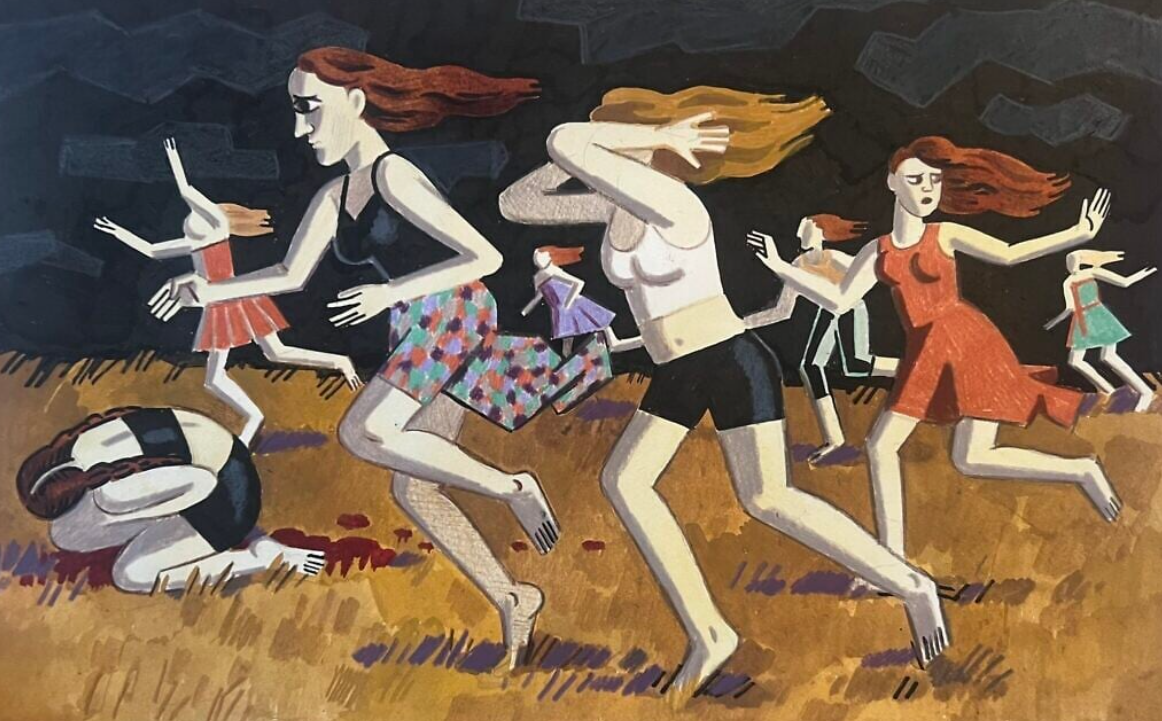
“Anti‐Semitism does not fall within the category of ideas protected by the right of free opinion… It is something quite other than an idea. It is first of all a passion”, wrote the French philosopher Jean-Paul Sartre in his 1946 book Reflections on the Jewish Question.
Jews who have been dealing with antisemitism over the last two years can sense what Sartre meant: the hatred towards us is beyond logic; it is reflexive. When the teenage daughter of a friend of mine was slapped on the London Tube by a man just because he saw her Star of David peeking out from her jumper, it was an act of reflexive hate. But it wasn’t only antisemitism – it carried another thin layer of gender-based hatred.
In his book, Sartre also uniquely sensed this gendered and sexualised hate towards Jewish women. As the world marks the International Day for the Elimination of Violence Against Women this November, it is worth taking a deep breath and diving into this toxic murky cocktail of misogyny and antisemitism.
We don’t need to swim far; it is enough to review the disturbing headlines from Israel, France and the US from the past month. Together they reflect how the objectification of Jewish women has been fully normalised globally.
It starts lightly on the battlefield of words and “ideas”. Variety, the US-based entertainment magazine, featured this month Hasan Piker, a controversial leftist commentator and Twitch streamer with nearly 3 million followers, infamous for saying that “America deserved 9/11”. Among his past outrageous comments, he downplayed the sexual assault of women on 7 October, declaring that it “doesn’t matter if rapes happened”.


For some unclear editorial reason, the magazine chose to promote his passionate rant against the Israeli actress Gal Gadot. Gadot, according to this pseudo-intellectual, is not a woman with her own body, agency and thoughts. Her body is a proxy, and her mere existence is a danger: “Gadot serves an important role in normalizing Israel as not a fascist ethno-state, but instead a place where a lot of beautiful women come from,” Piker said. “And those beautiful women happen to serve in the IDF, because there’s also this weird sexualisation of the forces as well that takes place, and it plays another role in normalising Israel and its activities and actions and whitewashing it.”
Piker is, for some reason, completely ignorant about his own fetishisation of Israeli women. However, this objectification of Jewish women’s bodies is far from being his unique take – it is a classic example of the old antisemitic trope of La belle juive, “the Beautiful Jewess”, in which non-Jewish creators throughout history have featured Jewish women in bad faith, often accompanied by expressions of antisemitic ideas. For them, the Jewess’s beauty was intended to corrupt non-Jews, or she could be “purified” only by a complete renouncement of her roots and beliefs – an antisemitic twist on the more familiar Madonna–whore complex.
“There is in the words ‘a beautiful Jewess’ a very special sexual signification, one quite different from that contained in the words ‘beautiful Rumanian,’ ‘beautiful Greek,’ or ‘beautiful American,’…This phrase carries an aura of rape and massacre”, Sartre explained. “The ‘beautiful Jewess’ is she whom the Cossacks under the czars dragged by her hair through the streets of her burning village”.
While Piker’s comments about the bodies of Israeli women were hyped by mainstream and social media, the reality shows that this objectification is targeting not only Israeli women, but Jewish women as a whole. If, after the Holocaust, we had managed to distance ourselves from the violent “aura” of the La belle juive trope, in the past two years our bodies have become a real battlefield once again, in the most physical sense.
In France, the harrowing gang rape of a 12-year-old Jewish girl returned to the headlines, as one of two teenagers found guilty of the rape had his sentence commuted on account of the “need to prepare for future reintegration”. In the original sentences, two 13-year-old boys were given seven- and nine-year prison terms respectively, for their participation in the gang rape on the basis of religion, while a third boy, the girl’s ex-boyfriend, was 12 at the time and could not be sentenced to jail due to his age. He was instead sentenced to five years in an educational facility.
At the time, the girl’s mother told Le Parisien that one of her daughter’s attackers said to her, “I know you’re not Muslim… So, what religion are you?” and then called the girl a “dirty Jew”. Following the gang rape, which was filmed and included death threats and an attempt by her ex-boyfriend to burn parts of her body, the three boys asked the girl to convert to Islam and made her swear on Allah not to say anything, her parents said.
During the 2024 court case, the presiding judge stated that “there is no doubt that [the victim] would not have been assaulted or raped if she had not been Jewish”.
In Israel, following the return of the last living hostages from Gaza last October, the state reported that about 50% of the living hostages had reported being sexually abused, including sexual coercion, gang rape and humiliation. Earlier this month, the released hostages Keith and Aviva Siegel testified before the UN Committee Against Torture, mentioning an incident in which a 16-year-old Israeli girl was forced to undress and perform oral sex on her captor. “She’s 16 years old. She’s never ever showed anybody her body. The Hamas terrorist just stood there and stared at her and smiled,” Aviva said.
These disturbing findings add to the ongoing investigation into the mass rape of mainly women – but also of men and children – during the 7 October attack, most of whom did not survive. In videos from interrogations of terrorists captured after the attack, some of them confessed to rape and said they had been instructed to do so by their commanders.
Even the global sisterhood failed Jewish and Israeli women. While forensic teams were collecting for months the body parts of murdered and raped Israeli women, UN Women avoided condemning the massacre and rape. Only after two months did it issue a pale condemnation, and finally in March 2024 Pramila Patten, the UN’s Special Representative of the Secretary-General on sexual violence in conflict, published a first report which found “reasonable grounds” to believe sexual violence took place in the Hamas-led attacks.
But it didn’t end there. Two weeks ago, Reem Alsalem, the UN Special Rapporteur on violence against women and girls, wrote on X that “no independent investigation found that rape took place on the 7th of October”. How can a UN official such as Alsalem so reflexively write these lies and press ‘send’?
Back to Sartre: “Antisemitic passion… precedes the facts that are supposed to call it forth; it seeks them out to nourish itself upon them… Indeed, if you so much as mentioned a Jew to an anti‐Semite, he will show all signs of lively irritation”.
In a world that has yet to be safe for any woman, being a Jewish woman carries an extra weight that we must acknowledge. While we are objectified and “othered” for our race, religion and nation, and antisemites show “lively irritation” at our mere existence, we must refine and define our experiences for ourselves and for the world. When we recognise what we are experiencing and reach out a comforting hand to each other in the name of a Jewish sisterhood, our bodies stop being just a battlefield. We reclaim our bodies, our history, our beliefs – and we become more resilient as a whole.

Keep community journalism free.
Jewish News is free for everyone. No paywall. No barriers. Just trusted journalism for anyone who wants to stay connected to Jewish life in Britain.
If you value that, please support us.
From as little as £5 a month, you can help keep our journalism free and accessible to all.
Every day, we report on the issues that matter to our community. We celebrate achievements, support charities, challenge antisemitism and ensure Jewish voices are heard more widely.
From as little as £5 a month, you can help us continue to:
- Report on the stories shaping Jewish life in the UK and beyond
- Bring our community together through shared stories, events and campaigns
- Celebrate the people, culture and moments that define our community
- Support organisations doing vital work across Jewish Britain
You can make a one-off donation or become a regular supporter. Every contribution helps keep our journalism free, independent and accessible to all.
If everyone who values Jewish News gave a small amount, it would make a real difference to our future.





















