Prefer Jewish News on Google
Italy shuts down online ‘Jew-hunting’ form targeting Israeli and Jewish tourists
Anonymous online campaign to map Jewish visitors deleted after government intervention and warnings it echoed Europe’s darkest history
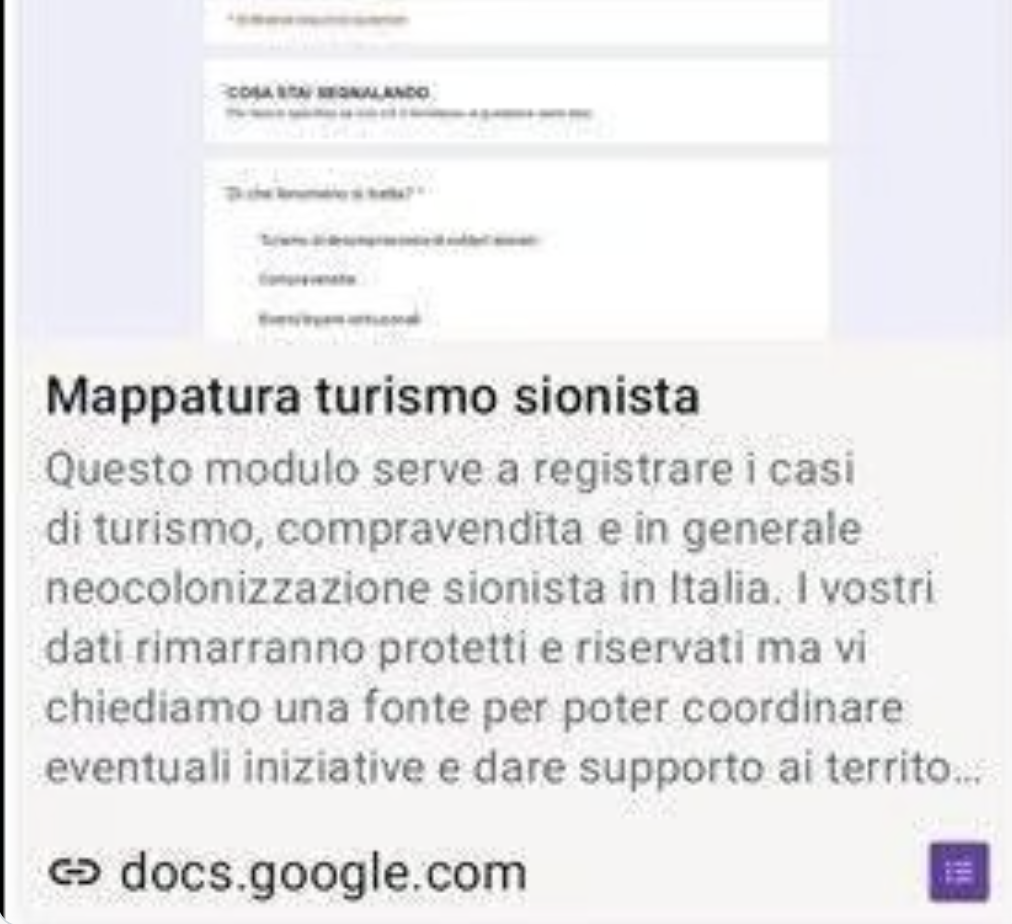
Italian authorities have shut down an anonymous online form that encouraged people to report the whereabouts of Israeli and Jewish tourists, after Jewish leaders warned it risked fuelling antisemitic attacks and echoed some of Europe’s darkest chapters.
The Google form, which circulated through social media and messaging groups before being removed, invited users to identify Israelis, Jews and people believed to have links to Zionism staying in hotels, holiday rentals, businesses and other public places across Italy.
The document said it was intended to record “Zionist tourism”, property purchases and what it described as “Zionist neo-colonisation” in Italy. It also asked contributors to report where Israeli or Jewish visitors had been seen and whether local organisations or activist groups were already “managing the phenomenon”, according to the Italian newspaper La Repubblica.
The form stated that responses would be sent to the Global Sumud Movement and would remain confidential. The group is known for organising pro-Palestinian flotillas to Gaza, although its leader denied any involvement in creating the questionnaire.
According to The Times of Israel, the form was removed following the intervention of Italy’s National Coordinator for the Fight Against Antisemitism, General Pasquale Angelosanto.


Italy’s Senate President Ignazio La Russa described the campaign as “an aberrant initiative, in open violation of fundamental human rights and the constitutional principles on which our nation is founded.”
Walker Meghnagi, president of the Jewish Community of Milan, condemned the initiative, saying: “I think we’re going back to the 1930s, to hunting Jews.”
He warned that publishing information about where Jewish people could be found could encourage extremists to act.
“What is happening today shows that there are unbalanced individuals out there, and if this kind of message spreads widely enough, you are certain to find someone willing to act on it,” he said.
“For this reason, mapping where Jews are is extremely serious.”
He also called on Italy’s judiciary and political leaders to take action against the campaign.

Davide Riccardo Romano, director of the Jewish Brigade Museum in Milan, warned of the dangers of compiling lists of Jewish people.
“History shows that when propaganda identifies a target and provides the coordinates to find it, violence ceases to be a possibility and becomes a certainty,” he said.
Alessandro Morelli, Italy’s Undersecretary of State to the Presidency of the Council of Ministers, described the form as “abhorrent”, saying it harked back to “the dark ages of Nazi fascism”, and called for unanimous political condemnation of the initiative.
Opposition senator Graziano Delrio compared the campaign to the blacklists that preceded Italy’s antisemitic racial laws under Benito Mussolini’s Fascist regime, saying: “We’re essentially talking about blacklists. We’re returning to the extremely dangerous climate that preceded the racial laws.”
Israeli Ambassador to Italy Jonathan Peled also condemned the initiative, writing on X: “The initiative to map Zionist tourism in Italy is an abominable action that highlights the alarming growth of antisemitic hatred in Italy and reveals, once again, the extremist and discriminatory drifts of the Pro-Pal movement.”
The European Jewish Congress said the questionnaire effectively encouraged people to identify and target individuals because they were Jewish or Israeli.
“Presented as a ‘mapping of Zionist tourism,’ the initiative effectively encourages the identification and targeting of individuals based on their actual or perceived Jewish identity or nationality,” the organisation said.
“Such attempts to single out individuals based on their identity create fear, fuel hatred and place Jewish communities at greater risk.
“The Italian authorities must act swiftly to ensure those responsible are held accountable and that such dangerous practices are stopped immediately.”
The incident comes amid growing concern over antisemitism in Italy. Figures from the Centre of Contemporary Jewish Documentation (CDEC), recorded 963 antisemitic incidents across the country in 2025, including a sharp rise in physical assaults. Recent incidents have included synagogue vandalism in Rome, physical assaults on Jewish people in Milan and verbal harassment in Venice.

Keep community journalism free.
Jewish News is free for everyone. No paywall. No barriers. Just trusted journalism for anyone who wants to stay connected to Jewish life in Britain.
If you value that, please support us.
From as little as £5 a month, you can help keep our journalism free and accessible to all.
Every day, we report on the issues that matter to our community. We celebrate achievements, support charities, challenge antisemitism and ensure Jewish voices are heard more widely.
From as little as £5 a month, you can help us continue to:
- Report on the stories shaping Jewish life in the UK and beyond
- Bring our community together through shared stories, events and campaigns
- Celebrate the people, culture and moments that define our community
- Support organisations doing vital work across Jewish Britain
You can make a one-off donation or become a regular supporter. Every contribution helps keep our journalism free, independent and accessible to all.
If everyone who values Jewish News gave a small amount, it would make a real difference to our future.