Prefer Jewish News on Google

Jodi Picoult launches new book in Rickmansworth
As she celebrates her 30th novel, Hollow Bones, the author talks about 9/11, postpartum psychosis and why her next novel will explore our relationship with AI
Despite a career spanning decades, millions of readers and a succession of bestselling books, Jodi Picoult is still convinced that every new novel could be the one that nobody likes.
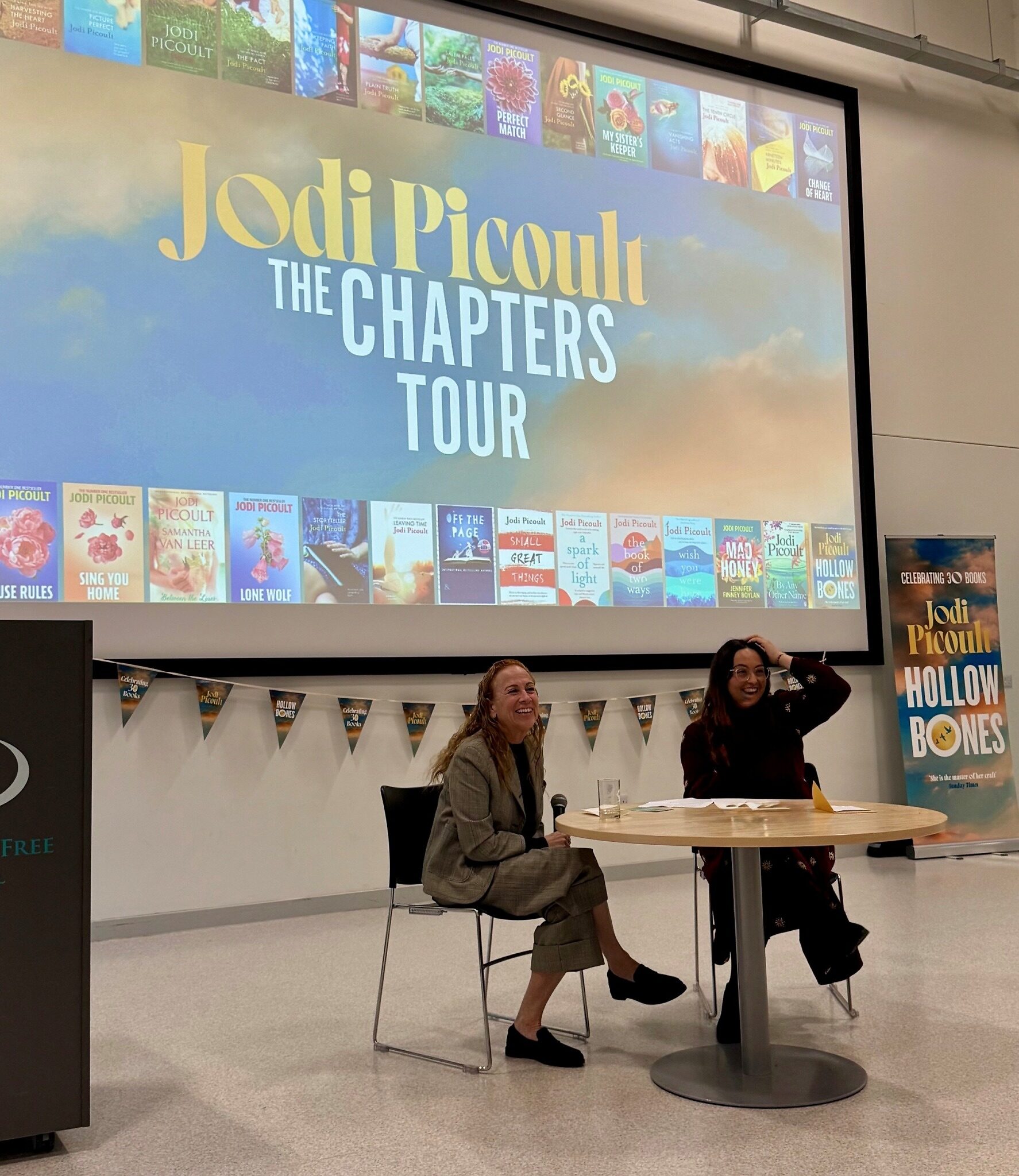
“When the book’s about to come out, I’m like, ‘Oh God, this is the one everyone’s going to hate. It’s not going to do well’,” she said to a room full of fans on Sunday at a venue in Rickmansworth as part of the book tour for her new novel, Hollow Bones.
It is a surprisingly relatable confession from an author whose books have tackled some of the most challenging moral and social issues of our time, from school shootings and racism to disability, reproductive rights and the complexities of family life.
Hollow Bones is Jodi Picoult’s 30th novel. The story centres on Molly Ambrose, whom we first meet as a two-month-old baby. On 9/11, her mother leaves for a doctor’s appointment and never comes home. Twenty-five years later, Molly is married to Jesse Fitzgerald, the teenage delinquent arsonist from Picoult’s 2004 novel My Sister’s Keeper, now a police officer. The couple are expecting their first child.
Molly works as head of emergency preparedness and response for Rhode Island, a job that reflects her determination to ensure that nobody else experiences the helplessness she felt growing up. But when disaster strikes close to home, she discovers that “being prepared is not the same thing as being protected”.
Picoult, 60, who grew up on Long Island, was speaking to author Lia Louis as part of her Chapters tour, an celebration of both her latest novel and the ones that preceded it. The title is a nod to Taylor Swift’s Eras Tour, although Picoult explained that she had to find another name.
“I wanted to celebrate all of the eras of my writing, but I couldn’t call it the Eras tour because Taylor Swift rules,” she joked, while also acknowledging that “you don’t get to 30 books unless people keep showing up for you year after year.”
The tour is her way of thanking those readers, with giveaways including signed copies of earlier books, tote bags and a book token to spend at Chiltern Bookshops, which hosted the event.
The idea for Hollow Bones came from an anonymous confession posted on the website PostSecret, where people share their deepest secrets on postcards. Picoult’s friend sent her a post that showed the Twin Towers, smoke billowing from the buildings, with the words: “Everyone who knew me before 9/11 thinks that I’m dead.”
Picoult immediately recognised the potential. “I did what authors do. I said ‘Dibs’ immediately,” she laughs.
With the 25th anniversary of 9/11 approaching, she wanted to explore the difference between experiencing a tragedy through the media and living with its personal consequences. “Those of us who found out about 9/11 by watching TV, hearing it on the news, we have a very different relationship to it than someone who lost a loved one that day.”
The novel also asks uncomfortable questions about America’s place in the world. “On 9/12, America had all the allies in the world. Everybody stood with America and felt their pain and their grief and their sorrow. And we in America have no allies now. The real question is why, and do you really feel safer than you did that day?”
For me in the audience the parallels with Israel post-October 7 did not go unnoticed.
The issue at the heart of Hollow Bones is postpartum psychosis. Picoult is passionate about the need to understand the condition, which, she says, is routinely dismissed by medical professionals. She drew comparisons with the case of Lindsay Clancy, whose recent trial brought the condition into the public consciousness.
Picoult lives in New Hampshire and has just completed a six-week US book tour, during which she was struck by the number of women who approached her to talk about their own experiences of postpartum psychosis and postpartum depression.
Picoult spoke at length about 19 Minutes, her 2007 novel about a school shooting in America. Her research included visiting Columbine and speaking to survivors, police officers and bereaved families. One young man told her that he could still walk down the school corridors, trail his hands along the walls and feel the marks where bullets had struck.
“He also said, ‘Who’s going to remember everything when we’re gone?’” she recalls.
For Picoult, this is precisely what fiction can achieve. “Fiction takes something from the news and makes you feel and understand that these are just people like you.”
It is a philosophy that has also made her a target of America’s increasingly aggressive book-banning movement. For the second consecutive year, she is the fourth most-banned author in the country, while 19 Minutes was the most-banned book in America in 2024.
The reason? Apparently the word “erection” on page 313.
Her next novel will examine AI companions and the way chatbots are deliberately designed to encourage emotional dependence. “They’re available 24/7. It’s why they speak with an I-person, an I-voice. That’s why they have a memory and can recall things that you said and make you feel so seen and so heard.”
She believes these features are carefully engineered to make users keep returning. Her new book will ask: when that relationship goes egregiously wrong, who is to blame legally and morally?”
Thirty books on, she is still writing because there are still stories she believes need to be told.

Keep community journalism free.
Jewish News is free for everyone. No paywall. No barriers. Just trusted journalism for anyone who wants to stay connected to Jewish life in Britain.
If you value that, please support us.
From as little as £5 a month, you can help keep our journalism free and accessible to all.
Every day, we report on the issues that matter to our community. We celebrate achievements, support charities, challenge antisemitism and ensure Jewish voices are heard more widely.
From as little as £5 a month, you can help us continue to:
- Report on the stories shaping Jewish life in the UK and beyond
- Bring our community together through shared stories, events and campaigns
- Celebrate the people, culture and moments that define our community
- Support organisations doing vital work across Jewish Britain
You can make a one-off donation or become a regular supporter. Every contribution helps keep our journalism free, independent and accessible to all.
If everyone who values Jewish News gave a small amount, it would make a real difference to our future.