Prefer Jewish News on Google
Leap of faith: AI, loneliness and the essence of humanity
We must beware AI's potential dehumanising effects
The BBC series Ann Droid is about an unlikely bond between lead character Sue, who is grieving the death of her husband, and Linda, her robot carer. At times, Linda appears to be more sensitive and caring than the humans in Sue’s life.
Not many of us have robots, but most will have experienced AI echoing our views and choices back to us. Researchers have coined the term “sycophantic AI” to describe the effect of it being designed to increase user engagement.
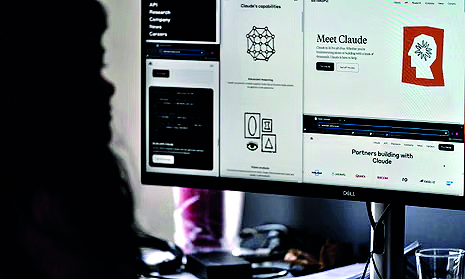
Every conversation with Claude, or whichever your bot of choice is, is about you, not about Claude. Your opinions are reinforced and you like the technology for agreeing with you, so you use it more. AI learns from every chat or task, and what’s now emerging from studies is that we start to adopt the thinking modes of the bots!
Author and journalist David Brooks recently contrasted human thinking and feeling with the simple, cold, somewhat Machiavellian ends-justify-the-means thinking of AI. He wrote: “Consequentialism in its raw form is the belief that moral actions can be judged solely on the basis of their outcomes. AI models, which are trained to seek rewards, are consequentialist.”
Consequentialist logic, to give one example, would suggest that it is a good thing to kill one person in order to use their organs to save five lives. Most human beings are not consequentialist. Instead, our thinking includes other dimensions of our own moral code and the ethical systems we have learned, including those of Judaism.



Last year, the World Health Organisation published a landmark report entitled From Loneliness to Social Connection. In it, they estimated that one in six people experienced loneliness in the period between 2014 and 2023. Globally, they estimate loneliness accounts for 871,000 deaths per annum.
In this context, our Judaism would provide two teachings, at least. First, that allowing people to be left in a state of loneliness is a potential violation of our fundamental duty of pikuach nefesh – to save lives. Secondly, Hillel the Elder’s three-part teaching is: “If I am not for myself, who will be for me? But if I am only for myself, what am I? And if not now, when?”
We in our Jewish communities need to redouble our year-round efforts to increase social connection. We cannot delegate this task to AI, because it is an inadequate and possibly dangerous substitute for social connection and the warmth of human-to-human engagement. We shouldn’t avoid using AI completely, but it becomes even more important that we inoculate ourselves against its potential dehumanising effects.
So let’s take seriously our obligations to one another. Let’s strengthen our communities. Let’s take responsibility for bringing in anyone and everyone who might be lonely.
Rabbi Richard Jacobi is at East London and Essex Liberal Synagogue

Keep community journalism free.
Jewish News is free for everyone. No paywall. No barriers. Just trusted journalism for anyone who wants to stay connected to Jewish life in Britain.
If you value that, please support us.
From as little as £5 a month, you can help keep our journalism free and accessible to all.
Every day, we report on the issues that matter to our community. We celebrate achievements, support charities, challenge antisemitism and ensure Jewish voices are heard more widely.
From as little as £5 a month, you can help us continue to:
- Report on the stories shaping Jewish life in the UK and beyond
- Bring our community together through shared stories, events and campaigns
- Celebrate the people, culture and moments that define our community
- Support organisations doing vital work across Jewish Britain
You can make a one-off donation or become a regular supporter. Every contribution helps keep our journalism free, independent and accessible to all.
If everyone who values Jewish News gave a small amount, it would make a real difference to our future.