Prefer Jewish News on Google
Life in the shadow of loss: Hersh Goldberg-Polin’s parents stir St John’s Wood Synagogue
Rachel Goldberg-Polin and Jon Polin move UK audience at Sacks Conversation
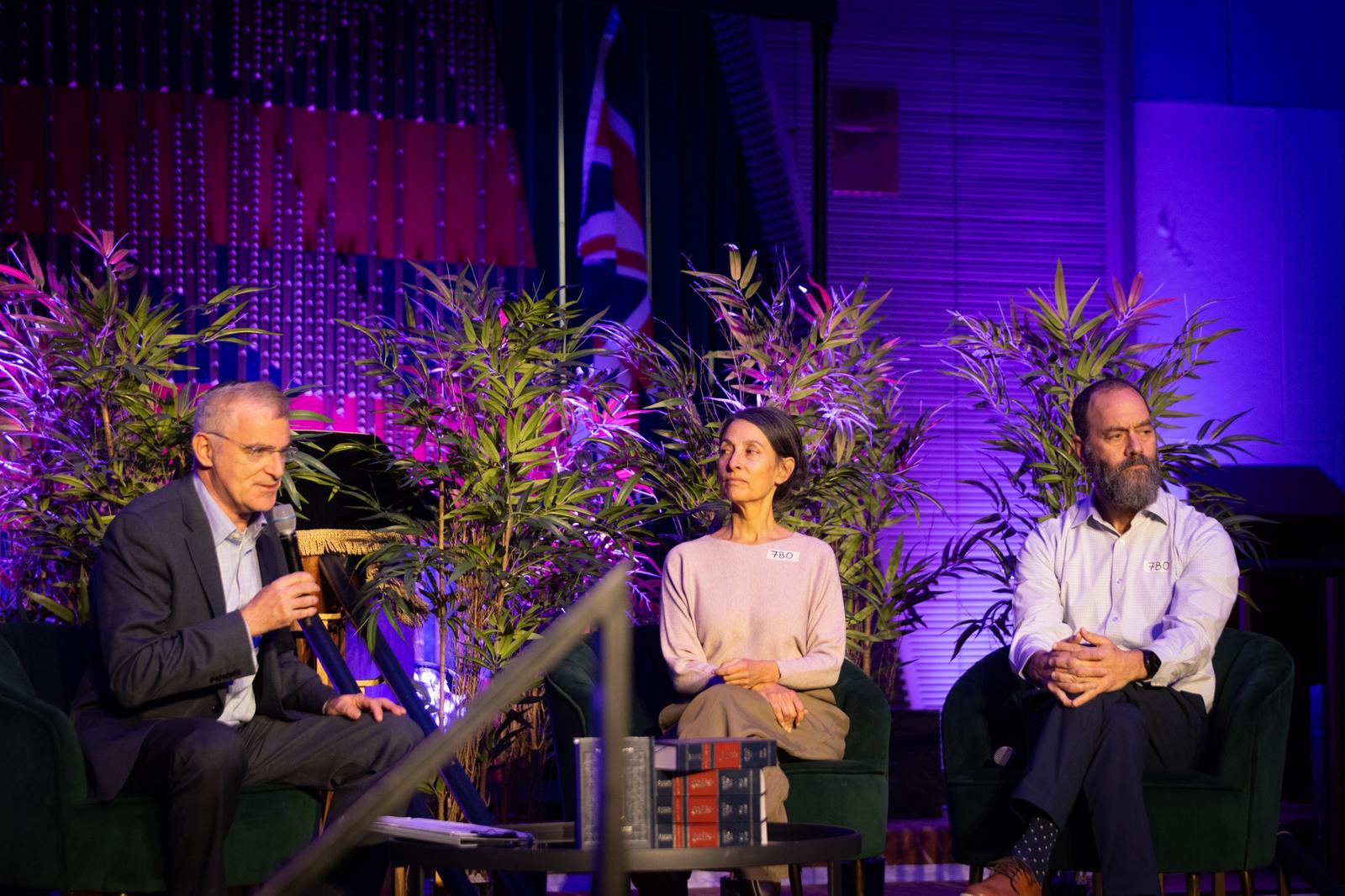
The parents of murdered hostage Hersh Goldberg-Polin brought a message of courage, dignity, and what they called “choosing life” to a packed St John’s Wood Synagogue this week, delivering one of the most powerful Sacks Conversations yet.
Speaking with diplomat Daniel Taub, Rachel Goldberg-Polin and Jon Polin shared reflections shaped by two years of anguish and activism, drawing repeated applause from the hundreds gathered to honour the legacy of Rabbi Lord Jonathan Sacks.
The annual event also marked the launch of the Conrad Morris Edition Koren Sacks Humash, a new edition of the Torah with Rabbi Sacks’ commentary, produced over six years and dedicated in memory of businessman and communal leader Conrad Morris. His family funded the project and ensured the edition will be distributed widely across United Synagogue communities.
Goldberg-Polin told the audience she had made a conscious decision about how she would live with grief, saying she refused to allow trauma to “turn me ugly”. The Torah’s call to “choose life”, she said, had become a daily discipline – not an abstraction but a deliberate act of moral survival. She described receiving accounts from released hostages who spoke of moments of comfort and strength they had drawn from Hersh during captivity, including how he shared words that helped others hold on. Those glimpses, she said, revealed “who he really was,” and have sustained the family as they navigate the emptiness left by his murder.

Jon Polin reflected on how familiar Torah passages now read differently, particularly the courage shown by Nachshon stepping into the Red Sea and Joshua and Caleb standing firm against despair. Those examples, he said, have shaped his understanding of leadership during the past two years. He spoke of Hersh’s own instinctive ability “to take a text and turn it into a life”, recalling testimonies from fellow hostages who described his strength and compassion even in the darkest circumstances.



Addressing the challenges faced by young diaspora Jews who feel disconnected from Israel, Goldberg-Polin urged them to judge the country with the same democratic maturity they apply at home. “Not everyone votes for the person in the White House or in Downing Street,” she said, calling it a “strange double standard” to demand unanimity from Israelis that is required nowhere else. Polin described an encounter in the United States where, after showing a photo of Hersh to a stranger, the response ignored their humanity entirely. Some people, he said, act not out of thought but out of “instructions”, making genuine dialogue impossible.
© Blake-Ezra Photography Ltd. 2013
Earlier in the evening, Dayan Ivan Binstock welcomed attendees and recalled how many of Rabbi Sacks’ most influential ideas were first delivered from the same pulpit. He praised the Morris family for ensuring that the new edition would reach “every shul in the United Synagogue”, and he described the project as a fitting tribute to a man who “lived for others” and whose communal impact “was absolutely enormous”.
A tribute film remembered Conrad Morris’ decades of philanthropy and his unwavering commitment to Jewish education and t the State of Israel. His son David Morris told the audience that dedicating the new Humash in his father’s memory was “the perfect tribute” to a man who never missed his weekly Torah portion and who believed deeply in ensuring Jewish learning was accessible to all.
Chief Rabbi Sir Ephraim Mirvis said Hersh had become “part of the narrative of Jewish life today”, and that because of his parents’ advocacy, “his legacy will be with Am Yisrael forever.” He also paid tribute to the Morris family’s generosity and to the global impact of Rabbi Sacks’ writings, which he said continued to shape Jewish thought well beyond the UK.
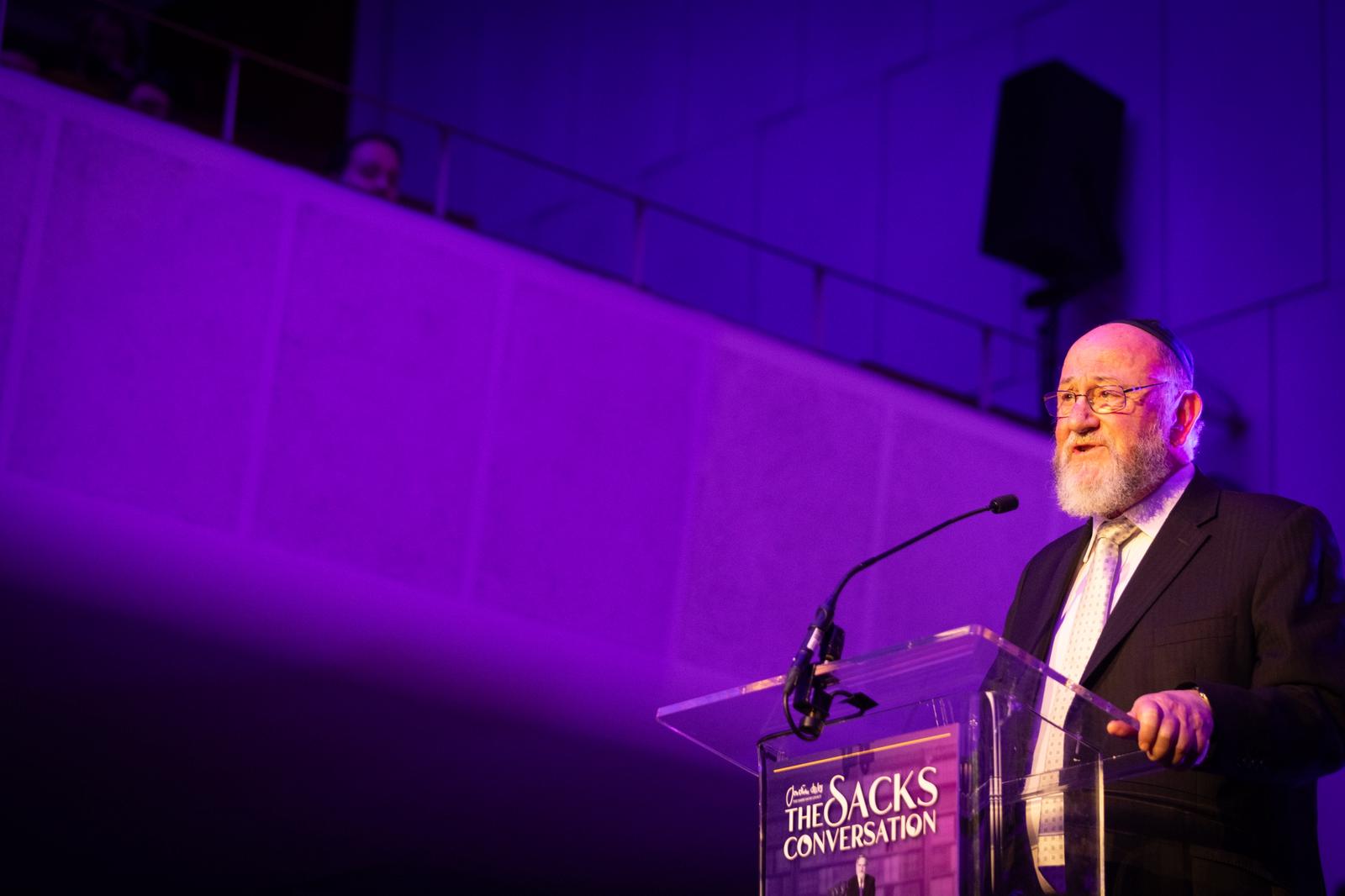
The evening concluded with a deeply personal address from Gila Sacks, who said seeing congregants reading from the new edition had moved her profoundly. Her father’s commentary, she said, had become “part of the furniture of our Jewish life”, a presence that accompanies families each week. She reflected on the page layout itself – Torah text surrounded by generations of commentary – as a reminder that “there is always more than one truth”, a principle she said the world urgently needs to relearn.
As the Goldberg-Polins left the synagogue, their message lingered: that even amidst devastation, Jews can choose dignity, courage and radical hope – and that doing so is itself a form of resistance.

Keep community journalism free.
Jewish News is free for everyone. No paywall. No barriers. Just trusted journalism for anyone who wants to stay connected to Jewish life in Britain.
If you value that, please support us.
From as little as £5 a month, you can help keep our journalism free and accessible to all.
Every day, we report on the issues that matter to our community. We celebrate achievements, support charities, challenge antisemitism and ensure Jewish voices are heard more widely.
From as little as £5 a month, you can help us continue to:
- Report on the stories shaping Jewish life in the UK and beyond
- Bring our community together through shared stories, events and campaigns
- Celebrate the people, culture and moments that define our community
- Support organisations doing vital work across Jewish Britain
You can make a one-off donation or become a regular supporter. Every contribution helps keep our journalism free, independent and accessible to all.
If everyone who values Jewish News gave a small amount, it would make a real difference to our future.