Prefer Jewish News on Google
Over 1,000 UK Jews sign letter backing ban on trade with Israeli settlements
Philanthropist Dame Vivian Duffield among signatories of letter sent to government

More than 1,000 British Jews—including leading philanthropist Dame Vivian Duffield and members from every major synagogue denomination—have signed a landmark letter calling for a UK ban on trade with Israeli settlements in the West Bank.
The letter, sent on Friday to Middle East Minister Hamish Falconer and Foreign Secretary Yvette Cooper, is aimed at showing genuine support across the Jewish community for such a move.
Signatories included academics, lawyers, United Synagogue, Masorti, and Progressive shul members, as well as 22 rabbis.
Organised by pro-peace advocacy group Yachad, the campaign invited signatories to allow their names to be published, with nearly 1,000 agreeing—providing an unusually transparent snapshot of communal support.

The letter highlights deep concern within some of the British Jewish community about the ongoing expansion of settlements, violence from extremist settlers, and the impact of these policies on Palestinians, Israeli democracy, and prospects for a two-state solution.


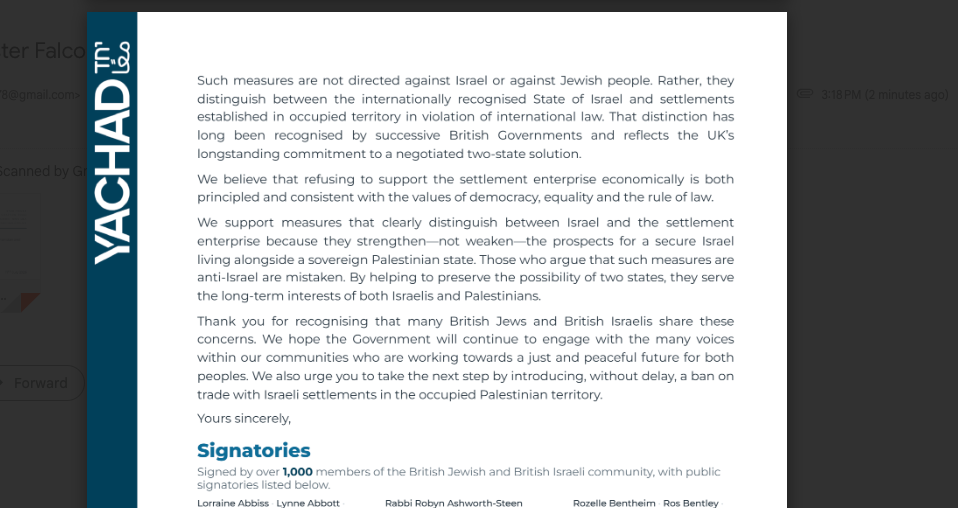
“Too often, public debate about Israel and Palestine reduces diverse communities to a single political position,” the letter states. “As British Jews and British Israelis, we know this is neither accurate nor fair.”
It continues: “For decades, Israeli human rights organisations, former security officials, legal experts, peace activists, and many ordinary citizens have warned that settlement expansion undermines the possibility of a negotiated peace and entrenches a reality of permanent occupation and unequal rights.”
The letter welcomes recent comments by Falconer in the House of Commons, who recognised that many Israelis and British Jews “see the terrible damage done by violent settlements” and cautioned against tarring entire communities with the same brush.
The letter argues that the proposed trade ban is principled and consistent with democracy, equality, and the rule of law.
It stresses that distinguishing between the internationally recognised State of Israel and settlements established in occupied territory is a longstanding UK policy and a necessary step to preserve the possibility of a two-state solution.
“We support measures that clearly distinguish between Israel and the settlement enterprise because they strengthen—not weaken—the prospects for a secure Israel living alongside a sovereign Palestinian state,” the letter reads.
“Those who argue such measures are anti-Israel are mistaken. By helping to preserve the possibility of two states, they serve the long-term interests of both Israelis and Palestinians.”

The push for a ban comes as Prime Minister Andy Burnham is widely expected to introduce proposals restricting imports and exports to Israeli settlements.
Trade Minister Chris Bryant told MPs this week that there is now a “very strong” case for a full ban—echoing moves in other EU countries, who view such measures as one of the last remaining levers to protect a two-state outcome.
The expected move is likely to draw a sharp response from mainstream communal bodies including the Jewish Leadership Council and Board of Deputies, who are expected to oppose any ban.
Chief Rabbi Ephraim Mirvis is understood to have raised concerns in meetings with government officials, including the Foreign Secretary.
The Board has previously argued that boycotts harm peace efforts, though the signatories of the new letter insist that refusing to support the settlement enterprise economically is both principled and in line with Jewish values.
Opponents of the ban argue that it fails to account for the complex realities on the ground, including distinctions between large settlements such as Ma’ale Adumim—integrated with Jerusalem’s economy and infrastructure—and illegal outposts, which even Israeli law recognises as unlawful.
Some communal leaders also claim a trade ban could impact UK Jewish visitors to the Western Wall in East Jerusalem, an argument dismissed by backers of the ban who note that banking and access arrangements would not be affected.
Supporters say a trade ban is a targeted step to discourage further settlement growth and reinforce the international consensus that settlements are a key barrier to peace.
“Economic measures that distinguish between Israel and the settlements do not target Israel or Jewish people as a whole—they focus specifically on policies undermining prospects for a negotiated peace,” argues the letter.
“This is about upholding international law, our community’s values, and the possibility of a better future for both peoples.”

Keep community journalism free.
Jewish News is free for everyone. No paywall. No barriers. Just trusted journalism for anyone who wants to stay connected to Jewish life in Britain.
If you value that, please support us.
From as little as £5 a month, you can help keep our journalism free and accessible to all.
Every day, we report on the issues that matter to our community. We celebrate achievements, support charities, challenge antisemitism and ensure Jewish voices are heard more widely.
From as little as £5 a month, you can help us continue to:
- Report on the stories shaping Jewish life in the UK and beyond
- Bring our community together through shared stories, events and campaigns
- Celebrate the people, culture and moments that define our community
- Support organisations doing vital work across Jewish Britain
You can make a one-off donation or become a regular supporter. Every contribution helps keep our journalism free, independent and accessible to all.
If everyone who values Jewish News gave a small amount, it would make a real difference to our future.