Live Now

Live blog: Israel election latest news and updates

Follow our live coverage for the latest developments, results and reaction as Israel votes.

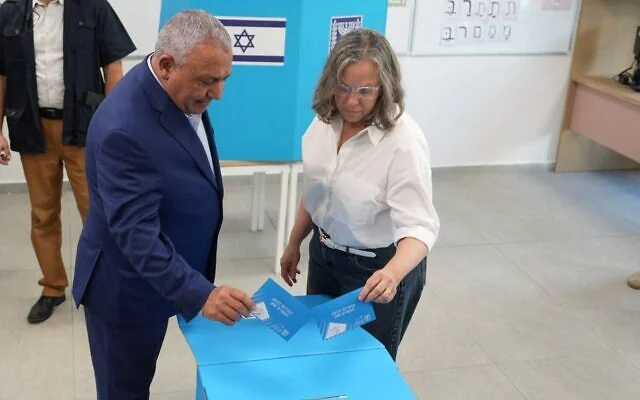
Yashar leader Gadi Eisenkot casts his ballot in Herzliya alongside his wife, Hannah, and family members. (Photo: Yashar)

Eisenkot’s party accuses Netanyahu of preparing to challenge election results

Gadi Eisenkot’s Yashar party has accused Prime Minister Benjamin Netanyahu of making unfounded claims about election fraud to prepare for a possible challenge to the results.

“Netanyahu is panicking and has begun making up stories and claiming that the election is being stolen. This is no accident. He is already laying the groundwork to challenge the election results,” the party said in a statement.

The accusation follows repeated claims by Netanyahu that his opponents are trying to “steal the election”, without providing evidence.

Yashar called for a decisive victory over Likud, saying the margin must be large enough to leave no room for disputes over the outcome.

IDF voter turnout now reaches 48%, up from 30% this morning

Voter turnout among Israeli soldiers has now reached 48 per cent as of 1pm, up from 30 per cent at 10am, according to the IDF.

The latest figure is also higher than the 44.4 per cent recorded at the same time in the 2022 election.

Soldiers began voting a week ago, with 850 polling stations set up at military bases across Israel and beyond its borders.

Gadi Eisenkot casts vote in Herzliya as supporters chant ‘next prime minister’

Yashar leader Gadi Eisenkot has cast his ballot in Herzliya alongside his wife, Hannah, and other family members.

Supporters greeted him with chants of “Who’s coming? The next prime minister!” and “Gadi, Gadi, Gadi!”

Others in the crowd chanted “Bibi, Bibi, Bibi,” referring to Prime Minister Benjamin Netanyahu.

“We are setting Israel on a new path,” Eisenkot said after voting. “We will be worthy of your trust. I promise.”

Yashar leader Gadi Eisenkot casts his ballot in Herzliya alongside his wife, Hannah, and family members. (Photo: Yashar)

US ambassador praises Israeli democracy as voters head to polls

US Ambassador to Israel Mike Huckabee has praised Israel’s democratic system as the country votes in its general election.

In an election day post, Huckabee highlighted Israel’s voting rules, describing the process as “contentious”.

“All voting is in person; ID required. No mail-in or absentee ballots. Arabs vote same as Israelis,” he wrote.

Huckabee also described Israel as one of the few democracies in the region.

ANALYSIS: Why Arab voters could hold the key to Israel’s next government

As Israelis head to the polls today in what many see as one of the most consequential elections in the country’s history, the Arab vote could prove crucial to the composition of the next government. The current estimates predict that more than 60 per cent of the Arab voters will participate in the current elections; in the 2022 elections, for reference, only 53.2 percent voted.

Representing roughly a fifth of Israel’s population, Arab citizens have the theoretical electoral weight of about 20 seats in the 120-member Knesset. With the election expected to be closely contested, their turnout could significantly affect the balance of power between Prime Minister Benjamin Netanyahu’s Right-wing bloc and the opposition parties’ so-called the ‘change bloc’, seeking to replace him.

Concerns over rising violent crime, personal security, successive wars, economy and deteriorating Jewish-Arab relations have prompted Arab civil-society organisations to mobilise voters across the country.

Yet despite Arab candidates standing – from left to hard-right – on most of the Jewish-led party lists across the political spectrum, much of the Jewish political establishment remains reluctant to cooperate with non-Zionist Arab parties, particularly in the aftermath of 7 October.

Nevertheless, Ra’am, the Islamist party led by Mansour Abbas, is seeking to join the next governing coalition, having made history in 2021 as the first independent Arab party to enter an Israeli government. The party, whose list now includes number 2 the Jewish and Zionist former senior police officer Yoav Segalovitz, has expressed a preference for a government led by the opposition.

The Joint List, an alliance of Arab Left-wing and Palestinian nationalist parties, has also indicated its willingness to support an alternative government from outside the coalition, subject to political conditions.

Such an arrangement would echo the 1990s, when Arab parties provided parliamentary backing to Yitzhak Rabin’s government without formally joining it, helping sustain his government during the Oslo peace process.

ANALYSIS: How 7 October inspired a new generation of political candidates

British-born Shira Shapiro is one of several candidates who became political after becoming caught up in the horror of October 7.

Shira, whose academic parents were living in London when she was born and who retains British citizenship alongside her Israeli one, started speaking publicly about her hero son Aner, an off-duty soldier at Nova who became famous for throwing grenades back at Hamas and protecting dozens of others in a shelter. He was killed by an eighth grenade. His best friend, Hersh Goldberg-Polin was also injured and then taken into captivity in Gaza, where he was killed when IDF troops approached where he and five others were being held.

Shira is running for Parliament on the list for Eisenkot’s Yashar, saying it was an extension of her son’s determination to save people.

“If I can enter the politics and make things happen differently here, I must do it,” she told Reuters.

She is one of at least nine candidates whose families were affected by 7 October. While they share a commitment to changing the country – they have different ideas about how to do it.

Sharon Sharabi had two brother taken hostage into Gaza – Eli and Yossi – while his British sister-in-law Leanne and two nieces were murdered on 7 October. It was only when Eli was finally released that discovered his wife and daughters had been murdered on 7 October, and his brother Yossi was killed in captivity.

Sharon is standing on a right wing ticket with the Our Home party, led by former Likudnik Avigdor Liberman, saying he believed the country needs better leadership.

Ultra-Orthodox party banned from tracking voters at polling stations

Israel’s Central Elections Committee has ordered the ultra-Orthodox United Torah Judaism (UTJ) party to stop tracking voters at polling stations.

The temporary order follows a report by Channel 13 that UTJ representatives were recording who had voted and who had not, allegedly breaking a court ruling issued last month.

The decision came after a complaint from the Movement for Quality Government in Israel.

Committee chairman Justice Noam Sohlberg has ordered UTJ to respond to the allegations.

Man arrested with knife near Israeli party leader Yair Golan

A man has been arrested carrying a knife near Democrats leader Yair Golan while he was campaigning in Tel Aviv, although police have denied claims of an attempted stabbing.

Golan’s party said the man approached him in an “intimidating manner” at Mesila Park before a large knife fell from his clothing.

Security guards tackled the suspect and alerted police, who arrested him.

Golan blamed the incident on what he called the “poison machine” operated by Prime Minister Benjamin Netanyahu and his “Qatari agents”.

Police confirmed that a Jerusalem man in his 20s was arrested with a knife but said there had been no attempted stabbing.

Shin Bet says Israeli election running smoothly despite voting concerns

Shin Bet chief David Zini has said Israel’s election is going “well so far” during a visit to the Central Elections Committee’s command centre at the Knesset.

Zini toured the facility alongside committee chairman Justice Noam Sohlberg and acting director-general Dean Livne to see how voting was being managed across the country.

“Voter turnout is high, and we can confidently tell the citizens of Israel that the elections are being monitored and conducted in a proper and inspiring manner,” he said.

His comments come after several political parties raised concerns about alleged voting irregularities.

Spoilt for choice? Israeli voters face tough decisions among 36 parties

Between 20 and 30 per cent of Israelis still hadn’t decided who they were going to vote for on the day of the election.

With a dazzling array of 36 parties there’s enough choice for every one to find a party they like but sometimes there can be a thing such as too much choice.

For British-born educator Matt Lipman, who made Aliyah twenty years ago, there were still three parties he was choosing between an hour before he wanted to vote.

Matt Lipman

“I like the change block, but I am choosing between them. It’s either going to be Bennett (B’Yachad, which means Together) or Eisenkot (Yashar), and there is also a new Haredi party that I am interested in. Even though I’m not Haredi, I hosted a meeting for them. They are called Haredi Public, and they are doing something completely different for their community, saying they want to play a bigger role in Israeli society. I think thats important for the future of the state.

“The most important thing for me is they are all not in the Netanyahu bloc or if they do end up in it, his coalition will look very different.

“We need high functioning people running the country that have in interest in serving it and not their sectarian bases.”

Live Now

ANALYSIS: Netanyahu and Eisenkot battle to become Israel’s largest party – but smaller parties could pay the price

Prime Minister Benjamin Netanyahu and his main challenger, Gadi Eisenkot, have spent the final days of the election campaign urging voters to back their respective parties, Likud and Yashar, in a race to become the largest faction in the Knesset.

Although Israel’s electoral system does not automatically give the largest party the right to form a government – the president appoints the candidate considered best placed to assemble a governing coalition – both leaders are hoping to strengthen their positions at the expense of smaller parties.

The tactic, known in Israeli politics as “drinking mandates”, involves attracting voters away from ideologically allied parties, concentrating support in a larger party without necessarily increasing the size of its political bloc.

But it carries a significant risk. Under Israel’s electoral system, parties must win at least 3.25 per cent of the vote, equivalent to roughly four Knesset seats, to enter parliament. Any party falling short receives no seats, potentially costing its entire bloc valuable representation.

Among the parties facing this risk are Finance Minister Bezalel Smotrich’s Religious Zionism and former general Ofer Winter’s Amcha Yisrael, both competing for Right-wing voters. On the anti-Netanyahu side, Eisenkot’s campaign is also drawing support away from allies, including Naftali Bennett and Yair Lapid’s Together alliance, Avigdor Liberman’s Yisrael Beiteinu and Yair Golan’s Democrats.

Meanwhile, two smaller parties have sought to position themselves outside the traditional political blocs: The Reservists and the Economic Party, led by former minister Yoaz Hendel and economist Yaron Zelekha, which advocates a broad Zionist coalition without ultra-Orthodox or Arab parties; and The Haredi Public, a new ultra-Orthodox party led by Motty Leitner, which seeks to challenge the established Haredi political leadership.

With neither political bloc assured a parliamentary majority, the fate of smaller parties could prove more consequential than which of the two leading parties finishes first.