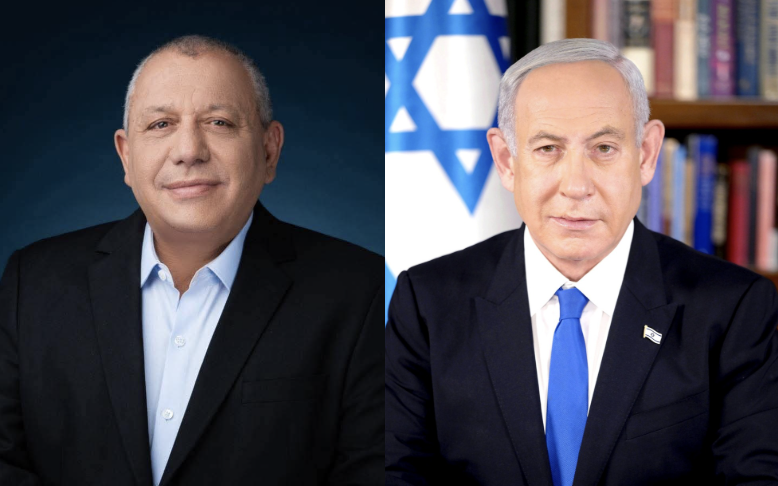
Gadi Eisenkot’s bloc is reportedly considering joining forces with Arab parties to remove Knesset Speaker Amir Ohana, a member of Benjamin Netanyahu’s Likud party.
According to Israel’s Channel 12, the bloc is looking to use its combined parliamentary strength to elect a new speaker, although no candidate has yet been agreed.
Oded Forer of Yisrael Beytenu and Elazar Stern of Eisenkot’s Yashar party are reportedly among those being considered.
With votes still being counted, Netanyahu’s bloc is projected to win 54 seats, Eisenkot’s 49 and the Arab parties 17.
Together, Eisenkot’s bloc and the Arab parties would hold 66 of the Knesset’s 120 seats, enough for a majority if they voted together.
Prime Minister Benjamin Netanyahu’s Likud party has remained the most popular party in several Israeli towns badly affected by the 7 October attacks and the wars that followed, according to partial election results.
In the northern town of Kiryat Shmona, which suffered extensive damage from Hezbollah rocket and drone attacks, around 48 percent of voters backed Likud.
Other northern communities near the Lebanese border, including Shlomi, Avivim and Dovev, also gave the party strong support, despite residents having been evacuated from their homes for long periods during the fighting.
In southern Israel, Likud remained the largest party in Sderot and Ofakim, where Hamas terrorists killed dozens of people during the 7 October attacks.
Nearly 39 percent of voters in Sderot backed Netanyahu’s party, according to results reported by The Times of Israel.
Israeli shares have fallen and the shekel has weakened as election results leave it unclear who will form the country’s next government.
The value of shares in some of Israel’s biggest companies fell by around 1.5 to 3 percent, while insurance company shares dropped 4.1 percent.
The shekel also lost 1 per cent of its value against the US dollar.
Ronen Menahem, an economist at Mizrahi Tefahot Bank, told The Times of Israel that investors were waiting for the final results and wanted a stable government that could help the economy grow.
With 84.5 percent of ballot boxes counted in Israel’s election, the bloc led by Prime Minister Benjamin Netanyahu remains on 54 seats, while Gadi Eisenkot’s bloc has risen to 49, according to partial results published by the Central Elections Committee.
The latest figures mark a shift from the previous update, when Eisenkot’s bloc stood at 47 seats and the Arab-led parties were projected to win 19.
The Joint List and Ra’am have now fallen to a combined 17 seats, down two, while Netanyahu’s bloc remains unchanged.
The Reservists party remains below the 3.25 percent electoral threshold on 2.7 percent, alongside People of Israel on 1.6 percent and Charedi Public on 0.2 percent.
The results remain provisional, with votes cast in double envelopes, including those of soldiers, still to be counted.
As Israel faces an uncertain political future following Tuesday’s election, David Davidi-Brown, chief executive of New Israel Fund UK, argues that real victory must go beyond the ballot box.
Read the full opinion piece here.
Joint List chairman Yousef Jabareen has declared his party ready to help remove Benjamin Netanyahu from power, as partial election results suggest Arab-led parties could secure a record 19 Knesset seats.
Speaking to Channel 13, Jabareen said: “Anyone who wants to offer a substantive and genuine alternative to Netanyahu’s government of bloodshed will have to talk to us in order to pave the way for the change that the Israeli public longs for.”
He added: “It is either continued racism, continued exclusion and continued supremacy, or genuine Jewish-Arab partnership.”
In a separate interview with Ynet, Jabareen pledged to “leverage our political power to advance the values we believe in”, saying his party was prepared to “pave the way for ousting the government of Netanyahu, Ben Gvir and Smotrich, and send them home.”
With 76.8 percent of ballot boxes counted, the Joint List is projected to win 13 seats and Ra’am six, giving the two Arab-led parties a combined 19.
Netanyahu’s bloc remains on 54 seats, while Gadi Eisenkot’s bloc stands at 47, leaving the latter dependent on support from Arab parties to secure a parliamentary majority.
With 76.8 per cent of ballot boxes counted, the Arab parties have risen to a projected 19 seats, up from 18 in the previous update, according to partial results published by Israel’s Central Elections Committee.
The bloc led by Prime Minister Benjamin Netanyahu remains on 54 seats, while Gadi Eisenkot’s bloc has fallen from 48 to 47.
The Joint List and Ra’am account for the Arab parties’ 19 seats.
The results remain provisional, with votes cast in double envelopes, including those of soldiers, still to be counted.
Yair Golan: “Netanyahu lost. I know how to count to 120. 65 is more than 55. That’s how Israeli democracy works. Period.
“The picture of reality must teach us one resounding lesson: We have no future here if we don’t stop being afraid. And if we don’t stop with the racism.
“We must no longer accept Netanyahu’s racist division between Jewish votes and Arab votes.
“The voice of an Israeli citizen voting in Taybeh is worth exactly as much as the voice of an Israeli citizen voting in Givat Shmuel. No less. Not approximately. Exactly.
“Anyone who tries to erase the voices of Arab citizens is surrendering to Netanyahu and giving up on Israel.
“And now let’s talk about Zionism. In Netanyahu’s bloc sit 16 Knesset members from non-Zionist Haredi parties, who promote mass draft evasion while our children are fighting and dying.
“If Netanyahu insists on counting only a Zionist majority, let him first subtract from his own bloc the 16 Knesset members from the non-Zionist Haredi parties. They won’t preach to us about Zionism.
“The Change bloc has a Zionist majority: 49 against 39. The Change bloc has an Israeli majority: 65 against 55. We have a majority. We have responsibility. And we have an opportunity to form a government of change in partnership with Israel’s Arab citizens. A government that will serve all Israeli citizens.
“Now it takes courage. It takes leadership. It takes stopping the fear and starting to act. A government of change now!”
The Kan broadcaster now has both blocs on 51 seats, while Channel 12 gives the Netanyahu bloc 52 seats and the Eisenkot bloc 49.

 Prefer Jewish News on Google