
 Prefer Jewish News on Google
Making sense of the sedra: Lech Lecha
Covenantal friendship and cross-religious partnership
When I read parashat Lech Lecha, I am always struck by the way Abraham — still Abram then — is introduced not merely as a man of faith, but as one who builds relationships. God calls him to leave everything familiar, to become a father to many nations, and Abraham responds not by retreating into isolation, but by forging connections that extend beyond his immediate household. Among those connections, the Torah names three allies: Aner, Eshkol and Mamre. These men are described as Abraham’s covenantal friends, partners in his pursuit of justice and defenders of his family when Lot is taken captive.
This triad of companions may seem like a small detail, but it is profoundly instructive. Abraham, the patriarch of monotheism, did not surround himself only with those who shared his precise beliefs. He entered into covenantal friendship with others who recognised the moral and spiritual leadership he embodied. Aner, Eshkol and Mamre were not Israelites — the people Israel did not yet exist. Yet they stood with Abraham in faith and in action. Their alliance was one of respect and shared purpose, not of uniformity.
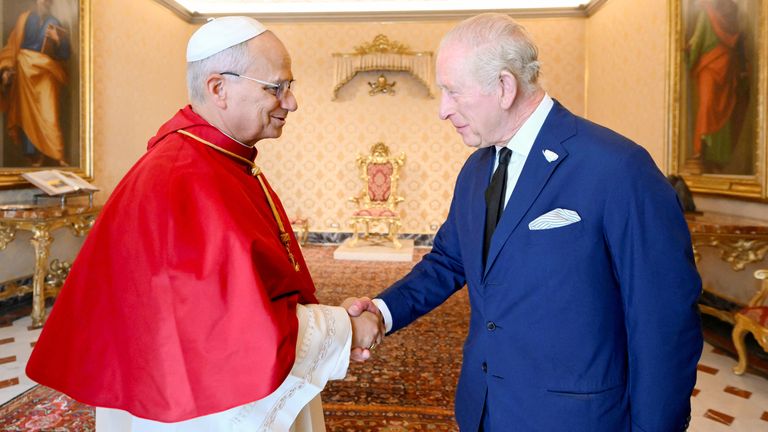
In our own times, I see an echo of this ancient covenantal friendship in the relationship between King Charles and Pope Leo. Much commentary, often critical, has arisen in Christian circles about the prospect of the two Heads of Church and State meeting in prayer. The concern seems to stem from an anxiety about doctrinal purity, or a fear that shared prayer across denominational or religious boundaries dilutes the sanctity of one’s own tradition.
But the story of Abraham teaches us otherwise. When Abraham gathered his three allies to rescue Lot, it was not a matter of theology but of justice. When he accepted the counsel of Mamre to circumcise himself — a profoundly spiritual act — he did so while acknowledging the wisdom of his non-Israelite friends. Abraham’s greatness was not in withdrawing from the world, but in engaging it; not in fearing contamination from others, but in inspiring them by example.
King Charles, like Abraham, bears a unique responsibility as both a spiritual and temporal figure. His kingship, while constitutional, carries the moral weight of a Defender of the Faith. Pope Leo, similarly, leads a global flock seeking to live out faith in the modern world. When these two figures meet in prayer, it should not be seen as a compromise, but as a restoration of the Abrahamic ideal: the capacity of leaders of faith and conscience to find common ground before the Creator.


In Jewish tradition, we bless those who “seek peace and pursue it”. Peace – shalom – is not the absence of difference, it is the harmony of difference brought into moral balance. Aner, Eshkol and Mamre represent that harmony — men of differing backgrounds who nonetheless shared a covenantal destiny with Abraham.
If our patriarch could find holiness in partnership with those outside his immediate faith, surely our modern leaders can do no less. In this light, the image of the Pope and the King in prayer is not controversial — it is covenantal. It recalls the very roots of our shared Abrahamic calling: to walk before God and be whole, together, or at least alongside each other.

Keep community journalism free.
Jewish News is free for everyone. No paywall. No barriers. Just trusted journalism for anyone who wants to stay connected to Jewish life in Britain.
If you value that, please support us.
From as little as £5 a month, you can help keep our journalism free and accessible to all.
Every day, we report on the issues that matter to our community. We celebrate achievements, support charities, challenge antisemitism and ensure Jewish voices are heard more widely.
From as little as £5 a month, you can help us continue to:
- Report on the stories shaping Jewish life in the UK and beyond
- Bring our community together through shared stories, events and campaigns
- Celebrate the people, culture and moments that define our community
- Support organisations doing vital work across Jewish Britain
You can make a one-off donation or become a regular supporter. Every contribution helps keep our journalism free, independent and accessible to all.
If everyone who values Jewish News gave a small amount, it would make a real difference to our future.





















