Prefer Jewish News on Google
Making sense of the sedra: Terumah
Looking out for others while remaining focused on our spiritual aspirations

When Rabbi DovBer of Lubavitch was a young man, he lived in the same house as his father, Rabbi Schneur Zalman. Rabbi DovBer and his family lived in the ground floor apartment, and Rabbi Schneur Zalman lived on the second floor.
One night, while Rabbi DovBer was deeply engrossed in his studies, his youngest child fell out of his cradle. Rabbi DovBer heard nothing. But Rabbi Schneur Zalman, who was also immersed in study in his room on the second floor, heard the infant’s cries. The Rebbe came downstairs, lifted the infant from the floor, soothed his tears, replaced him in the cradle, and rocked him to sleep. Rabbi DovBer remained oblivious throughout it all.
Later, Rabbi Schneur Zalman admonished his son: “No matter how lofty your involvements, you must never fail to hear the cry of a child!”
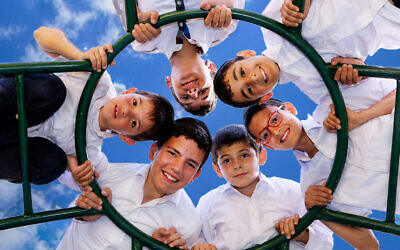
Parshat Terumah describes the Cherubim, the child-like images that sat on top of the Holy Ark: “The Cherubim shall have their wings spread upwards … their faces were each one towards his brother” (Shemot 25:20).
Elsewhere, however, the faces of these Cherubim are described as “their faces were toward the house” (Divrei HaYamim II:3:13).



Our Sages (Bava Batra 99a) note the seeming contradiction in the respective verses regarding the direction faced by the Cherubim. In the one they are described as facing one another, yet they are also described as facing the walls of the House of the Mikdash. They explain that they faced each other when they were “doing the will of Heaven” and faced away from each other when they were “not doing the will of Heaven”.
If when the Cherubim faced the “house” they were facing the walls of the Mikdash, why is that considered “not doing the will of Heaven”? Surely facing the walls of the holiest location in the world is something positive not negative?
The Ktav Sofer explains that if someone wants to truly do the “will of Heaven”, he can’t be focused solely on himself and his private spiritual aspirations. Hashem wants us to each personally ensure we actively care for our fellow with our faces gazing “toward [our] brother”.
If, however, our spiritual aspirations are limited to our “house” and we turn our back on and ignore the plight of our brothers and sisters, such selfish behaviour – no matter how cloaked with “spirituality” and “holiness” – is anathema to Hashem’s will. If you can’t hear the metaphoric cry of the Jewish baby, then your actions are not in consonance with what Hashem wants.
We need to be constantly aspiring to grow and have our spiritual “wings spread upwards” while simultaneously ensuring our eyes remain firmly focused on and locked into the needs of the other!
Rabbi Brendan Stern is at Hendon United Synagogue

Keep community journalism free.
Jewish News is free for everyone. No paywall. No barriers. Just trusted journalism for anyone who wants to stay connected to Jewish life in Britain.
If you value that, please support us.
From as little as £5 a month, you can help keep our journalism free and accessible to all.
Every day, we report on the issues that matter to our community. We celebrate achievements, support charities, challenge antisemitism and ensure Jewish voices are heard more widely.
From as little as £5 a month, you can help us continue to:
- Report on the stories shaping Jewish life in the UK and beyond
- Bring our community together through shared stories, events and campaigns
- Celebrate the people, culture and moments that define our community
- Support organisations doing vital work across Jewish Britain
You can make a one-off donation or become a regular supporter. Every contribution helps keep our journalism free, independent and accessible to all.
If everyone who values Jewish News gave a small amount, it would make a real difference to our future.