Prefer Jewish News on Google
Musician Ronnie Scott honoured with blue plaque by English Heritage
English Heritage bestowed the commemorative plaque ahead of the 60th anniversary of the opening of the first Ronnie Scott's club in Chinatown, Soho.
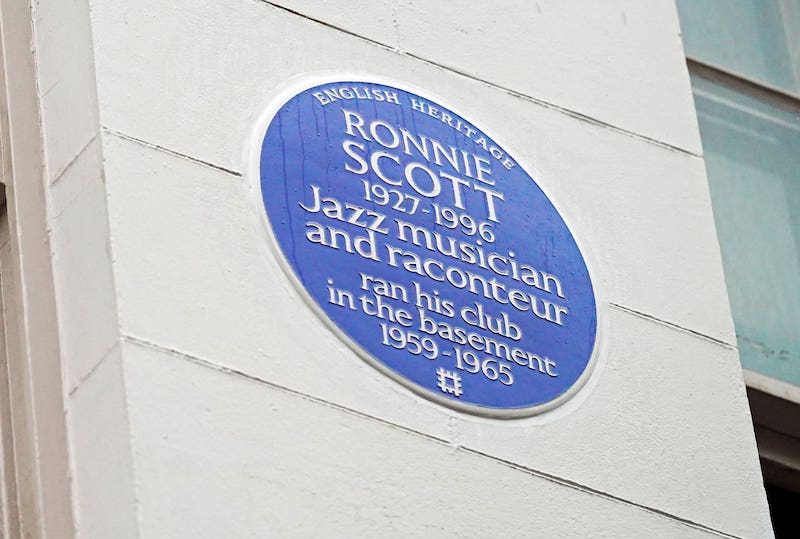
Jewish Jazz musician Ronnie Scott has been honoured with a blue plaque at the site of his first London club.
English Heritage bestowed the commemorative plaque ahead of the 60th anniversary of the opening of the first Ronnie Scott‘s club in Chinatown, Soho.
Scott, who was born ‘Ronald Schatt’ to Jewish parents in Aldgate, whose father was of Russian ancestry, and whose mother attended the Portuguese Synagogue in Alie Street.
The memorial, which describes Scott as a “jazz musician and raconteur”, was unveiled on Thursday to the sounds of Alex Garnett playing the musician’s iconic tenor saxophone while Scott’s widow watched on.
Mary Scott told the assembled crowd: “Ronnie received many accolades during his lifetime, each time he would chuckle with pleasure, feeling honoured, a little mystified and humbled.

“When awarded the OBE his only regret was that his mother wasn’t there to see it.
“The English Heritage blue plaque is the well-deserved jewel in the crown of recognition for his lifetime contribution to jazz.
“I am grateful to have lived long enough to see this happen and am overjoyed and honoured to be a part of the celebration.”
The original Ronnie Scott‘s bar was opened in the basement of 39 Gerrard Street on October 30 1959 with the help of a £1,000 loan from the musician’s step-father.
Scott, along with fellow saxophonist Pete King, originally built a small bandstand and brought in a baby grand piano.
They later refurbished the basement bar, which sits below what is now a Taiwanese restaurant, introducing built-in seating and dimly lit table lamps in a bid to emulate New York’s jazz clubs.
In 1961, Scott and King managed to break a ban on American jazz musicians travelling to the UK following negotiations with the Musicians’ Union and the American Federation of Musicians.
Californian jazz saxophonist Zoot Sims was the first American musician to enjoy a month-long residency at the club.
He was followed by artists such as Johnny Griffin, Roland Kirk, Dexter Gordon, Sonny Stitt, Stan Getz, Benny Golson, Ben Webster, and Al Cohn.
Early clientele included Harold Pinter, the Beatles, Peter O’Toole, and Spike Milligan.
Scott and King moved the club to its current, larger home at 47 Frith Street, Soho, in the summer of 1965.
The club’s managing director, Simon Cooke, said; “Ronnie Scott’s Jazz Club has led the way in British jazz for 60 years through its innovative programming and championing of the music and musicians.
“An English Heritage blue plaque is a fine acknowledgement of the contribution that Ronnie Scott himself made to the British jazz scene.”
The blue plaque scheme has been running for 150 years and was first proposed by William Ewart MP in 1863 in the House of Commons.
It has been run by English Heritage since 1986 when it took control of the scheme from the Greater London Council.

Keep community journalism free.
Jewish News is free for everyone. No paywall. No barriers. Just trusted journalism for anyone who wants to stay connected to Jewish life in Britain.
If you value that, please support us.
From as little as £5 a month, you can help keep our journalism free and accessible to all.
Every day, we report on the issues that matter to our community. We celebrate achievements, support charities, challenge antisemitism and ensure Jewish voices are heard more widely.
From as little as £5 a month, you can help us continue to:
- Report on the stories shaping Jewish life in the UK and beyond
- Bring our community together through shared stories, events and campaigns
- Celebrate the people, culture and moments that define our community
- Support organisations doing vital work across Jewish Britain
You can make a one-off donation or become a regular supporter. Every contribution helps keep our journalism free, independent and accessible to all.
If everyone who values Jewish News gave a small amount, it would make a real difference to our future.