Prefer Jewish News on Google
Campus fellowship is aimed at bridging Jewish-Muslim ‘dialogue gap’
Founders of an interfaith initiative tell Jewish News they are 'working hand in hand – yad by yad – to build a better future'
![Yad Fellowship Co-Founders Irfan Zaman [L] and Noah Katz [R]](https://static.jewishnews.co.uk/jewishnews/uploads/2025/04/y7DarBZF.jpeg "Yad Fellowship Co-Founders Irfan Zaman [L] and Noah Katz [R]")
For more than a year, it didn’t have a name. It was simply “Project X”, a placeholder for an idea quietly forming in Irfan Zaman’s mind. A space for dialogue. A platform for new voices. A response to the growing polarisation he saw sweeping across higher education, particularly among Jewish and Muslim students.
“I’d been working on it for a while,” said Zaman, CEO of SOAS Students’ Union. “It didn’t have a title or a structure. But I knew something was missing in the interfaith space, something fresh, something led by young people, something that wasn’t just reactive.”
The idea remained abstract until a pivotal moment at last year’s NUS conference. The atmosphere in the room was tense. A motion on Palestine was being debated, and what followed, as both Zaman and his future co-founder Noah Katz described it, was a stream of increasingly hardline interventions, from calls for BDS to personal attacks on UJS and Jewish students.
Katz, representing UJS at the time and now a public affairs lead at the Board of Deputies, was one of the only Jewish students to speak up. “I said, ‘I’m a proud Jewish student and I’m proud to be part of UJS,” he recalled. “And you could hear a pin drop. Ten minutes later, I left the room. My Apple Watch registered an unusually high heart rate, it thought I was having a heart attack.”
Zaman had been in the room, trying to facilitate the conversation. That moment, Katz’s calm but firm statement, and the silence that followed stayed with him.

“It was a turning point,” Zaman said. “I remember thinking: this is the counter-voice that’s missing. Not just in that room, but across our campuses. I reached out to Noah a few months later and said, ‘Would you want to be part of this?’ That’s how it all started.”
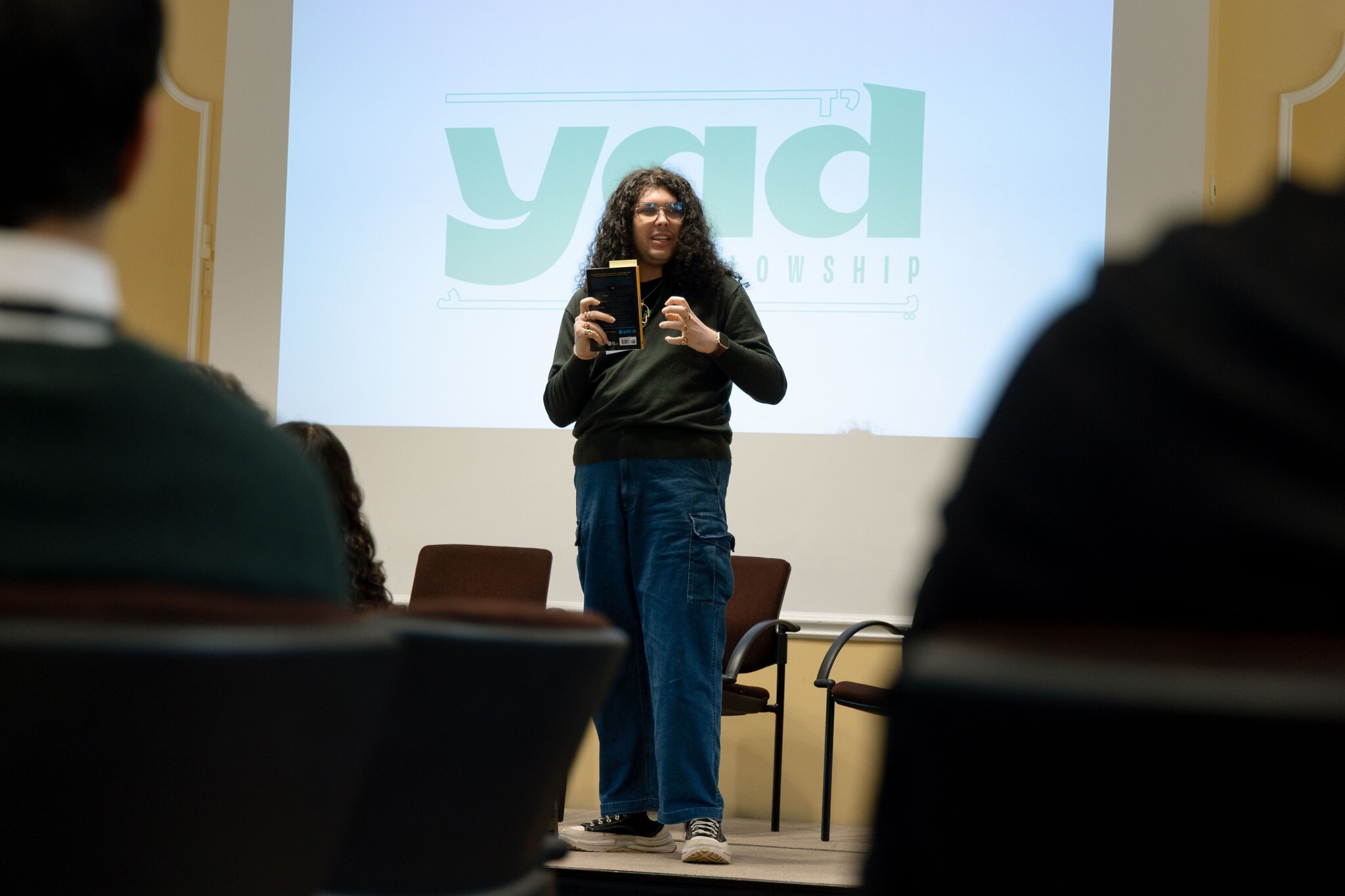
The result was the Yad Fellowship, which takes its name from the word “hand” in both Hebrew and Arabic, an interfaith initiative designed to bring Muslim and Jewish students together to challenge what its founders call “the dialogue gap”. Rather than fixate on geopolitical disagreements, Yad centres around emotional resilience, shared humanity, and leadership development.
“We’re not trying to be another Israel-Palestine fellowship,” said Katz. “This is about building a generation of leaders who can disagree constructively, who can stay in spaces that feel difficult, and who can model coexistence wherever they go, whether that’s Parliament, the pulpit or a campus common room.”
The programme launched with a two-day summit at Cumberland Lodge in March, attended by more than 40 student leaders, SU presidents, university staff, politicians and religious figures. In just six weeks, Zaman and Katz managed to secure support from the National Union of Students, SOAS Vice Chancellor Professor Adam Habib, Lord Mann, Laura Marks, Rabbi Charley Baginsky, Dr Lindsay Simmonds and several other prominent interfaith advocates.
“We wanted to show what was possible,” said Zaman. “This wasn’t a vague ideal. We created a space where students, university executives and religious leaders were in the same room, listening, challenging, learning. That doesn’t happen very often.”

It was, by all accounts, an intense but hopeful event. Participants included students leaders from Warwick, Leeds, LSE, Bristol, Liverpool and beyond, many of whom said they never had an interfaith conversation that didn’t feel defensive or forced. The Fellowship’s success, its founders say, lies in how it was structured: carefully, intentionally, and above all, co-created.
“We’re building this with students, not for them,” said Katz. “We’re starting with the most willing and able to be in the room. This isn’t about throwing everyone into a dialogue circle and hoping for the best. It’s about building trust and scaling it outward.”
Zaman agrees. “If we had tried to bring everyone together from the start, every voice, we’d sink the Fellowship on day one. So, we began with people who were ready. And they’ll take what they’ve learned back to their campuses.”

The programme is grounded in a set of “belonging principles”, aimed at anchoring students in shared humanity before they tackle complex topics like antisemitism, Islamophobia and Israel-Palestine. Conversations are deliberately challenging but held within a framework that values respect over rhetoric.
“Dialogue on campus has become impossibly binary,” said Katz. “It’s gone from ‘I’m right, you’re wrong’ to ‘I’m right, you’re evil’. We’re trying to change that.
We’re not teaching people to debate. We’re giving them the skills to listen, respond, and remain human in the process
Although overwhelmingly positive, the summit wasn’t without difficult moments. One session became particularly heated, but what followed reinforced why Yad’s approach works.
“We had expert facilitators who could steer it back, not shut it down,” said Zaman. “It wasn’t about smoothing things over, it was about holding the tension and still ending up with something constructive. In a different setting, that conversation could’ve derailed everything. But here, it became proof of concept.”
Much of the programme’s success comes from its intentionality. From the carefully selected cohort to the training sessions and even the name itself, everything is steeped in the idea of doing with care, yad by yad, as Katz puts it.
“We are not rooted in legacy institutions,” he said. “We’re not bound by organisational baggage. We’re building this as members of our own communities, authentically together.”
Both Zaman and Katz are already looking ahead. They hope to formalise the Fellowship as an academic-year programme with around 20 participants annually, mainly Jewish and Muslim students, but with some room for others from minoritised backgrounds and different faiths. The age group, 18-25, is deliberate.
“There are brilliant organisations working with under-18s and community dialogue,” said Zaman. “That’s not our focus. Our expertise is in higher education; that’s the best space we’re best placed to impact. And we want to be honest about where we can make change.”
The vision is clear: a network of alumni who go on to lead, on campuses, in politics, in faith spaces, with empathy and conviction. They hope to see future Yad fellows making real change in their communities, influencing legislation, challenging extremism, and reshaping how dialogue happens in public life.
“What we’re trying to give them is the emotional resilience to exist in difficult spaces,” said Katz. “To know how to handle themselves and others. To recognise that they belong.”
Zaman added: “They need to know the power they have and that the political culture they’ve inherited isn’t one they have to stick with. The future is theirs to shape. It’s theirs to lead.”

Keep community journalism free.
Jewish News is free for everyone. No paywall. No barriers. Just trusted journalism for anyone who wants to stay connected to Jewish life in Britain.
If you value that, please support us.
From as little as £5 a month, you can help keep our journalism free and accessible to all.
Every day, we report on the issues that matter to our community. We celebrate achievements, support charities, challenge antisemitism and ensure Jewish voices are heard more widely.
From as little as £5 a month, you can help us continue to:
- Report on the stories shaping Jewish life in the UK and beyond
- Bring our community together through shared stories, events and campaigns
- Celebrate the people, culture and moments that define our community
- Support organisations doing vital work across Jewish Britain
You can make a one-off donation or become a regular supporter. Every contribution helps keep our journalism free, independent and accessible to all.
If everyone who values Jewish News gave a small amount, it would make a real difference to our future.