
 Prefer Jewish News on Google
‘Once in a lifetime discovery’ of Roman-era statues in Israel archaeological dig
The two marble busts, one bearing a Greek inscription with the name 'Lycurgus' were found during a dig in Binyamina, near the former Roman centre of Caesarea
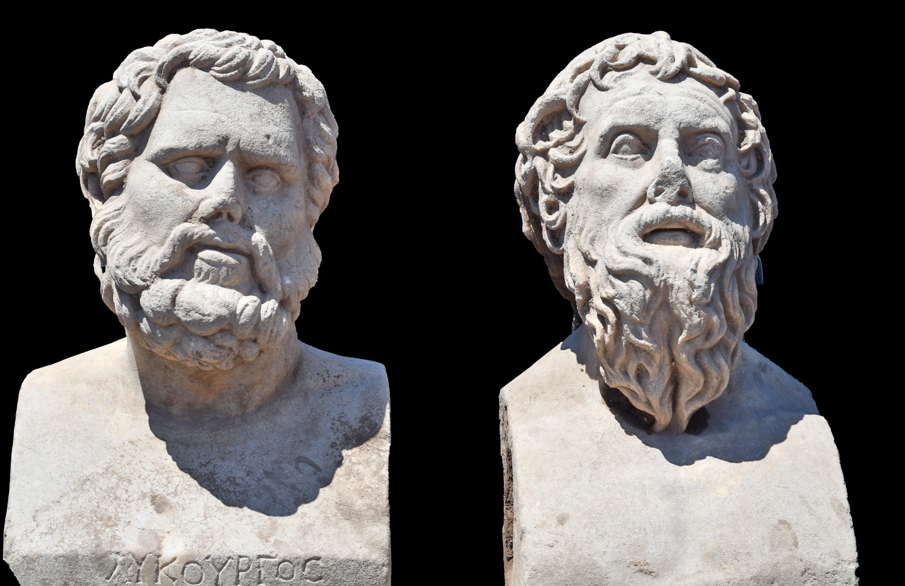
Two Roman era marble statues hailed as a “once in a lifetime discovery” have been found during an archaeological dig near Caesarea, with the Israel Antiquities Authority describing them as the first of their kind to have been uncovered in the area for decades years.
The statues, which are due to be presented publicly this week at an archaeological conference at the Eretz Israel Museum in Tel Aviv, were found during the excavation of a Roman-Byzantine period winepress at the archaeological site of Binyamina. One of the statues bears an inscription in Greek – the name “Lycurgus”.
Michael Sorotskin, archaeologist for the Israel Antiquities Authority, described how “while digging [out] the winepress, something was sticking out of the ground, and the workers called me.
“There was a feeling that we were about to discover something that really shouldn’t be there. Suddenly we saw that this was not the usual pottery – it was marble! Then, slowly, slowly, the two statues were revealed. I’m still struggling to find the right words. It is simply wondrous.”
Eliran Oren and Avishag Reiss, excavation directors on behalf of the Israel Antiquities Authority, described how the statues “were not discovered in situ where they once stood.



“Mysteriously, they were found neatly laid, face down, inside a wine-collection pit…meaning they were buried when it went out of use. At present, it is not known why the statues were hidden here – perhaps to preserve them.”
The discovery was made on the final day of excavating the site, with Oren and Reiss describing the find as “a once-in-a-lifetime discovery.
“It was very unexpected”, they added, “but somehow, the really big discoveries always turn up on the excavation’s very last day.”
Caesarea was the centre of Roman life in what was originally named the province of Judea, prior to the ethnic cleansing of Jews by the Romans under the Emperor Hadrian, when the empire renamed the area “Syria Palaestina”.
Dr Peter Gendelman, a Caesarea region expert from the Israel Antiquities Authority, said that “during the Roman period, statues of this type were displayed both in public buildings and in the homes of the elite, who sought to connect themselves to the cultural and spiritual world of antiquity. Not far from the discovery site, remains of a bathhouse were previously uncovered, and it is possible that the statues decorated a luxurious villa of a Caesarea resident.”
Dr Gendelman said that “The last time such a figure was discovered here was in the 1990s. One protome bears a Greek inscription preserving the name of Lycurgus. Two significant people with this name are known from Greek history – Lycurgus of Sparta, its founder; and Lycurgus of Athens, a famed 4th century BCE statesman and orator. Possibly this statue may prove to be of one of these two historical figures, but our research is just beginning.”
Gil Omer, Director General of the Eretz Israel Museum, Tel Aviv, also known as MUZA said: “It is not every day that 1,700-year-old marble statues are uncovered in such an impressive state of preservation. We are proud to be the place where the public will be able to encounter this extraordinary discovery for the first time, and to continue seeing it after the conference as well.
“Presenting the statues in MUZA’s Ceramics Pavilion is a rare opportunity to introduce visitors to an exceptional archaeological find shortly after its discovery, and to connect them with a fascinating story.”
The archaeological conference at MUZA this week is the product of a collaboration between the museum itself, the Israel Antiquities Authority Central Region, the Sonia and Marco Nadler Institute of Archaeology at Tel Aviv University, and the Institute of Archaeology of the Martin (Szusz) Department of Land of Israel Studies and Archaeology at Bar-Ilan University.

Keep community journalism free.
Jewish News is free for everyone. No paywall. No barriers. Just trusted journalism for anyone who wants to stay connected to Jewish life in Britain.
If you value that, please support us.
From as little as £5 a month, you can help keep our journalism free and accessible to all.
Every day, we report on the issues that matter to our community. We celebrate achievements, support charities, challenge antisemitism and ensure Jewish voices are heard more widely.
From as little as £5 a month, you can help us continue to:
- Report on the stories shaping Jewish life in the UK and beyond
- Bring our community together through shared stories, events and campaigns
- Celebrate the people, culture and moments that define our community
- Support organisations doing vital work across Jewish Britain
You can make a one-off donation or become a regular supporter. Every contribution helps keep our journalism free, independent and accessible to all.
If everyone who values Jewish News gave a small amount, it would make a real difference to our future.





















