Prefer Jewish News on Google
OPINION: Embrace of Tommy Robinson exposes painful rift
That Tommy Robinson, of all people, can walk into Israel and be cheered as a hero perhaps says less about him and more about the state of the world
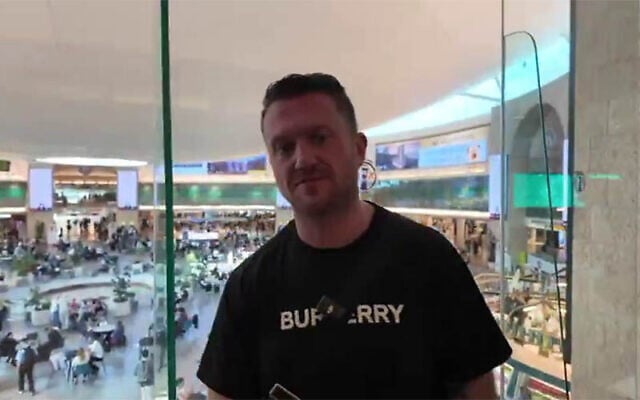
The atmosphere was electric. Over a thousand Israelis, on their feet, chanting in true English football fan style, “Oh Tommy, Tommy! Tommy, Tommy, Tommy, Tommy Robinson!”
It was surreal. Britain’s most controversial street activist, a man who has spent over a decade fighting accusations of far right, racism, and antisemitism, being given a rock star welcome, and hailed as a hero.
Tommy Robinson was in Israel at the invitation of the Israeli government. Amichai Chikli the Israeli Minister for Diaspora Affairs, the man whose job is to engage and align with Jewish communities abroad, called Robinson, “a courageous leader on the front line against radical Islam,” while the Board of Deputies and Jewish Leadership Council branded Robinson “a thug who represents the very worst of Britain.” So not exactly on the same page
You could feel the dissonance between the cheers of Israelis who see Robinson as a courageous truth-teller and an ally, and the deafening silence of British Jews watching from afar, horrified, insulted, or at best, deeply uncomfortable.
Tommy Robinson is nothing if not convincing. Charismatic, slick, armed with statistics, albeit, not always accurate, and self-belief, he commands the stage and knows how to work a crowd.



He presents himself as an investigative journalist, and rejects the label of far-right anti-Islam activist. He presents his documentary series ‘The Rape of Britain’ as evidence of his journalistic credibility, one who is prepared to speak out and take on issues that the main stream media simply won’t.
He frames himself as the outsider who stood up to grooming gangs, the establishment, and now, to antisemitism. When challenged about his 2022 piece The Jewish Question, where he claimed Jews “have outsized influence in media and politics”, he brushed it off as “truth, not hate.”
When asked about antisemitism in the English Defence League, the movement he founded, he cited the Jewish division, the black division and the LGBT division in the organization. When it was pointed out that the leader of the Jewish division left due to Nazi elements, Robinson said he left the EDL for similar reasons. Indeed, the reason he gave at the time was the “dangers of far-right extremism”.
He also pointed out that he is attacked vociferously from the extreme right and the left in equal measure. He’s always got a comeback, which he delivers it with such certainty, such unflinching conviction, it pulls you in.
For the Israeli right, Robinson is the kind of ally you can take to war. He speaks their language, blunt, populist, emotional. He rails against Islamist extremism, the hypocrisy of Western elites, and the corruption of the media.
And let’s be honest, Israel needs allies. European governments wobble, the UN sneers, and much of the Western left has turned its back. So, when someone like Robinson who can get hundreds of thousands out on the streets of Britain, stands up and says, ‘I support Israel’, the instinct is to welcome him with open arms. And this is not entirely new. As the left has drifted deeper into anti-Israel rhetoric, even obsession, Israel has been cosying up to right-wing and even far-right governments in Europe for some time now.
But this embrace puts Israel squarely at odds with British Jewry. The Minister for Diaspora Affairs, the man tasked with building bridges with the global Jewish community, could be perceived as lighting bonfires instead. Perhaps though, Chikli isn’t the one being reckless. Maybe he sees something the polite, cautious Jewish establishment refuses to admit, that while, rough around the edges, and despite his past, Tommy Robinson speaks to an anger bubbling just below the surface, in Israel, in Britain, in the West.
The Jewish Community leadership in the UK has made its position clear. In The Independent, David Aaronovitch called Robinson “division in human form.” In Jewish News, Raoul Wootliff wrote: “Go back to where you came from, Tommy, you are not welcome in Israel.” Wootliff also staged a one-man demonstration at the Tel Aviv event, shouting out “Tommy Robinson is a racist.” He was unceremoniously evicted from the hall.
In the Jerusalem Post, Daniel Goldman wrote “Robinson’s credibility is fatally undermined by his criminal record.” He goes on to question Robinson’s honesty, and his suitability as an ally. Meanwhile, open rows inside British Jewry, show a community divided over representation and strategy.
The truth is, many British Jews no longer believe the Board of Deputies represents them adequately. Its diplomatic, softly-softly approach, endless meetings, press releases, and polite rebukes feel toothless in a country where antisemitism has exploded since 7 October.
Two Jews were murdered in a terror attack outside a synagogue in Manchester. Jewish fans have been banned from a football match in Birmingham because police “can’t guarantee their safety.” Is Birmingham to become a no-go area for Jews? Today in the UK, Jews are spat at, harassed on their way to school, assaulted on the street, both verbally and physically, and more.
The established leadership issues statements and expresses “deep concern.” It’s not enough. So, when Robinson storms onto the scene, strong unapologetic, uncompromising, defiant. It’s no wonder that some Jews may be encouraged by the thought that they are not alone, and that someone is fighting back on their behalf.
When asked why he thinks knows better than the UK Jewish leadership. Robinson answers clearly, “This is no time for weakness.”
But is Tommy Robinson the right man to fight their battles?
He gets things done. He’s unafraid, forces issues into the light, and doesn’t back down. But his style is head-on, confrontational, messy, and often drags uninvolved into the fight, not just the guilty. He says what others won’t, but sometimes that’s the problem. His war on Islam doesn’t always stop neatly at extremists. Most Jews are uncomfortable with such a level of confrontation and don’t want to be caught in the crossfire.
There’s also the question of motive and intent. Is this genuine solidarity with Jews, or a convenient vehicle and well-timed reinvention for a man once photographed alongside neo-Nazis?
Still, that Tommy Robinson, of all people, can walk into Israel and be cheered as a hero, perhaps says less about him, and more about the state of the world. How desperate Israel is for allies. How fearful and disillusioned British Jews have become.
It’s easy to dismiss him as a grifter. It’s harder to admit that he’s saying what many are thinking, but are too afraid to say out loud, that Britain is changing, that antisemitism is out of control, and that those tasked with protecting Jews are out of their depth.
Tommy Robinson has found a stage where his message lands, not because he’s pure, or has changed, rather, because the moment in the West is broken. He speaks to the fear, the anger and the frustration.
He may be sincere, or he may be hustling. Either way, he’s what happens when fear, fury and frustration create unlikely allies. The question for UK’s Jews and for Israel isn’t so much, is my enemy’s enemy my friend, but who exactly is my enemy, and who is my friend?

Keep community journalism free.
Jewish News is free for everyone. No paywall. No barriers. Just trusted journalism for anyone who wants to stay connected to Jewish life in Britain.
If you value that, please support us.
From as little as £5 a month, you can help keep our journalism free and accessible to all.
Every day, we report on the issues that matter to our community. We celebrate achievements, support charities, challenge antisemitism and ensure Jewish voices are heard more widely.
From as little as £5 a month, you can help us continue to:
- Report on the stories shaping Jewish life in the UK and beyond
- Bring our community together through shared stories, events and campaigns
- Celebrate the people, culture and moments that define our community
- Support organisations doing vital work across Jewish Britain
You can make a one-off donation or become a regular supporter. Every contribution helps keep our journalism free, independent and accessible to all.
If everyone who values Jewish News gave a small amount, it would make a real difference to our future.