Prefer Jewish News on Google
OPINION: It’s time to stop pretending that our community is united
Yesterday's events show British Zionists have split into two main tribes. This must be recognised and accepted, rather than ignored
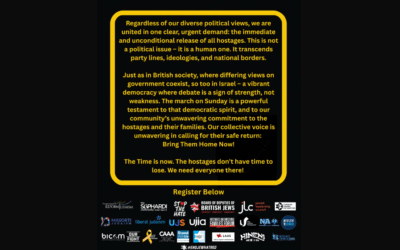
Late last week, a few days prior to the Jewish communal march in central London, new language advertising the event was published.
“Regardless of our diverse political views” the new statement said, “We are united in one clear, urgent demand: the immediate and unconditional release of the hostages. This is not a political issue – it is a human one. It transcends party lines, ideologies and national borders.
“Just as in British society, where differing views on government co-exist, so too in Israel, a vibrant democracy where debate is a sign of strength, not weakness.”
It went on to call the planned march on Sunday “a powerful testament to that democratic spirit.”
This language was markedly different in tone to that which had originally been expressed by mainstream communal organisations. The earlier implication had been that the march would be one which would unequivocally tell the British government that it would be a profound betrayal to recognise a Palestinian state without the preconditions of Hamas disarming and the hostages being freed. The new poster, which also listed organisations associated with the event, had seen one group, Herut UK, removed – suggesting that the phrase “regardless of our political views” should have included the words “terms and conditions apply” in parentheses.


Suspicions were raised that the new language was an attempt to patch together a coalition which was fraying at the seams. There were rumours that some in Progressive denominations had been deeply unhappy with how the march had previously been presented. No matter – the cracks had now been painted over, and the event could proceed without a hitch.
Except, of course, that this was not what happened.
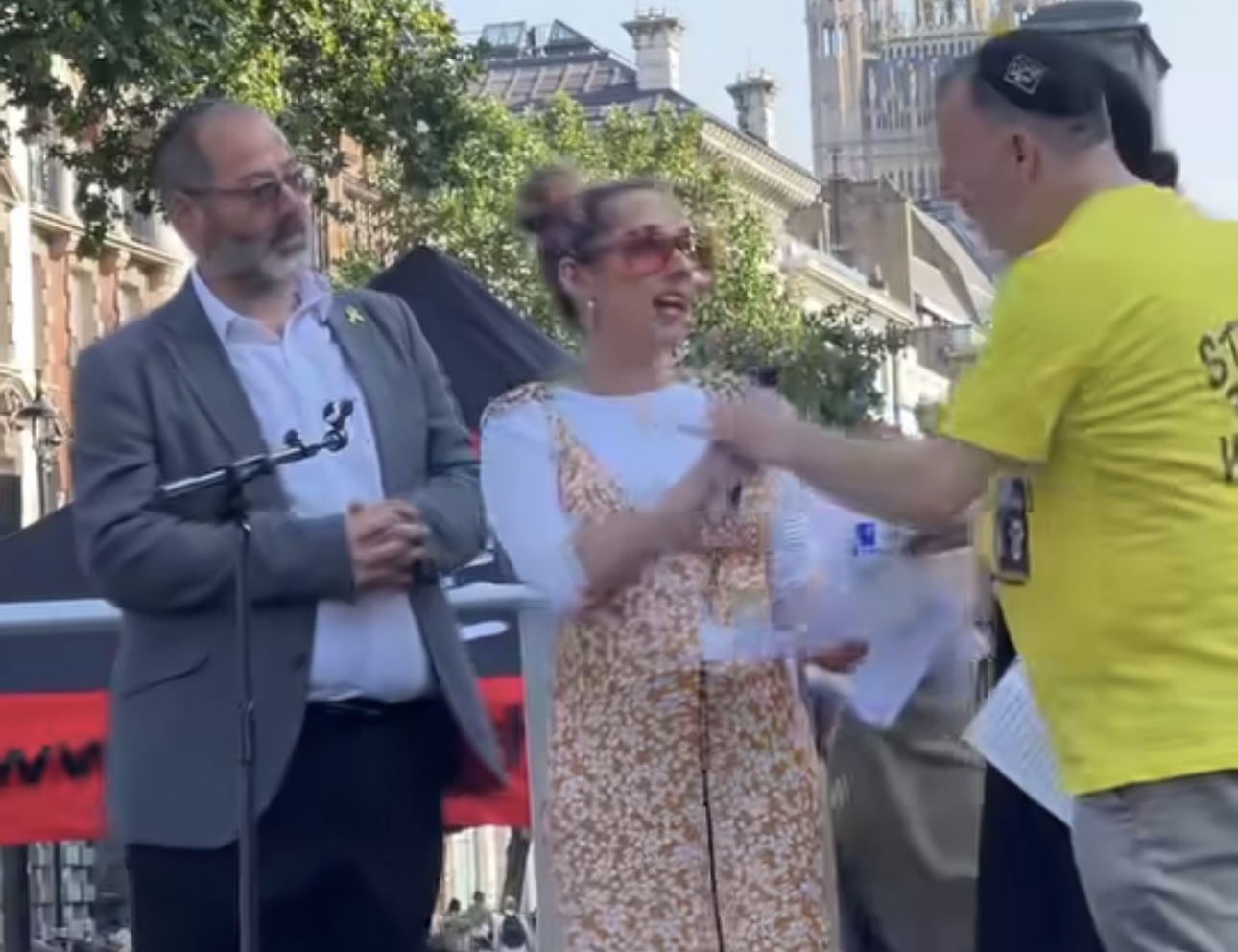
As we know, the co-CEOs of Progressive Judaism – Rabbi Charley Baginsky and Rabbi Josh Levy – were heckled increasingly loudly by the crowd as they gave their joint speech – culminating in representatives of one of the organising groups, Stop the Hate, getting up on stage and asking the two Rabbis to leave it.
This deeply unfortunate situation may well have exposed an awkward but fundamental truth. Perhaps it is time for us all to stop pretending that our community – and by that I don’t mean those anti-Zionists on its outermost fringes, but those who define themselves as Zionists – is united. We are not. Two main groups, or tribes, have effectively formed – A and B. There are, of course a number of people who sit in between (I would place myself here), but these two new blocs effectively operate as follows.
Tribe A believes that the core beliefs and ideas that Israel and Zionism were founded on are now being continuously chiselled away by the actions of the Israeli government, which contains a rogues gallery of bigots and mindless yes-men, presided over by a deeply cynical megalomaniac. While understanding that a military operation was necessary in the immediate aftermath of 7 October, Tribe A has become increasingly disillusioned with the way it has proceeded – and in recent months has become considerably more vocal in that dissatisfaction. They do not understand people in Tribe B, whom they perceive to be either ignorant zealots or seemingly intelligent people completely blinded by their deep emotional ties to Israel and therefore unwilling to accept, for example, that war crimes have been committed in Gaza. They are also frustrated with those who will fundamentally agree with them in private but who advise them that speaking up is counterproductive as it will reveal a divided community and provide ammunition to those who truly are Israel’s enemies.

For Tribe B – and this includes people who previously would have counted themselves as liberal in outlook – 7 October changed everything. Hamas ran amok, murdering at will and dragging 250 hostages into captivity. As far as Tribe B is concerned, that demonstrated, unambiguously and conclusively, what the future is for Israel’s seven million Jews – and more than a few of its Arab population as well – if a Palestinian state is allowed to come into existence. They believe that the Palestinians – whether via Hamas, or some new infernal terror organisation which has yet to come into being – will use all the means at their disposal to wipe out Jewish life in the land of Israel. They believe that every resource the Palestinians are given will be used by the Palestinians towards that singular end point – with the behaviour demonstrated by Hamas in almost two decades of governing the Gaza Strip as the clearest example imaginable. And they are stunned – and more than a little sickened – that the wider world, a procession of Western governments, and the people in Tribe A cannot see what to them is so obvious. They view Tribe A as being more concerned with perceptions – how non-Jews view them – than with reality. They also deeply resent what they see as condescending language about how the Jewish community needs to be “brave” and recognise “the truth” of the situation. As far as they are concerned, they are the ones who understand the truth of the situation.

For both these Diaspora tribes, Israelis themselves are often treated as a tool, to be used when convenient, ignored when not. Tribe A will point to the regular polling of the Israeli population which shows that approximately three quarters of Israelis support an end to the war and a deal which brings back all the hostages. They are somewhat less keen on citing Israeli public opinion on a two-state solution, or on the recognition of a Palestinian state – because the numbers are far less positive. Tribe B are eager to highlight the viewpoints of Israelis who agree with them. They are less enamoured by discussion of the long – and growing – list of former heads of the Shin Bet, Mossad and IDF Chiefs of Staff who oppose the continuation of this war.
The friction comes when attempts are made to join both tribes together in a semblance of communal unity. Sunday’s rally was announced as a rally for the hostages – but both tribes interpreted that differently. Tribe A felt – particularly in the wake of the Israeli cabinet’s decision last week to fully occupy the Gaza Strip – that a failure to criticise the Israeli government decision would be a profound betrayal of the hostages. The Hostages and Missing Families Forum in Israel has, after all, itself strongly condemned the Israeli government’s stated intent to occupy all of Gaza. Tribe B felt that discussion of this point was an attempt to divert attention away from the plight of the hostages themselves, and that while tens of thousands of Israelis may have marched against the Israeli government’s position, that this was a march to protest the British government’s position.
Tribe A saw the removal of the rabbis from the stage as an utter disgrace, and proof that the community has been overrun by extremists. Tribe B viewed the speech by the rabbis as being out of touch and an utter failure to read the mood of the crowd, viewing the subsequent rabbinical ejection as an unfortunate but understandable reaction.
Perhaps the time has now come for the community to admit that it is divided. That though people may love Israel – and consider themselves to be proudly Zionist – the ways in which they express that love and that pride are increasingly different.
You may argue that the small size of the community here means that unity is more important than ever. That is certainly a position which can be respected. But if the current situation in Israel and Gaza continues – for months, maybe even for years – attempts to pretend that unity prevails are bound to continuously culminate in situations like that experienced yesterday.
Far better, perhaps, to openly acknowledge such differences – maybe even find a way to debate or discuss them in a context of mutual respect – than to simply continue to pretend that they do not exist.

Keep community journalism free.
Jewish News is free for everyone. No paywall. No barriers. Just trusted journalism for anyone who wants to stay connected to Jewish life in Britain.
If you value that, please support us.
From as little as £5 a month, you can help keep our journalism free and accessible to all.
Every day, we report on the issues that matter to our community. We celebrate achievements, support charities, challenge antisemitism and ensure Jewish voices are heard more widely.
From as little as £5 a month, you can help us continue to:
- Report on the stories shaping Jewish life in the UK and beyond
- Bring our community together through shared stories, events and campaigns
- Celebrate the people, culture and moments that define our community
- Support organisations doing vital work across Jewish Britain
You can make a one-off donation or become a regular supporter. Every contribution helps keep our journalism free, independent and accessible to all.
If everyone who values Jewish News gave a small amount, it would make a real difference to our future.