Prefer Jewish News on Google
OPINION: The Abraham Accords – under fire but built to last
On the Accords' fifth anniversary, Emirati author and strategist Amjad Taha describes how despite efforts by Hamas and other Islamist groups, the light of the Accords refuses to dim
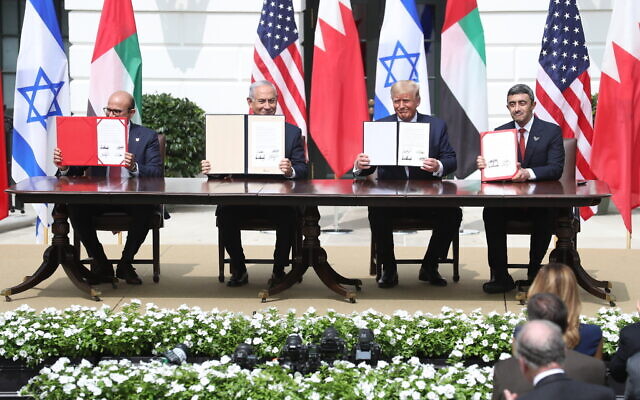
In 2020, when the Abraham Accords were signed, many people looked at it and saw what they thought would be a temporary, fragile pact, easily swept away by the winds of conflict. Instead, it has become the single most resilient bridge of diplomacy in a region where bridges are often burned. In a time of darkness, when terror struck on October 7, the accords stood as an anchor reminding the world that peace, once born, does not surrender easily.
People understood the meaning of travel when skies were closing. When members of Congress in Washington or parliamentarians in Canberra could not find flights to Israel, when airlines suspended services, FlyDubai never stopped. It carried passengers across closed skies, offering not just transport but a lifeline of truth. In February 2025 alone, more than 1,083,000 international passengers moved through Ben Gurion Airport, a rise of 55 percent on the previous year. Nearly 99,000 of them traveled between Dubai and Tel Aviv, an air corridor of resilience.
People follow the money as much as the skies. Trade between the UAE and Israel, once nonexistent, reached 6.44 billion dollars between 2021 and 2024. With the Comprehensive Economic Partnership Agreement, the goal is clear: 10 billion dollars in bilateral trade within five years. For the UAE, that means almost 2 billion dollars added to its GDP by 2030. For Israel, it means access to capital, technology, and markets once unimaginable. For both, it signals a future tied not by slogans but by supply chains.
People also know peace has enemies. Islamist movements Hamas in Gaza, the Muslim Brotherhood networks in Sudan, Hezbollah and al-Qaeda operatives on the Red Sea are working to sabotage the train of accords. Port Sudan, still hostage to a Brotherhood-led army, has become a hub for weapons, drugs, and terror finance. Captagon shipments are routed through its docks, seizures in recent years have confirmed Sudan as a growing transit point for the narcotic, with chemical precursors entering through porous borders. Hezbollah facilitators and al-Qaeda cells use the same routes, working with Houthi allies across the Red Sea. What should be a port of trade is now a theatre of terror. For many in the region, Port Sudan has earned a new name: the Hamas of Africa.
People are not blind to this danger. The United States has already named Sudan’s minister of economy and senior army figures as directly tied to Iran and terrorist networks. Washington warned that instability there is being manufactured, not accidental, and driven by alliances with Islamist actors who profit from war. The picture is stark: Sudan’s economy and ports risk being repurposed as staging grounds for drugs, weapons, and the planning of atrocities. This is where the next October 7 could be seeded, not in shadows, but in plain sight. What extremists hoped would derail the accords has instead exposed the scale of the threat and strengthened the resolve to confront it.



People know every challenge forces the project forward. In 2026, expansion will define the accords. More states, from the Middle East to Asia, are expected to join. Early talks are already surfacing in UN corridors, with Syria quietly placed on the horizon for 2025. What began with the UAE, Bahrain, Morocco, and Israel will not remain confined, it will spread.
People in Gaza already saw the results. Because of the accords, the UAE was able to coordinate directly with Israel and open humanitarian channels that would otherwise have been far more challenging. Nearly 50,000 tonnes of relief have been delivered, including food, medicine, and shelter equipment. Over a thousand patients, many of them children with cancer, have already been airlifted to Abu Dhabi for treatment, and the number continues to rise. The UAE built a 150-bed field hospital in Rafah, staffed with more than 100 doctors and nurses, and has installed two large desalination units capable of producing 600,000 liters of clean water daily. Power generators were sent to restore electricity to medical centers, while humanitarian corridors carried blankets, tents, and emergency equipment. All of this was only possible because the accords created the trust and coordination needed to act quickly and at scale.
People of faith draw strength from scripture. The Qur’an reminds: “Whoever saves one life, it is as if he had saved all of mankind.” (5:32). The Torah commands: “Seek peace and pursue it.” (Psalm 34:14). These are not competing truths but converging ones, echoing the very spirit of the accords.
People sometimes ask if optimism is naïve. The truth is sharper: optimism is strategy. The accords are not a candle in the storm, they are the storm that sweeps away despair. And perhaps, with a smile, one day the busiest checkpoints in the region will be the ones guarding queues for trade expos and concerts, not borders of war.
People know this much: the Abraham Accords are not an agreement signed in 2020, they are a promise being lived in 2025, a promise that refuses to end.

Keep community journalism free.
Jewish News is free for everyone. No paywall. No barriers. Just trusted journalism for anyone who wants to stay connected to Jewish life in Britain.
If you value that, please support us.
From as little as £5 a month, you can help keep our journalism free and accessible to all.
Every day, we report on the issues that matter to our community. We celebrate achievements, support charities, challenge antisemitism and ensure Jewish voices are heard more widely.
From as little as £5 a month, you can help us continue to:
- Report on the stories shaping Jewish life in the UK and beyond
- Bring our community together through shared stories, events and campaigns
- Celebrate the people, culture and moments that define our community
- Support organisations doing vital work across Jewish Britain
You can make a one-off donation or become a regular supporter. Every contribution helps keep our journalism free, independent and accessible to all.
If everyone who values Jewish News gave a small amount, it would make a real difference to our future.