Prefer Jewish News on Google

OPINION: Universities risk tragedy by failing to move proactively against extremists
There seems to be an attitude at UK universities that unequivocally extremist actions by some of its students are a trial to be weathered, rather than a problem to be faced down.
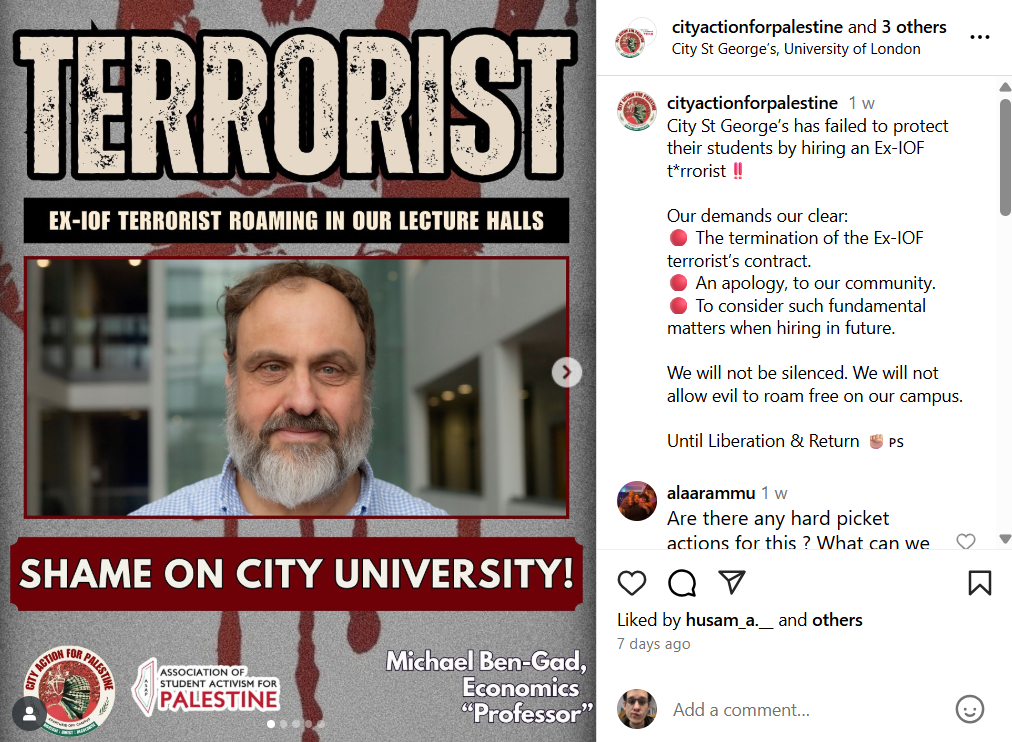
Last week, an organisation calling itself “City Action for Palestine” launched a campaign against an Israeli academic at City St George’s University of London, Michael Ben-Gad. On social media, it described him as a “terrorist” and “evil”. It demanded that Ben-Gad be fired, that the university “apologise” for employing him and that the institution “consider such fundamental matters when hiring in future”.
For this group, Ben-Gad’s “crime” is that he is an Israeli. The group sought to rudimentarily dress this up – citing his IDF service in the 1980s, which overlapped with the 1982 Lebanon War – but gave the game away when they described his time as a lecturer at the University of Haifa, where almost half the students are Arab, as “six years working in a genocidal society”.
On Friday, the group held a sit-in demonstration in one of the main thoroughfares inside a university building. Activists with their faces hidden by keffiyehs – except in one case where a participant was inexplicably wearing a motorcycle helmet – screeched anti-Israel slogans and repeated the claim that “there is a terrorist on campus”.
This Wednesday, they upped the ante, disturbing a lecture given by Ben-Gad, accusing him of having blood on his hands. The Professor told Sky News that one of those who disrupted his lecture “made a threat about having my head chopped off.”
This is, as more than one thousand academics have described in an open letter written in Ben-Gad’s defence, “targeted harassment”. The university, to its credit, as Ben-Gad himself has made clear, has supported him. It provided extra security for his classes – that security was evident in a video showing the protestors being removed from the lecture theatre – and even offered him a period of paid leave. Two admirable defensive measures.



What they appear to have completely failed to have done – at least so far – is to take any proactive measures, specifically, holding any of the students who are part of “City Action for Palestine” accountable for their actions.
On Monday, Jewish News contacted the university, specifically asking “What action will be taken by the university against those from this society encouraging targeted harassment of a university employee? The response from the university on Tuesday included the declaration that “the university will not tolerate the harassment of its staff and students. We reject the unlawful actions of this small group of individuals that is neither affiliated with the university nor its students’ union.”
On Wednesday, Ben-Gad’s lecture theatre was invaded and, in his own words, one student made a direct death threat towards him.
The standard definition of ‘not tolerating’ something is to make sure that it may not continue. “City Action for Palestine” is clearly made up of current students at the university – their statements have included the line that “we will not allow evil to roam free on our campus.” Note the “our” in that sentence. Yet there have been no announcements by the university of any form of punitive action against the students in question.
There seems to be an attitude among university administrations in this country that unequivocally extremist actions by some of its students are a trial to be weathered, rather than a problem to be faced down. When confronted with the fact that societies founded and led by their students – and even including the institution’s name in the title – are engaged in utterly repulsive behaviour, universities have sought to hide behind the fact that such groups are not “official” university societies, as if this means it is not their “official” problem.
Take the situation earlier this month at Goldsmiths (also part of the wider University of London). “Goldsmiths for Palestine” announced that they would be marking the second anniversary of 7 October with “a night of remembrance and resistance” – the “remembrance” was not, of course, in reference to the 1,200 men, women and children murdered by Hamas on that date. No, that was the “resistance” part.
The university’s response was entirely indicative of the ‘don’t rock the boat’ thought process which has been allowed to take hold in so many academic administrations. It noted that “Goldsmiths for Palestine” had no official status as a student organisation at the university and that the event was taking place off campus. Problem solved, apparently! It may not surprise you to learn that when “Goldsmiths for Palestine” occupied one of the university’s buildings for a few weeks last summer the institution humiliatingly caved in to a series of demands from the group, literally putting these on its own website. So, not an official university organisation then – just one with the power to force the college authorities to cave in to its demands.
Michael Ben-Gad has indicated his determination to carry on teaching, despite the efforts of those whom he accurately describes as “brownshirts”. He has said that his “main concern is for people who are far more vulnerable than I am, and I mean particularly Jewish students who have been targeted all over the country.”
In that regard, too, university responses have been sluggish. On Saturday 11 October, a student at Oxford University, Samuel Williams, led pro-Palestinian marchers in London in a chant which he said “we’ve been workshopping in Oxford… ‘Gaza, Gaza, make us proud, put the Zios in the ground’”. By late afternoon on Monday 13 October, he had been publicly identified. National papers published his identity. And yet it still took another 24 hours for Oxford to confirm that they had suspended a student – at the same time as the police announced that an arrest had been made.
The Prime Minister criticised the university for dragging its feet – and he wasn’t wrong. Having seen the video, university authorities would have doubtless known far earlier than most exactly who this was – and yet they appear to have waited until an arrest had been made to take any kind of action. This made it seem that if he had not been arrested, they may have taken no action at all.
The Jewish community in this country has been begging the authorities in this country to clamp down on the hideous rhetoric and aggressive hate marches which have been allowed to fester, warning that it would lead to tragedy. Almost three weeks ago, this is exactly what happened in Manchester. British Jews have also been pleading with university authorities to clamp down on the rampant intimidation of Jews on campus, which has similarly been allowed to take place virtually unchecked.
Do we really have to wait for another unspeakable horror before they too are moved to act?

Keep community journalism free.
Jewish News is free for everyone. No paywall. No barriers. Just trusted journalism for anyone who wants to stay connected to Jewish life in Britain.
If you value that, please support us.
From as little as £5 a month, you can help keep our journalism free and accessible to all.
Every day, we report on the issues that matter to our community. We celebrate achievements, support charities, challenge antisemitism and ensure Jewish voices are heard more widely.
From as little as £5 a month, you can help us continue to:
- Report on the stories shaping Jewish life in the UK and beyond
- Bring our community together through shared stories, events and campaigns
- Celebrate the people, culture and moments that define our community
- Support organisations doing vital work across Jewish Britain
You can make a one-off donation or become a regular supporter. Every contribution helps keep our journalism free, independent and accessible to all.
If everyone who values Jewish News gave a small amount, it would make a real difference to our future.