Prefer Jewish News on Google
EXCLUSIVE INTERVIEW: Starmer criticises police failure to use powers ‘already there’ to tackle hate marchers
Speaking to Jewish News, PM says 'a bit of clarity about what is antisemitic is much needed' within the force
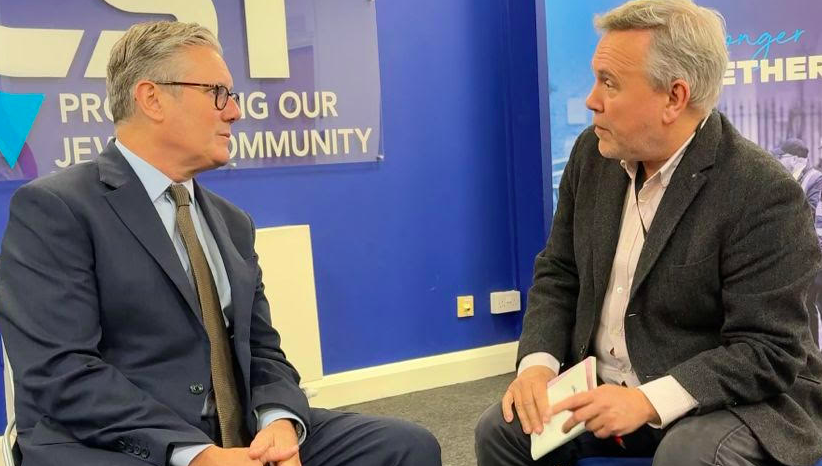
Prime Minister Keir Starmer has called on police officers to use powers “that are already there” to crack down on antisemitic hate chants, including “Globalise The Intifada,” at pro-Palestine marches.
He said that within the force, “a bit of clarity about what is antisemitic is much needed.”
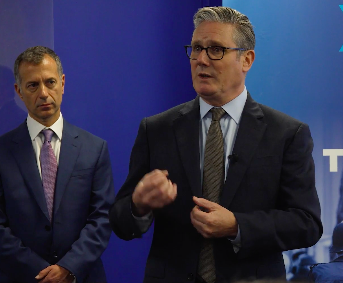
Speaking to Jewish News during a visit to the Community Security Trust (CST) office in London—where he paid tribute to staff who bravely responded to the Manchester synagogue attack and those who protect the entire community every single day—the Prime Minister appeared critical of some officers’ failure to act over “clear cases of Jew-hate on Britain’s streets,” promising to sit down with police chiefs to discuss the issue.
The PM told Jewish News: “I think we need to look at how we’re exercising the powers that are already there.
“Where something is clearly antisemitic, we need to do more about it. Obviously, we will discuss with police chiefs how they deal with these incidents on the ground. But I think a bit of clarity about what is antisemitic is much needed.”

He continued: “The chanting that goes on, and the slogans that are used, absolutely have to be dealt with in a different way in our view.”
The PM added he and the Home Secretary would “immediately speak to police chiefs about exercising the powers we have already got in relation to that.”
The Prime Minister’s criticism of current police failures to arrest individuals engaging in openly antisemitic chants came as he also criticised the University of Oxford, saying it had been “slow” to deal with a student accused of antisemitism at a protest last weekend.
Starmer said universities “should not be a place where Jewish students fear even to go, in some cases not wanting to go to university to have the education that they’re entitled to, or if they do go are concerned about their identity, how they’re going to be dealt with and reacted to.”
The PM added: “We have to stand up to that. And some universities have been too slow. Look at Oxford this week. That was a slow reaction to the clearest of clear cases. I won’t say any more than that, because obviously there are proceedings in place now.”
Oxford has suspended a student who was arrested on Wednesday on suspicion of inciting racial hatred after allegedly chanting for Gaza to “put the Zios in the ground” at a protest in London on Saturday.
Starmer also repeated his view that the chant “Globalise The Intifada” was indeed an antisemitic call for attacks on Jews in this country, and elsewhere outside of Israel, Gaza, and the West Bank.
He also cited Home Secretary Shabana Mahmood’s work in reviewing whether, besides using existing powers more robustly, “there are additional powers that are needed to effectively tackle the rise of hate chants against Israel and the Jewish community in this country.”
 In a wide-ranging interview with Jewish News, the PM said he “understands” why, in the aftermath of the Heaton Park Synagogue atrocity on Yom Kippur, many now accuse him of letting down the community since Labour came to power.
“I understand the frustration that runs very deep in the Jewish community, particularly after Manchester, but not just because of Manchester,” said Starmer, adding he recognised why Jews in the UK feel “insecure and unsafe.”
He added: “It’s my responsibility to meet that challenge with action, not words. So I do understand that, and that is why I’ve spent time talking to individuals, to groups, and going to a number of synagogues to have those discussions, private visits, not going in with cameras, but in order to have those discussions. So I do understand it, and I’m absolutely determined that we will address it.”
“And we want to work with you and support you, as we have done in the past, but even more so as we go forward.”
Starmer also referenced his extended family in Israel.
He said that “through them, I felt that after October 7, it wasn’t just the most horrific attack since the Holocaust, and it was that… it was also, certainly for my family members, a visceral sense of insecurity that went right through their hearts.”
“We need to recognise that, yes, there’s the physical things that need to be done, but we need to absolutely understand the impact that this has on individuals, their families, their lives and their community, ” he added.
“We have heard loud and clear in the last few days and weeks that words are not enough,” added the PM. “Action matters, and we’re absolutely committed to that.”
During Thursday’s visit to the CST headquarters, where he and the Home Secretary both addressed staff, including founding chairman Sir Gerald Ronson, Board of Deputies president Phil Rosenberg, and Jewish Leadership Council chief executive Claudia Mendoza, Starmer spoke frankly about his recognition that “action rather than words” was now required to change the perception of many Jews to life in this country.
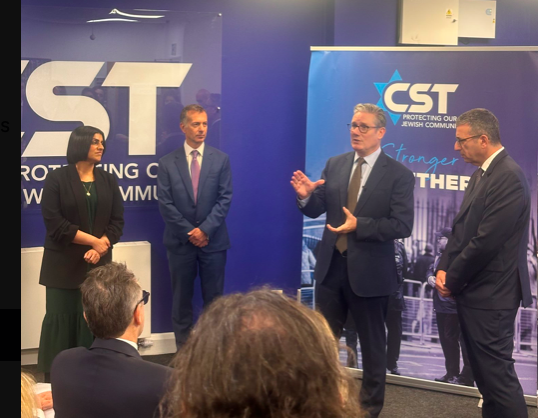
He confirmed the government will provide a £10 million cash injection for the CST to provide further security for the Jewish community, adding: “We have heard loud and clear in the last few days and weeks that words are not enough. Action is what matters, and we’re absolutely committed to that.
“We’re putting in an additional £10 million for the protection of the Jewish community, through CST but obviously for the community.
“But money alone isn’t enough. That doesn’t get the security, doesn’t deal with antisemitism in the way that we need to.”
He also confirmed that the Government’s independent antisemitism adviser, Lord John Mann, is to conduct a review of antisemitism within the NHS.
“Because you will know, and I know, there are just too many examples, clear examples, of antisemitism that have not been dealt with adequately or effectively,” said Starmer.
“So we need to do that review. We’ve already put in place management training in relation to the NHS, but I think we need a wider review, because in some cases, clear cases are simply not being dealt with, and so we need to get to the root of that.”
But Jewish News told the PM that for many in the community, there was another problem that he had yet to deal with—the anti-Israel haters within his own party.
We also raised the example of Labour-run Brent Council in north-west London, which, despite protests from the Jewish, Hindu, and other communities within the borough, had moved ahead with a divisive twinning arrangement with the West Bank city of Nablus, at a time when tensions were already heightened as a result of the war in Gaza.
Starmer responded, saying: “Wherever we see antisemitism, anywhere in our organisations or institutions, we have to tackle it and root it out.
“That includes the Labour Party. That’s why, as you will recall, when I was elected as Labour leader in April 2020, I said my first task was to root out antisemitism in my party.
“I knew Labour needed to tackle that issue, and we needed to tackle it robustly. I will continue to do so.”
Pressed again over the backbench MPs who, to many in the community, appear to only spout hatred of the state of Israel, Starmer added: “I also said this is a job that is never done, never completed, something we need to keep on at, and we will.”
Jewish News also raised the decision to go ahead with a move to recognise a Palestinian state prior to the release of the hostages, telling the PM that this was the final straw for many in the community with both him and his party.
Asked if he now regretted the decision to recognise Palestine last month, the PM said: “I stand by my decision.”
He added: “I do understand the different reactions. There’s not a uniform reaction within the Jewish community regarding it.
“Some people are opposed, and have been very clear with me about that… others equally have supported the move that we made.”
The PM continued: “I think it is important to appreciate that there was a deep concern that if action wasn’t taken, the very prospect of a Palestinian state was diminishing.
“And second, that because France, Australia, Canada, and others all acted together in relation to recognition, that is what pushed the New York Declaration, where many countries in the region were much, much clearer than they have ever been before about Hamas playing no part in any governance or future arrangements.
“We needed that clarity.”
He was also confident that the UK could now play a vital role in attempts to disarm Hamas in the weeks and months ahead in Gaza.
“Let me be really clear about this: we played an important part behind the scenes in what led to the peace, and I’m proud that we did that quietly, calmly, using UK diplomacy,” added Starmer.
“I’m already talking to allies and colleagues about how we stand ready to play a future role. We need to, because it’s our duty and responsibility to play whatever role in the end is most effective.
“I have put forward a suggestion on the decommissioning of Hamas’s capability of weaponry, which is vital because there will be no lasting peace until there is decommissioning of Hamas. What I mean by that is not just the weaponry, but also the tunnels and the infrastructure.
“Because of our particular experience in Northern Ireland with the IRA, I do think that there are lessons. There’s no match. Obviously, these situations are different. There are lessons that we can bring to bear, and working with others, I think we can play a leading part in that.
“It will be vital because decommissioning has to happen in order for the peace plan to work, and so it’s vital that that work is done.”
Starmer also paid tribute to the “incredible bravery” of the CST, both in responding to the attack in Manchester and in protecting the Jewish community, saying he felt the benefit of its work when he attended synagogue with his family.

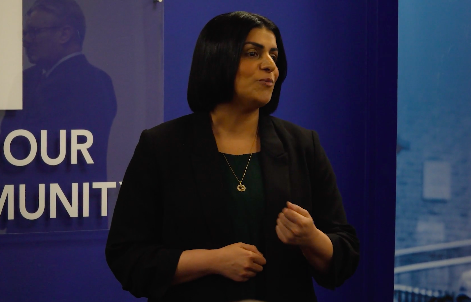
Mahmood, who accompanied the Prime Minister on his visit to the CST on Thursday, said she was reviewing protest legislation and providing additional police protection outside synagogues and other locations.
But she added that the “bigger question” was how to improve community cohesion so that Jewish children could “go to school without learning what a lockdown is”.
Mark Gardner, chief executive of CST, said he had had a “very straightforward and very productive” meeting with the pair.
He said: “Things that I was told to say, I didn’t really need to say, because both the Prime Minister and the Home Secretary said it in a very straightforward way, what the problem is and what needs done about it.
“And also that security is a bandage. We don’t want to live behind high walls for the rest of our lives.”

Keep community journalism free.
Jewish News is free for everyone. No paywall. No barriers. Just trusted journalism for anyone who wants to stay connected to Jewish life in Britain.
If you value that, please support us.
From as little as £5 a month, you can help keep our journalism free and accessible to all.
Every day, we report on the issues that matter to our community. We celebrate achievements, support charities, challenge antisemitism and ensure Jewish voices are heard more widely.
From as little as £5 a month, you can help us continue to:
- Report on the stories shaping Jewish life in the UK and beyond
- Bring our community together through shared stories, events and campaigns
- Celebrate the people, culture and moments that define our community
- Support organisations doing vital work across Jewish Britain
You can make a one-off donation or become a regular supporter. Every contribution helps keep our journalism free, independent and accessible to all.
If everyone who values Jewish News gave a small amount, it would make a real difference to our future.