Prefer Jewish News on Google
Prime Minister Burnham cites Jewish Care as ‘gold standard’ as he promises major sector reform
New PM visits to Jewish Care's north-west London premises to make high-profile pledge to address long-standing challenges in social care sector
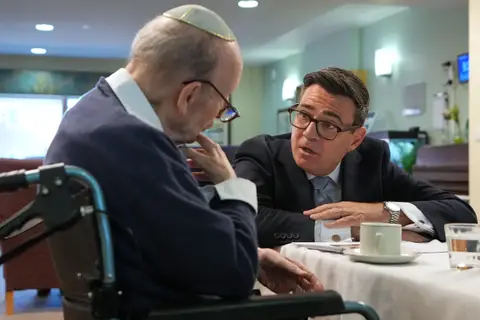
Prime Minister Andy Burnham has hailed Jewish Care as offering the “gold standard” in social care as he used the charity’s north-west London premises as a platform to announce a sweeping pledge to address the sector’s long-standing challenges.
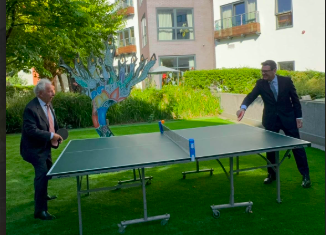
At a high-profile media event, flanked by Jewish Care Life president Lord Levy, president Steven Lewis, and Baroness Louise Casey, Burnham—whose father has Alzheimer’s—praised the organisation and the wider sector.
“I want to recognise all the good care organisations… and we are lucky to be in one,” he said.
Reflecting on his previous visit, he added, “I visited Jewish Care here as a member of parliament 13 years ago, and I remember thinking, ‘this is the gold standard – this is how it should be.’”
The PM later told Jewish News:”I came to Jewish Care in Golders Green today because it shows what good looks like. Whole person care. You know it when you see it.


“What this community understands, and what the system too often forgets, is that care is not a task list.
“It is knowing that the kosher meal matters, that Shabbat matters, that the challah delivered to someone’s door is not a nice extra but part of the care itself. Jewish Care’s Holocaust Survivors’ Centre is the only place of its kind in the country. Those are people who lost everything once. This country should not be asking them, or their children, to lose all they have rebuilt in order to pay for care.”
He added:”I want to say plainly to the charities in this community: I know you have been carrying this system while Westminster looked away, and I know the last few years of rising costs have been brutal.
“So, I have asked Baroness Casey to bring her review forward by a year, and to answer how we build a National Care Service in England: integrated with the NHS, preventative, person-centred, with home care wherever possible.
“Person-centred has to mean what it means here, care that fits someone’s faith, their language, their memories, not a service that flattens all that out. We are not waiting for the review on the workforce.
“I want the fair pay agreement turned into a proper career, with training, security and progression. The 1,500 staff and 3,000 volunteers who make Jewish Care possible deserve that.”
Picture by:
Kirsty Wigglesworth PA
Burnham also described it as a “major dereliction of public duty” that successive governments had failed to fix the crisis in social care.
He highlighted the work of Jewish Care’s “sister organisation The Fed,” recalling his familiarity with it from his time as Greater Manchester mayor.
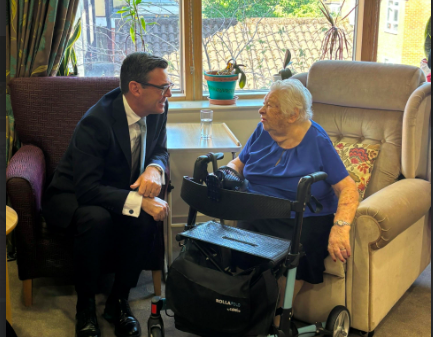
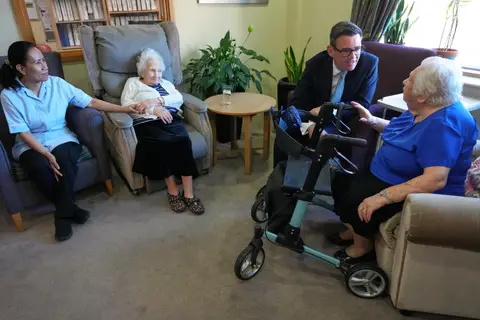
During the event, the Prime Minister met with residents, including Dorothea Jacobs, 103, and Doreen Reindorp, 98, to learn about their experiences.
He looked particularly moved as he discussed life with an elderly male resident wearing a kippah.
In footage later aired by ITV News, one resident was overheard expressing surprise there was “another one” in the PM’s role as he spoke with Burnham.
Jewish Care CEO Daniel Carmel-Brown later told Jewish News, “We were honoured to welcome the Prime Minister to Jewish Care as he set out his vision for the future of adult social care.
“Alongside addressing an audience of stakeholders, he took the time to meet residents and staff at our Otto Schiff care home, gaining first-hand insight into the lives of those who rely upon and deliver care every day.”
Carmel-Brown stressed the importance of the issue: “Few issues are more important to the wellbeing of our society than ensuring that older people and those who need care can live with dignity, security and support. Yet for many years social care has remained one of the great unresolved challenges facing our country.
“Successive governments have recognised the need for reform, and many have pledged to address it, but meaningful and lasting change has proved elusive. That is why today’s announcement is significant.”
Baroness Casey, who is conducting an independent review of the social care system, spoke warmly about Jewish Care, describing it as a “privilege” to be inside the “impressive north west London site.”
“She urged others to “take a look around, if you have the chance, and think, ‘Isn’t this what we would want for people?’”
Casey added, “People are still living in their homes, not a project, not a hospital but a home with people who will look after you for the rest of time.”
The event drew a strong turnout from government, including Health Secretary Yvette Cooper, Communities Secretary Angela Rayner, and Justice Minister and Finchley and Golders Green MP Sarah Sackman.
Cooper reiterated the government’s wish to show “solidarity” with the UK Jewish community.
Lord Levy later told Jewish News that the presence of the Prime Minister and senior ministers was “not just a tribute to Jewish Care and what it has achieved and the care it gives, but it is a tribute to Anglo-Jewry and the way it has led in the social services, in day care, and so many other areas.
“It obviously is a tribute to Jewish Care and the way we care for our own, but also how we hope that we can help a much wider society,” he added.
“Anything we can do to help wider society is vital. This is about everyone in the UK together—the best possible care and the need to deal with any problem we face.”
Local MP Sackman added:”My family has seen first hand the brilliant work of Jewish care where my father has volunteered with dementia sufferers over many years.
“There is a lot that can be learned from Jewish Care who do brilliant work caring for the elderly in the Jewish community. Jewish Care embodies the values of gemilut hasadim, acts of lovingkindness, and I am pleased that the Prime Minister chose the Golders Green campus to announce his plans to fix adult social care.”
House Secretary Rayner told Jewish News that Jewish Care “shows a model that can give people the fullest independence but recognises that a lot of conditions mean some people might need more support.”
“It gives them that hybrid of being able to get support as well as independent living,” she continued. ” And then when they need that extra support, that is available as well.”
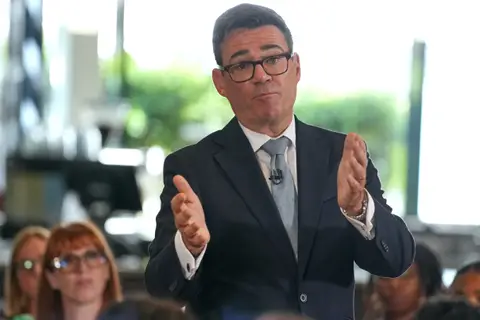
In his speech, Burnham promised to reform social care to help “my dad and the millions like him” who face the unfairness of the current system.
He acknowledged that “difficult, difficult decisions” could be needed on tax to pay for fundamental changes but insisted that fixing social care would save the NHS billions of pounds a year.
He said he had accelerated Baroness Casey’s review so it will report next year and promised reforms to improve the “strength and capability” of the social care workforce.
He also confirmed plans to begin cross-party talks, stating it was the “right thing to do” to try to find a consensus.
Burnham explained that the NHS spends around £2.5 billion a year keeping people in hospital who are medically fit to leave because there is no suitable care available in the community.
He argued that a lack of “preventative front-end social care service” was costing the NHS “several billion pounds a year.”
“We owe it to the public before we talk about tax rises to do more with what you’ve got,” he said. “But some of what we want to do in the fuller sense will require difficult, difficult decisions, and we will be honest with people about those.”
He indicated that tax rises for social care could be included in the next election manifesto, saying, “We will put them before the country at the right time, and we will hopefully proceed with people’s consent.”
Burnham added he was prepared to stake his political reputation on delivering these changes.

Keep community journalism free.
Jewish News is free for everyone. No paywall. No barriers. Just trusted journalism for anyone who wants to stay connected to Jewish life in Britain.
If you value that, please support us.
From as little as £5 a month, you can help keep our journalism free and accessible to all.
Every day, we report on the issues that matter to our community. We celebrate achievements, support charities, challenge antisemitism and ensure Jewish voices are heard more widely.
From as little as £5 a month, you can help us continue to:
- Report on the stories shaping Jewish life in the UK and beyond
- Bring our community together through shared stories, events and campaigns
- Celebrate the people, culture and moments that define our community
- Support organisations doing vital work across Jewish Britain
You can make a one-off donation or become a regular supporter. Every contribution helps keep our journalism free, independent and accessible to all.
If everyone who values Jewish News gave a small amount, it would make a real difference to our future.