Prefer Jewish News on Google
Pro-Palestine protesters led ‘concerted campaign to oppose police conditions’
Court hears organisers knowingly urged crowds towards a police cordon after a march near a synagogue was blocked over safety concerns
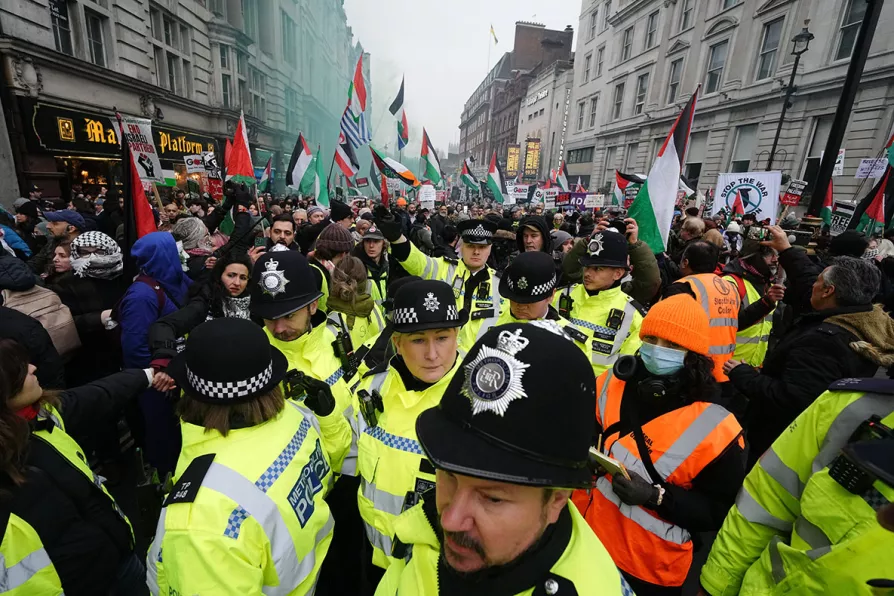
Two pro-Palestine protest organisers on trial accused of breaching police conditions at a rally took part in a “concerted campaign to oppose conditions”, a court has been told.
Benjamin Jamal, 62, director of the Palestine Solidarity Campaign, and Christopher Nineham, 63, vice chair of the Stop the War Coalition, are both accused of failing to comply with a condition that meant attendees of a protest on 18 January last year must stay on Whitehall in central London, in a static rally.
Jamal is also charged with two counts of inciting other protesters to breach police conditions.
The Metropolitan Police had blocked the pro-Palestine march from gathering near a synagogue in central London amid concerns it risked causing “serious disruption” to congregants attending Shabbat services.
Protesters targeting the BBC had been planning to gather outside Broadcasting House in Portland Place before marching to Whitehall.



Police first imposed conditions under the Public Order Act to prevent the rally from gathering in the area, near to Central Synagogue in Great Portland Street, and later banned the protesters from marching as police and organisers did not agree on a route, Westminster Magistrates’ Court heard.
Commander Adam Slonecki, who was in charge of the policing of the protest, decided to ban gathering outside Portland Place, citing concerns that national demonstrations “had a severely adverse impact on a significant portion of the Jewish community who had become fearful of attending the synagogues during protest”, prosecutors said.
In a meeting with police on 8 January, Jamal said his group were willing to speak to police and work to find compromises but would not yield to what he called “unacceptable political pressure by people who have got a pernicious agenda”, the court heard.
Prosecutors say the defendants felt the ban was not supported by evidence and resulted from political pressure.
The BBC did not raise any concerns about the protest being held near its headquarters, the court heard.
In a statement shared on X on 13 January, the Palestine Solidarity Campaign said the group would assemble in Whitehall before marching towards the BBC “in an orderly fashion”.
The post, which ended with the hashtag #WeWillMarch, was reposted by Jamal, the court heard.
Kevin Dent KC, prosecuting, said Scotland Yard had made organisers and attendees aware of the conditions through social media posts, articles on its website and with leaflets given out on the day.
“The events on 18 January were not an ad hoc reaction to spontaneous events but a continuation of a concerted campaign to oppose conditions,” Mr Dent told the court on Thursday.
“The prosecution say Mr Nineham will have known about conditions, and like Mr Jamal clearly disagreed with them.”
In a recording of a speech Jamal made to the thousands of protesters on Whitehall, played to the court, he said: “Friends, you all know the extremes that the police and the political establishment have gone to suppress our right to protest and our right to march.
“This week the police tried to impose upon us, a route for a march which had been approved by the Board of Deputies of British Jews.
“We, the Palestine Solidarity Movement, decide where we protest, not the board of deputies, not the Chief Rabbi, not the Community Security Trust, not any Zionist group that has supported Israel’s genocide and its 76 years of apartheid.
“Our intention today was to march to the BBC. We wanted to do so because of its complicity, through the bias of its reporting, a bias confirmed in a recent investigation…”
Jamal said a delegation of the leaders of the six groups which organised the march would walk towards the BBC, carrying flowers which they intended to place at corporation’s headquarters in Portland Place, the court heard.
Crowds began to follow Jamal and others’ lead, prosecutors said, with footage shown to the court showing people walking towards a police cordon which “eventually buckled under the pressure of large numbers of people moving forward”.
“We suggest that this (crowds following) cannot have been any surprise,” Mr Dent said.
The first police cordon was breached shortly after 3pm which was an outcome Jamal “always wanted to achieve”.
Though the cordon was breached, the public order conditions remained in place, which the defendants knew, or ought to have known, prosecutors said, as other cordons remained in place and exits were blocked off.
Mark Summers KC, defending, told the court the conditions the defendants are said to have breached were unlawful.
He said the defendants would have laid flowers the feet of police officers if they had not been permitted to walk to the BBC.
They wanted to lay the flowers “as a symbolic, expressive act of protest, to mark complicity of the state broadcaster in the events in Gaza through skewed coverage”, Mr Summers said.
He said neither defendant knowingly breached conditions, claiming Jamal and Nineham were directed by police to walk through the cordon on Whitehall.
“Policing (of the cordon) was a panicked, seat of the pants affair,” Mr Summers said.
“A scene of abject confusion and chaos, even amongst police. How can it plausibly be said to have looked otherwise to those they were policing.”
Nineham and Jamal both deny one count of failing to comply with public order conditions, and Jamal denies two further charges of inciting others to breach conditions.
The trial continues on Monday.

Keep community journalism free.
Jewish News is free for everyone. No paywall. No barriers. Just trusted journalism for anyone who wants to stay connected to Jewish life in Britain.
If you value that, please support us.
From as little as £5 a month, you can help keep our journalism free and accessible to all.
Every day, we report on the issues that matter to our community. We celebrate achievements, support charities, challenge antisemitism and ensure Jewish voices are heard more widely.
From as little as £5 a month, you can help us continue to:
- Report on the stories shaping Jewish life in the UK and beyond
- Bring our community together through shared stories, events and campaigns
- Celebrate the people, culture and moments that define our community
- Support organisations doing vital work across Jewish Britain
You can make a one-off donation or become a regular supporter. Every contribution helps keep our journalism free, independent and accessible to all.
If everyone who values Jewish News gave a small amount, it would make a real difference to our future.