Prefer Jewish News on Google
REVIEW: Holy Fool, Park Theatre
Timely tale of a composer's creative struggle in Stalinist Russia hits home
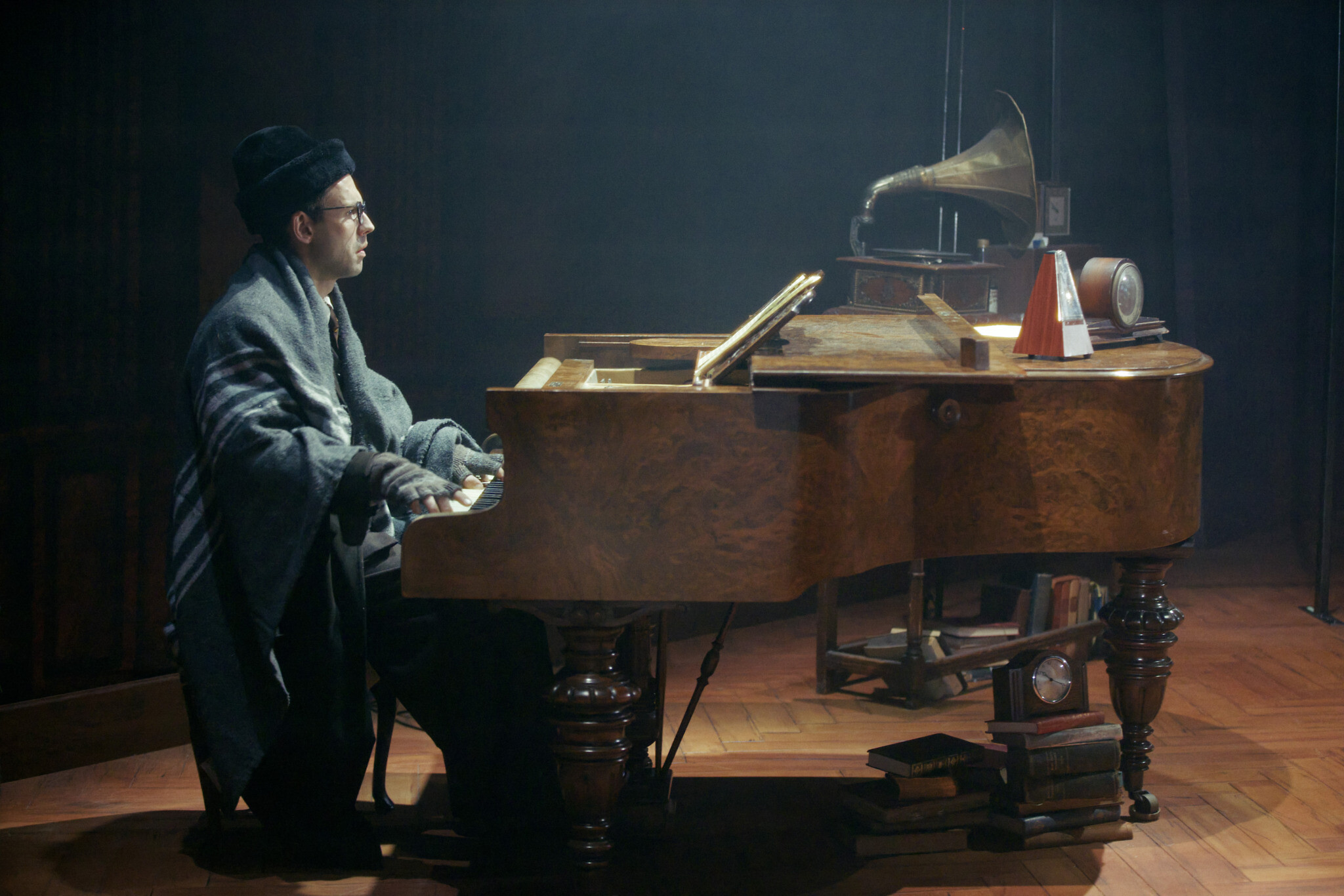
With the challenges facing so many creative artists today — actors, painters, musicians, film and TV stars — Rosalind Adler and Lea Sellers’ new play, Holy Fool, could not be more timely.
This is the lightly fictionalised story of the agonies faced by the composer Dimitri Shostakovich as he struggled to retain artistic freedom in Stalin’s Soviet Union.
The play opens as his grand opera, Lady Macbeth of Mtsensk, dedicated to his first wife, Nina, debuts in Leningrad in 1936. Thanks to lovely performances from Benjamin O’Mahony as Shostakovich, and an eye-rolling, cynical Jenna Augen as Nina, we are treated to the full range of his fears and terrors.
Chief among these terrors, of course, is Stalin, who, in the manner of Roman emperors, has the power to blight Shostakovich’s career. Lady Macbeth was a brief, short-lived success, before Stalin crushed the composer.
In his roller-coaster life, Shostakovich and his contemporaries faced the banning of their music before being lured out by the puppet-master, Stalin, playing with their emotions as a tiger might with potential prey.



William Fricker, Holy Fool’s set and costume designer, has cleverly ensured that the telephone in every Shostakovich apartment is buried in cushions, as the family is well aware that they are almost certainly bugged.
And we, the audience, are similarly assured by Shostakovich’s grand declarations that he will “never join the [Communist] Party” — spoiler alert, of course he does — and that he will “never go to New York”, to be put on show for the greater glory of the Soviet Union. Unfortunately, of course, the phone rumbles to life underneath the cushions, just as our hero finishes declaring that even if Comrade Stalin himself were to ask him to go to New York, he would refuse. On the line is Comrade Stalin and one can almost see O’Mahoney turn green as he speaks to the man with the literal power of life and death over him.
This tightly written play, directed with warmth and affection by Kate Fahy, benefits from two other actors doubling and in some cases tripling up on roles — Fergus O’Donnell and Phoebe Pryce. O’Donnell plays a close family friend, Izaak, but also brings great comic timing to a running gag role as a plumber, brought in to deal with leaks — leaks which may be literal and may also be metaphorical. You can practically hear him sucking his teeth as he turns into the Plumber from Hell.
Pryce appears as the plumber’s daughter, a terrifying Soviet inspector, and finally as someone who has taken the plunge which Shostakovich should have done — she has defected.
Pryce’s role as Katya is to push the composer into re-thinking his long hidden Fourth Symphony, which he was too nervous to publish and perform in Stalin’s time.
There is a lovely scene in the second act when Izaak brings the news to Nina that finally, Stalin has died. But then Shostakovich bursts in with other news — that his great friend, the composer Prokofiev, has also died. The irony that both men died on the same day — in fact Stalin died 55 minutes after Prokofiev — has a strange effect on the three friends. They are wildly happy that their greatest enemy has died, but grieving Prokofiev’s death and mourning the fact that he was no longer alive to enjoy a Russia without Stalin.
This is a fine depiction of a man forced to walk a tightrope and make painful compromises in order to put food on his family’s table. Which of us, I wonder, might not do the same?
Holy Fool runs at the Park Theatre in Finsbury Park until 10 October.

Keep community journalism free.
Jewish News is free for everyone. No paywall. No barriers. Just trusted journalism for anyone who wants to stay connected to Jewish life in Britain.
If you value that, please support us.
From as little as £5 a month, you can help keep our journalism free and accessible to all.
Every day, we report on the issues that matter to our community. We celebrate achievements, support charities, challenge antisemitism and ensure Jewish voices are heard more widely.
From as little as £5 a month, you can help us continue to:
- Report on the stories shaping Jewish life in the UK and beyond
- Bring our community together through shared stories, events and campaigns
- Celebrate the people, culture and moments that define our community
- Support organisations doing vital work across Jewish Britain
You can make a one-off donation or become a regular supporter. Every contribution helps keep our journalism free, independent and accessible to all.
If everyone who values Jewish News gave a small amount, it would make a real difference to our future.