Prefer Jewish News on Google

Telegraph’s German rescue deserves applause – and scrutiny
£575m Axel Springer deal welcomed after Abu Dhabi bid collapse, but regulatory hurdles and ownership concerns persist
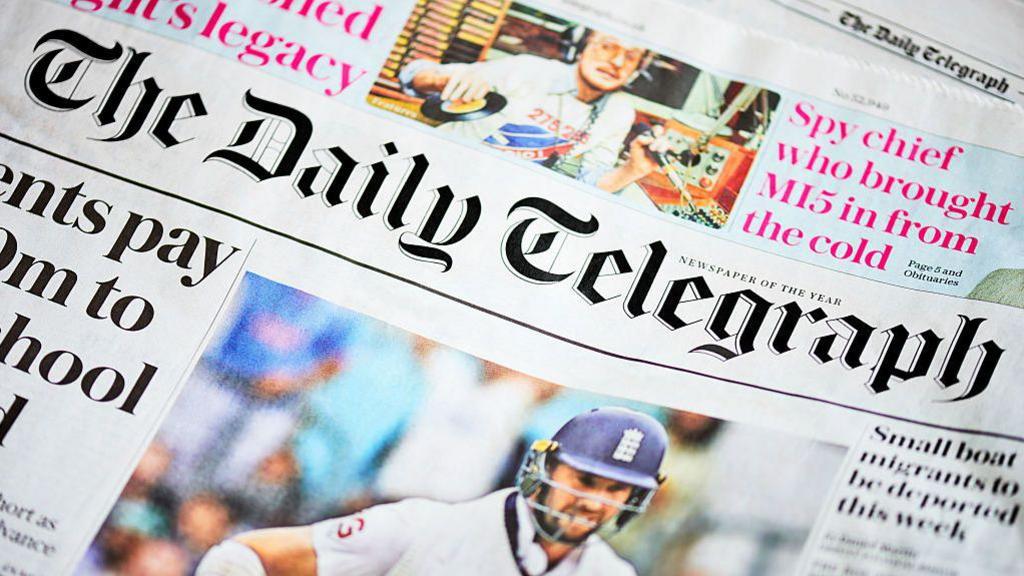
The £575m bid last month for The Telegraph titles by Germany’s Axel Springer was greeted with universal approval. After a long period of uncertainty for the titles, the paper is seen as having achieved a safe landing for colleagues who work at The Telegraph and editorial independence. Axel Springer, owner of Bild, Welt, Politico and Business Insider, is seen as able to accommodate all manner of views.
The media coverage has been as much driven by the height of the effective proprietor, 6-foot-7-inch Mathias Dopfner, as by the history of the Axel Springer family and the group’s generally strong pro-European leanings. Britain generally welcomes foreign ownership, regarding it as a signal that the UK is open to inward investment. The Tories opposed and legislated in November 2014 against an earlier bid for The Telegraph, which would have seen effective ownership pass to Abu Dhabi.
The Gulf State is a reliable UK trading partner and a signatory to the Abraham Accords with Israel. Abu Dhabi was barred from ownership after heavy lobbying amid concerns that stewardship by an authoritarian state with no tradition of press freedom would be unwelcome.
Axel Springer’s Israel-friendly stance must be a plus at a time when British and Jewish communities around the world find themselves under siege. The group’s post-Second World War objectives include a commitment to foster ‘reconciliation of Jews and Germans’.
There has been some glee on the left that DMGT, the owners of the Daily Mail (my employer), were the losing under-bidders in the battle for control. The deal has also been well received by those currently and formerly associated with Telegraph titles. Writing in the Spectator, its former editor Fraser Nelson noted the new owners are committed to the ‘right of existence of the State of Israel and oppose all forms of antisemitism.’



That is reassuring. Nevertheless, I always find it curious that anyone, except for Israel’s greatest enemies and ill-informed protesters, should have any truck with the idea that Israel, now 78 years old, shouldn’t exist!

Before the bunting is hung out, it is worth considering several issues. The Telegraph papers have been unwavering in their support of Israel since the horrors of 7 October, 2023.
The titles also have been unstinting in their reporting of antisemitism in Britain and across the globe. They have offered robust commentary on evil when the British Jewish community has been in need of loyal friends in the secular media.
Axel Springer, in contrast to the previous Abu Dhabi-backed bid, faces no specific legislative opposition. But in the manner of any overseas takeover, it will have to jump through the hoops of Ofcom and the Competition and Markets Authority. There is consensus that this should be routine and no bar to German control. It is possible that the American-Israeli assault on Iran, higher interest rates and falling asset values could yet change the economics of the transaction.
The Telegraph papers have been unwavering in their support of Israel since the horrors of 7 October, 2023. The titles also have been unstinting in their reporting of antisemitism
Germany has done more than almost any other European country to confront and recognise with monuments, street signs and museums its Nazi past and the suffering it brought to Jews. The German corporate world, which I confront almost every day as a city editor, prefers not to dwell on the past or seek to erase it.
Before the Second World War, Axel Springer, the founder of the modern company, ran a small printing and publishing firm, Hammerich & Lesser-Verla. In keeping with the ordinances of the time, it was directly accountable to the Ministry of Propaganda.
In 1934, Springer married Martha Else Meyer, whose father was Jewish. In 1938, he divorced her on the grounds of his infidelity. But it was also the case that her heritage would have barred him as an editor and publisher. She and her mother were later dispatched to the Theresienstadt Ghetto, where many Jews starved to death. For many talented Jews, this was a way station to Auschwitz.
Meyer and her mother were survivors and supported by Springer after the war.
In 1934, Springer had joined the National Socialist Motorist Corps, an organisation devoted to motorsport which eschewed any ideological commitments. But as a paramilitary organisation, it could not avoid being implicated in the Nazi regime’s racist policies. After the war, Springer was permitted by the British occupation authorities to establish his own publishing house, Axel Springer GmbH, as someone who had never been a member of the Nazi party. The launch of Bild Zeitung in 1952 was the seed for a fabulously successful media group.
There is nothing in the past of Axel Springer or its current leadership which might be seen as a bar to foreign ownership of The Telegraph. If the deal goes ahead, it will pay a very high price.
But when ownership passes overseas, so do command and control. For newspapers, as with any other asset, this injects a different kind of uncertainty. Wealthy new proprietors – as the Washington Post has found under the control of Amazon founder Jeff Bezos – do not guarantee editorial freedom.
- Alex Brummer is City Editor of the Daily Mail

Keep community journalism free.
Jewish News is free for everyone. No paywall. No barriers. Just trusted journalism for anyone who wants to stay connected to Jewish life in Britain.
If you value that, please support us.
From as little as £5 a month, you can help keep our journalism free and accessible to all.
Every day, we report on the issues that matter to our community. We celebrate achievements, support charities, challenge antisemitism and ensure Jewish voices are heard more widely.
From as little as £5 a month, you can help us continue to:
- Report on the stories shaping Jewish life in the UK and beyond
- Bring our community together through shared stories, events and campaigns
- Celebrate the people, culture and moments that define our community
- Support organisations doing vital work across Jewish Britain
You can make a one-off donation or become a regular supporter. Every contribution helps keep our journalism free, independent and accessible to all.
If everyone who values Jewish News gave a small amount, it would make a real difference to our future.