Prefer Jewish News on Google

The Jewish family behind Britain’s first computer
How the Lyons dynasty helped pioneer British computing and left a lasting mark on commerce and innovation
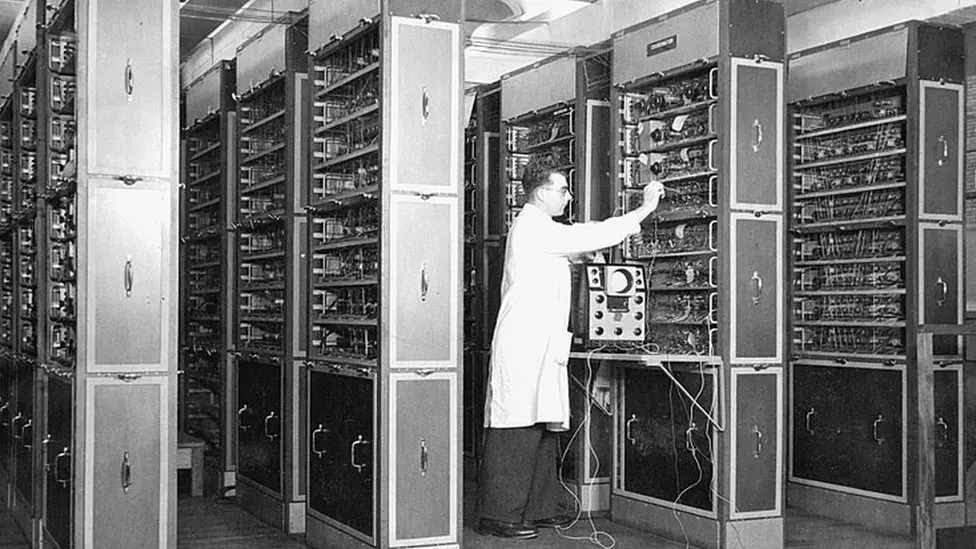
Driving to work each weekday from Richmond-upon-Thames to Kensington, the route passes the oversized, near-completed redevelopment of the Olympia exhibition site. My eyes often alight on the red brick mansion flats opposite, where there is a blue plaque honouring the memory of Sir Joseph Lyons, a founder and chairman of the once great catering and food empire J. Lyons & Co., famous for its eponymous tea houses and still an upmarket high street tea and coffee brand.
Adjacent to Olympia is a second Hammersmith building site, part of the redevelopment, with bright hoardings proclaiming the history of the now-demolished buildings, which housed the offices of Lyons and Britain’s first computer in commercial use. The Lyons’ name has special status and meaning in our family.
Both my mother, born Rachel Lyons, and my wife, Tricia, through her father, are descendants of the Lyons dynasty. Sir Joseph Lyons, as he became, had no issue. His brother Saul Lyons was father to 17 children and what must constitute one of the largest cousinhoods in Anglo-Jewry, of which we both are a part.
Even though J. Lyons & Co. was always the name over the door, and one of which we remain proud. It was relatives of the Lyons dynasty, the Salmon and Gluckstein families, who were the entrepreneurs who built the enterprise into a national commercial institution and global presence.
I was reminded of the vision of the founders and their descendants and their contribution to Britain by a recent obituary in The Guardian. The left-leaning newspaper may not be the most popular title in the Jewish community (I worked there for 25 years), but its obits offer a menagerie of tributes to Britain’s creative genius. It celebrates the lives of showbiz, film, music and scientific figures, a good number of whom have Jewish roots.



Schoolchildren these days and visitors to the Science Museum in London will be familiar with the name of Alan Turing, the mathematician and troubled inventor of modern computing. In his role at Bletchley Park, where German codes were broken during the Second World War, Turing played a key role in defeating the evil of Nazism.
Less known is the name of Frank Land, the business computer pioneer and the UK’s first professor of information systems, whose life was commemorated in a Guardian obit this month. Land, who died on May 26 this year, was part of a team of scientists recruited by the forward-thinking executives of J. Lyons to compute the costs, margins, revenues and earnings of the baked goods produced by the catering group.
Land was instrumental in the formation of Lyons Electronic Office (LEO) and his creation of the first information systems in Britain, which kept executives up-to-date with the finances and stockkeeping at J. Lyons’ 250 outlets and changed the face of commerce. Among other things, Leo capably calculated the tax tables for the Inland Revenue as soon as the Chancellor sat down on budget day.
As a veteran financial journalist, I can personally testify to what an important tool it would become in understanding the impact of tax changes on different groups in society and businesses. Leo was also rather good at working out the best formula for blending J. Lyons’ signature Red Label and Green Label teas!
Frank Land’s life offers an exemplary example of the Jewish imprint on our national life. More broadly, it demonstrates how the country can benefit from the immigrant experience.
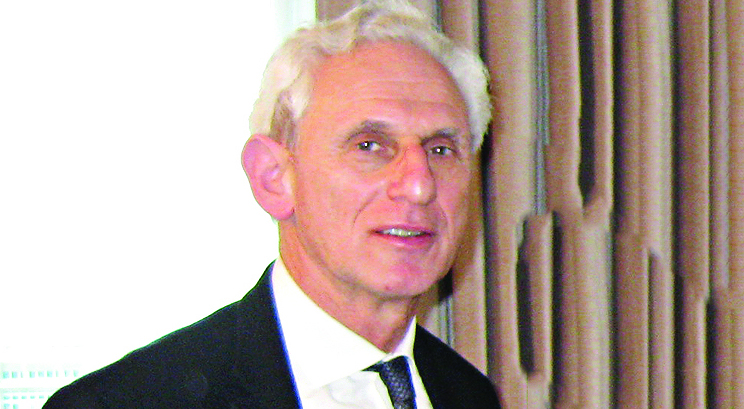
Land was born in Berlin, the son of Louis Landsberger, a dealer in motor accessories, and Zofia (née Weinberger), an artist. They fled to Britain in 1939 after all their properties were confiscated by the Nazis. Land’s father was interned on the Isle of Wight for almost a year with other emigrés.
Frank Land attended Willesden County Grammar School and went on to read economics at the London School of Economics. After his groundbreaking career at Lyons, he returned to the LSE and was appointed the first professor of information systems.
J Lyons may have outlived its time as an independent thriving business. The name lives on through the literature of Patrick Hamilton, Betty Miller and other fiction writers of the 1940s, 50s and 60s and through Lyons’ branded goods.
But there is not a business or enterprise in the nation which will not have benefited from the pioneering IT work done by J. Lyons in Hammersmith.
Alex Brummer is the city editor of the Daily Mail.

Keep community journalism free.
Jewish News is free for everyone. No paywall. No barriers. Just trusted journalism for anyone who wants to stay connected to Jewish life in Britain.
If you value that, please support us.
From as little as £5 a month, you can help keep our journalism free and accessible to all.
Every day, we report on the issues that matter to our community. We celebrate achievements, support charities, challenge antisemitism and ensure Jewish voices are heard more widely.
From as little as £5 a month, you can help us continue to:
- Report on the stories shaping Jewish life in the UK and beyond
- Bring our community together through shared stories, events and campaigns
- Celebrate the people, culture and moments that define our community
- Support organisations doing vital work across Jewish Britain
You can make a one-off donation or become a regular supporter. Every contribution helps keep our journalism free, independent and accessible to all.
If everyone who values Jewish News gave a small amount, it would make a real difference to our future.