Prefer Jewish News on Google

Thank you, Next. And M&S, Tesco and Burberry. Imagine Britain without Jewish enterprise
Yet Jews know, perhaps more than most, what happens when hatred escalates and there is nowhere left to go
As the trauma of the last several weeks has unfolded for British Jews, broadcasters and others constantly refer to the small size of a community besieged by anti-Semitism. Certainly, in relation to the burgeoning Islamic minority, which is forecast to vacuum up a record number of seats in the May 7 local elections, the assaults endured by Jews and their institutions have been tenfold greater.
There has been feigned surprise that so many members of the Jewish community interviewed, posting on social media or writing about their experiences, talk about leaving the UK and moving to Israel. People cannot understand why Jews would want to leave for a land that is so often at war. Yet leaving for a homeland was a choice not available in the 1930’s as fascism and anti-Semitism erupted in Germany, Hungary (from where my father escaped) and other countries.
Watching and listening to some of the media coverage one might think that British Jews were an odd minority, mostly living in Golders Green and north Manchester, wearing kippot and garbed in black coats and hats. There is precious little understanding of what our community, back in Britain since the 17th century, has contributed and still contributes to our society. If we were to flee it would blow a huge hole in Britain’s cultural, media, academic and scientific life.
As a financial and economic commentator for several decades, I live in constant wonder at the Jewish contribution to commerce and the companies in the FTSE 100, whose ups and downs are reported on news bulletins each day.
On my way home from the Daily Mail’s offices in Kensington, I drive past a blue plaque opposite Olympia celebrating the life of Sir Joseph Lyons (a family relative) who helped to keep Britons supplied in the decades in the mid-20th century. The firm bearing his name, J Lyons & Co, was the first in Britain to embrace computer technology.



There is some shyness in the Jewish community about referring to business success. People fear that it feeds into the Corbynite narrative, inherited by Zac Polanski’s Greens, that Jews are vampire squids sucking resources out of the economy.
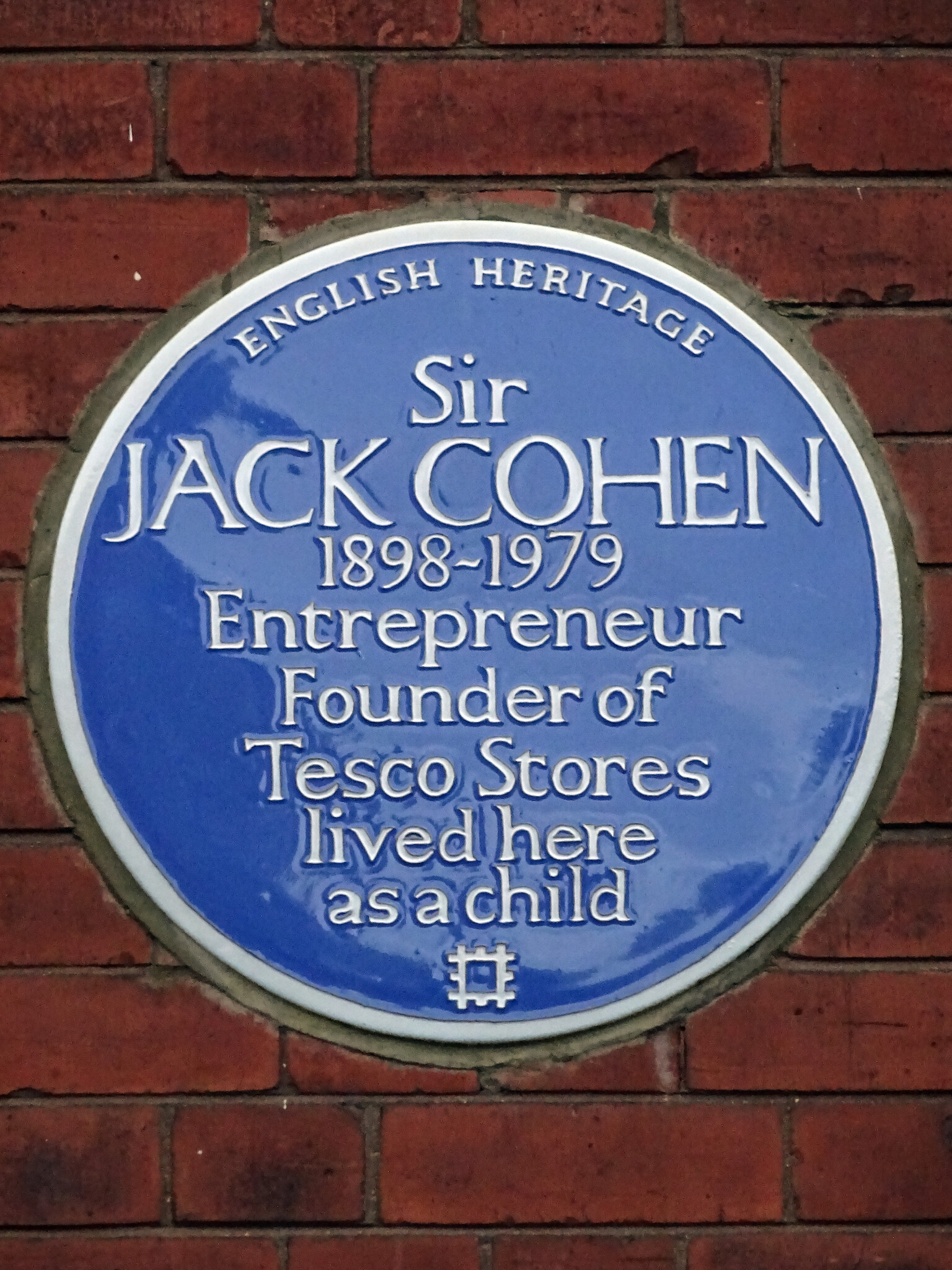
There is another very different way of looking at this. Imagine what life would be like for consumers, the nation’s workforce, energy suppliers and many other economic players were it not for the Jewish gift to enterprise in Britain. It goes without saying that Sir John Cohen’s Tesco, the country’s biggest supermarket chain with some 30pc market share, offers consumers the keenest prices.
The list of retail concerns with Jewish heritage is almost too long to repeat here. But among the biggest stars are Next, Marks & Spencer, JD Sports, Burberry, online shopping pioneer Ocado, Curry’s (the former Dixons) and fashion chains such as River Island
But it is Tesco’s innovation with the introduction of supermarkets, computerised stock systems just in time delivery, among other things, which dominates all UK’s retail culture.
The list of retail concerns with Jewish heritage is almost too long to repeat here. But among the biggest stars are Next, Marks & Spencer, JD Sports, Burberry, online shopping pioneer Ocado, Curry’s (the former Dixons) and fashion chains such as River Island. The modern City of London, generating 8pc and upwards of the nation’s output, is housed in developments such as Broadgate and Canary Wharf, brought to fruition by Jewish real estate visionaries.
Surprising as it may seem, Shell, currently Britain’s most valuable stock market company, owes its origins to Lord Bearsted, the former Marcus Samuel.
In an age of conflict, when defence is so critical to the nation, we can be grateful to the legacy of the late Lord Weinstock and GEC. When his company was broken up after his departure, the defence arm, including submarine platform Vickers and defence electronics group Marconi were sold to Bae Systems, one of the world’s leading makers of aircraft, missiles and advanced avionics.
And if you are reading this on your mobile device, spare a moment for engineers at GEC who first came up with the idea that communications systems, developed for the battlefield, could be developed as a consumer product. The licence was sold to Racal which would later spin-out Vodafone.
Across the board in electronics, pharma, AI and finance, Britain’s Jewish community inspires and creates. Its contribution to the common weal and the nation’s prosperity should be celebrated not demonised.
- Alex Brummer, City Editor, the Daily Mail

Keep community journalism free.
Jewish News is free for everyone. No paywall. No barriers. Just trusted journalism for anyone who wants to stay connected to Jewish life in Britain.
If you value that, please support us.
From as little as £5 a month, you can help keep our journalism free and accessible to all.
Every day, we report on the issues that matter to our community. We celebrate achievements, support charities, challenge antisemitism and ensure Jewish voices are heard more widely.
From as little as £5 a month, you can help us continue to:
- Report on the stories shaping Jewish life in the UK and beyond
- Bring our community together through shared stories, events and campaigns
- Celebrate the people, culture and moments that define our community
- Support organisations doing vital work across Jewish Britain
You can make a one-off donation or become a regular supporter. Every contribution helps keep our journalism free, independent and accessible to all.
If everyone who values Jewish News gave a small amount, it would make a real difference to our future.