Prefer Jewish News on Google
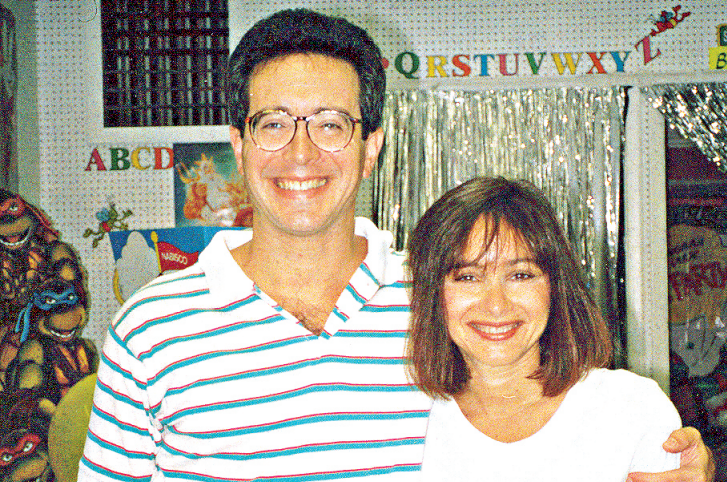
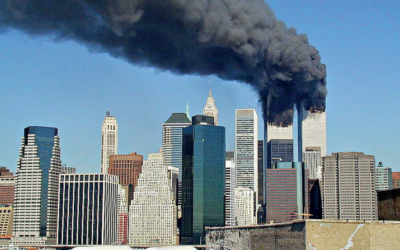
At 8.44am on 11 September, 2001, Arlene Fried left a voicemail for a woman she barely knew. The 49-year-old lawyer was already at her desk at Cantor Fitzgerald, on the 104th floor of the North Tower of the World Trade Centre. Her brother, Elliott Joseph, had put her in touch with someone considering a career in law who wanted advice. Two minutes later, American Airlines Flight 11 struck the tower.
For Arlene’s family, the voicemail established that she had made it to work that morning. It also preserved one of the last things they knew she did. “Selfless,” Elliott says 25 years later. “An act of kindness to a total stranger.” Arlene was a mother of three who decided to study law while bringing up her daughters. Her youngest was five when she went to Columbia Law School, and she continued doing the school run alongside her studies before building a legal career that eventually took her to Cantor Fitzgerald, where she became assistant general counsel. By September 2001, she was commuting from Long Island into lower Manhattan while raising three children and helping care for ageing parents.
Elliott remembers another part of her life that was harder to capture on paper: the number of people who thought of her as their closest friend. “She was an extraordinary person,” Elliott, 72, tells Jewish News. “She was the best friend of a dozen or more different people. If you ask them, ‘Who’s your best friend?’, they’d say Arlene.”
Later that September, hundreds gathered at her synagogue for a memorial service. Friend after friend stood up and said much the same thing. “She was just a loved and appreciated person in so many people’s lives, and had so much to give.” Elliott and Arlene were close too. The siblings spoke on the phone every day, often while they were both driving into Manhattan. Elliott would call to ask where she was and what the traffic was like. He remembers Arlene putting on her eye makeup behind the wheel and saying that if she had managed to do it, the traffic could not have been too bad.
Arlene had been on the 104th floor. The aircraft struck below her, and those above the impact zone were trapped. Her family never received a DNA identification


On the morning of 11 September, Elliott had been at the gym. He came out to find the phones were not working properly and boarded the subway from Forest Hills towards Manhattan. He still did not know what had happened downtown when he heard passengers talking about an attack on the World Trade Centre. “You could imagine how my heart sank when I heard that,” he says.
For a while, the family found reasons to believe Arlene might not have been there. She had a long commute from Long Island, and the attack had happened early. Perhaps she had been delayed. Perhaps she had not reached her desk yet. Then they learnt about the voicemail. “That became the unfortunate proof that she was there,” Elliott says. They continued looking for her. “For those first few days, we were searching,” Elliott says. “We hoped maybe she had ended up in a hospital or somehow made it down the stairs. We were waiting for any news that might tell us she was still alive.”
Arlene had been on the 104th floor. The aircraft struck below her, and those above the impact zone were trapped. Her family never received a DNA identification. “It was devastating, and everybody was really in shock,” Elliott says. “We couldn’t process that it happened.” Elliott remembers the memorial service, held around two weeks later, as “a reality point”, when the family was beginning to understand that she was not coming home.
For Arlene and Elliott’s parents, Nicholas and Ronny Joseph, the death of their daughter came more than half a century after they had survived the Holocaust. Nicholas, who was born in Romania in 1921, had been studying medicine when anti-Jewish laws forced him from his education. He later spent two-and-a-half years in forced labour in occupied Russia, under Hungarian supervision, digging trenches and building roads. Elliott recalls his father describing being made to walk along roads looking for unexploded mines.
Ronny grew up in Transylvania, in a region that had been part of Romania before coming under Hungarian rule during the war. She was deported in 1944 during the mass deportation of Hungarian Jews and survived alongside two sisters and two aunts. Elliott says they were eventually sent to a subcamp of Auschwitz, where they worked in a factory. Her mother was murdered.
Nicholas and Ronny eventually made their lives in the United States. Elliott grew up in a country which he regarded very differently from the Europe his parents had known. His father was never so certain.
“My father always told me that what happened in Europe, the Holocaust, could happen here,” Elliott said in an interview recorded around the first anniversary of 11 September. “I dismissed it as absurd.”
“I grew up in this country, and I believed in institutions of freedom and liberty,” he says now. “We’re far distant from Europe and the Middle East, and it just seemed like a safe haven.” His sister’s murder changed that. “It happened here, and unfortunately, he was right,” Elliott says. “It can happen anywhere.”
Nicholas had lost almost his entire family during the Holocaust. Yet in the recording made a year after 11 September, he described Arlene’s death as “the biggest blow, more so than the Holocaust and the communist era that I lived through.” Elliott says his father had tried to explain the difference. His parents had been young during the Holocaust, when catastrophe was unfolding around an entire community. Decades later, they had built a family in America and reached an age when they expected their children to outlive them. “Losing your parents is something that you’re always preparing for,” Elliott says. “You never expect to lose a child. And for me, you never expect to lose a sibling.”
For Elliott, there was also the speed of it. “From a moment where life was normal, in one moment it was changed,” he says. “I always say it’s the before and the after.” Ronny had spoken to Elliott about the Holocaust from an early age. “I was haunted by the knowledge of what people are really like,” he says. “It took away my innocence.” But he also grew up hearing how his mother, her sisters and aunts had survived by staying together and sharing what little food they had. “When I heard the stories of survival, the survival was based on kindness and helping each other and staying together as a family,” Elliott says. “What I learned was … you try to repair the world with acts of kindness. Even though it’s futile, that’s all you can do.”
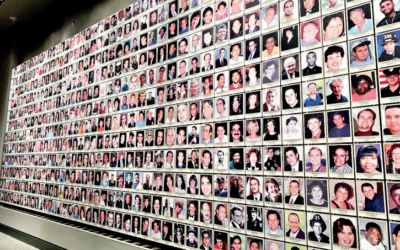
After Arlene was killed, there was a period when the family struggled to speak about her. Elliott found the silence particularly difficult. “That was the hardest thing, to pretend like she never existed,” he said in the recording made around a year after her death. Over time, her name returned to family conversations. One of her daughters might mention something their mother would have liked or remember something she had done. “If you keep someone alive by recounting their memories, while you’re thinking of them, in a sense, they continue to be alive in your heart and in your mind,” Elliott says.
Arlene’s death also influenced the documentary projects Elliott chose to support. After 11 worshippers were murdered at Pittsburgh’s Tree of Life synagogue in 2018, he contacted filmmaker Trish Adlesic and suggested making a film.
A Tree of Life would focus not on the gunman but on the families living with what he had done. “It’s all about the impact it had on the family,” Elliott says. “There is the personal cost of each individual life being lost. I wanted people to connect.” He has since supported other documentaries dealing with antisemitism and Jewish history, including Holding Liat, about the family of Liat Beinin Atzili following her abduction on 7 October, and Righteous Road Trip, about non-Jews who risked their lives to save Jews during the Holocaust. For Elliott, the same focus on individual lives matters when talking about 11 September. He objects to the description of the Twin Towers having simply “collapsed”. “They didn’t collapse,” he says. “They were destroyed in an act of malicious murder and terrorism.” “The mind kind of can’t really process a tragedy on a large scale,” he adds. “If you focus on one story and one person’s life, people can appreciate that and be moved by it.”
For most of Elliott’s life, there was one place at the centre of his family’s history that he chose not to visit. He grew up hearing his mother’s accounts of the Holocaust and later became involved in editing a book about the horrors of Auschwitz. But it was only when he turned 70, two years ago, that he finally went there himself.
From the watchtower at Birkenau, he saw the scale of the site that years of reading had been unable to convey. “You cannot appreciate it unless you go there,” he says. Elliott described finally being there as “cathartic” – “the victim returning to the scene of the crime”. “With all the stories I heard growing up, it was as if I were there.”
There is another place connected to his family’s history that Elliott has visited very differently. He and his relatives have returned to the World Trade Centre site every year since the attacks. The first time was only weeks after 11 September, when the ruins were still smouldering. This September, Elliott will return for the 25th anniversary. In the recording made around the first anniversary, his father tried to put into words the absence of a daughter whose remains had never been returned. “She just, I guess, disintegrated into thin air,” Nicholas said. “Therefore, she’s always around us.”
Nicholas died in 2006 and Ronny ten years later. The three young daughters Arlene left behind are now women with careers and families of their own. Her eldest became a dentist and has two children who are now at university. Her middle daughter works with autistic children in the state school system, later married and has a child as well as three stepchildren. Her youngest works in early childhood development and is also married. Their mother never got to see any of it.
What Elliott can still describe are the details of the life she had already built: studying law while raising three daughters, the journeys into Manhattan, the friends who each believed they were her best friend and the daily calls between a brother and sister checking where the other had got to in the traffic. “Every life is sacred, every life is important, every life is essential,” he says. At 8.44am on 11 September 2001, Arlene Fried was sitting at her desk on the 104th floor of the North Tower. Someone she barely knew wanted career advice.
Arlene called her back.

Keep community journalism free.
Jewish News is free for everyone. No paywall. No barriers. Just trusted journalism for anyone who wants to stay connected to Jewish life in Britain.
If you value that, please support us.
From as little as £5 a month, you can help keep our journalism free and accessible to all.
Every day, we report on the issues that matter to our community. We celebrate achievements, support charities, challenge antisemitism and ensure Jewish voices are heard more widely.
From as little as £5 a month, you can help us continue to:
- Report on the stories shaping Jewish life in the UK and beyond
- Bring our community together through shared stories, events and campaigns
- Celebrate the people, culture and moments that define our community
- Support organisations doing vital work across Jewish Britain
You can make a one-off donation or become a regular supporter. Every contribution helps keep our journalism free, independent and accessible to all.
If everyone who values Jewish News gave a small amount, it would make a real difference to our future.