Prefer Jewish News on Google
OPINION: The revealing thought process of the academics backing Palestine Action
This is not an example of cause-agnostic support for free expression or political protest. This is a case of the ends being seen to justify the means.
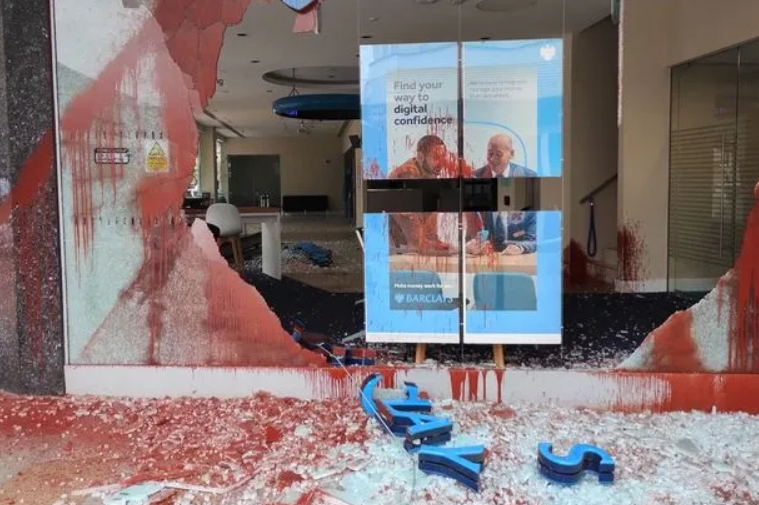
There is a growing campaign against the proscription of Palestine Action, the group that used organised criminality to pursue its anti-Israel politics until they were banned as a terrorist group by the Home Secretary last month.
The latest statement in their support is a letter to the Guardian (where else?) by a predictable list of academics and veteran activists. It includes this revealing sentence:
“We fully share the aim of ending the flow of weapons from Britain to Israel and the belief that all participants in the pro-Palestine movement should be free to make our own decisions about how best to achieve that goal.”
This kind of thinking, with no qualifications or restrictions, could justify Elias Rodriguez shooting dead Sarah Milgim and Yaron Lischinsky outside the Jewish Museum in Washington D.C. in May. Rodriguez was a participant in the pro-Palestinian movement, and he made his own decision that shooting dead two people leaving a Jewish community event was the best way to achieve his goal. He even shouted “Free Palestine” when he did it. And he isn’t the only example.
I hope the signatories of the Guardian letter would agree that this was terrorism, but who knows? That sentence could be read as justifying the use of violence to achieve a political goal, which serves as a decent shorthand definition of terrorism anyway. Rodriguez has been glorified and his political manifesto shared by plenty of people and organisations in the pro-Palestinian movement, including Unity of Fields, an American group that used to be Palestine Action U.S., so it isn’t too far-fetched to think there will be similar attacks in future.



The Guardian letter also claims that proscribing Palestine Action “represents an attack both on the entire pro-Palestine movement and on fundamental freedoms of expression, association, assembly and protest.” This is nonsense. Palestine Action’s entire approach was to use criminal methods to achieve a political goal. Their activists set out to smash up buildings and cover them in paint. If they gained entry, they smashed up the offices and equipment as well. This criminal modus operandi was not an add-on, or an occasional by-product: it was the whole point. It shouldn’t need saying, but there is no automatic freedom to break the law.
It is perfectly possible to protest against Israel and campaign for Palestine without using criminal methods. Violence is a choice. Palestine Action advised their activists take a sledgehammer with them when they went out to do a Palestine Action activity – and you don’t need a sledgehammer for peaceful protest.
Cutting through the high-blown political rhetoric, it is hard to avoid the view that the signatories of that Guardian letter support Palestine Action because they believe the Palestinian cause is just, and therefore the suffering in Gaza justifies any response. The same goes for the people getting themselves arrested in Palestine Action’s name every weekend. But this is not an example of cause-agnostic support for free expression or political protest. If a far right group used Palestine Action’s tactics to attack immigration centres, asylum hotels and the offices of law firms who work on immigration cases, using organised criminal damage and intimidation to try to bring about an end to immigration, similar support would not be forthcoming from the people now supporting Palestine Action. This is a case of the ends being seen to justify the means: which is, ironically, the logic that terrorists have used for decades.
These letter-writers reveal more than they intend. If proscription really is an attack on the entire pro-Palestine movement, then that would imply the entire movement supports the use of political violence and criminality to achieve its goals. And who knows, maybe they are right about that – who am I to argue? – in which case, proscription of the most violent element of that movement seems more, not less, justified as a result.

Keep community journalism free.
Jewish News is free for everyone. No paywall. No barriers. Just trusted journalism for anyone who wants to stay connected to Jewish life in Britain.
If you value that, please support us.
From as little as £5 a month, you can help keep our journalism free and accessible to all.
Every day, we report on the issues that matter to our community. We celebrate achievements, support charities, challenge antisemitism and ensure Jewish voices are heard more widely.
From as little as £5 a month, you can help us continue to:
- Report on the stories shaping Jewish life in the UK and beyond
- Bring our community together through shared stories, events and campaigns
- Celebrate the people, culture and moments that define our community
- Support organisations doing vital work across Jewish Britain
You can make a one-off donation or become a regular supporter. Every contribution helps keep our journalism free, independent and accessible to all.
If everyone who values Jewish News gave a small amount, it would make a real difference to our future.