Prefer Jewish News on Google

This has been the most extreme government in Israel’s history
if Israel does not choose a strategic future, the current coalition will choose one for us, one irreversible fact on the ground at a time
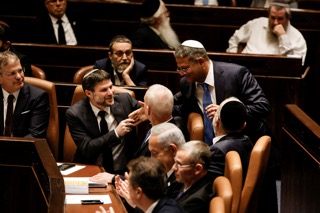
Within the space of a few days, two developments in the West Bank exposed the same dangerous flaw in Israel’s present leadership: the substitution of political spectacle for national strategy.
The first was the government’s decision to advance construction in E1, the highly sensitive corridor between Jerusalem and Ma’ale Adumim. The second came this morning, when MK Zvi Sukkot entered the Palestinian village of Madama under IDF protection and took a sledgehammer to a monument commemorating Palestinian “martyrs.”
At first glance, these appear to be entirely different events. One involves planning committees, tenders and thousands of proposed homes. The other was a made-for-social-media stunt carried out by a politician wielding a hammer.
But they are driven by the same political instinct: create irreversible facts, bypass institutional restraint and present anyone who questions the wisdom of the act as insufficiently patriotic or a traitor.
Together, they represent the culmination of the most extreme government in Israel’s history.

That description is not political hyperbole. Previous Israeli governments included hardliners, promoted settlement construction and made decisions that damaged the prospects for peace. But never before have the most radical elements been given such sustained power over the institutions capable of turning their ideology into permanent reality.
This coalition did not merely include the far right; it made the far right indispensable. Politicians once regarded as operating beyond the boundaries of legitimate government were handed authority over national security, policing, settlement policy and significant aspects of civilian administration in the West Bank.
The result has been a fundamental reversal of responsibility. Extremists are no longer pressuring the government from outside. They are the government. The people who once challenged the restraints of the state now possess the political power to dismantle them from within.
E1 and the incident in Madama are therefore not deviations from this government’s course. They are its logical culmination.
Let us begin with what should be obvious. Monuments glorifying those who murdered Israelis are morally repugnant. Palestinian incitement is not an invention or an excuse. It is real, it has consequences and it must be confronted.
But Israel is a state governed by laws, not by the impulses of individual politicians. A member of the Knesset is not the police, the army or the sovereign. He cannot appropriate the authority of the state simply because he believes the state is moving too slowly.
According to the IDF, Sukkot and his entourage departed completely from the arrangements agreed for their visit. The army accused them of acting “deceptively and manipulatively” and said soldiers had been diverted from operational duties to protect the tour. Even Prime Minister Benjamin Netanyahu described taking the law into one’s own hands, particularly by a public representative, as unacceptable.
The IDF was effectively used as security for a political performance it had neither authorised nor intended to facilitate.
That should concern Israelis across the political spectrum.
Israel asks its soldiers to operate in one of the most morally and operationally complicated environments imaginable. Their authority must come from the government, be exercised through the chain of command and remain anchored in the law. When politicians manipulate military protection to carry out ideological stunts, they blur the line between national security and partisan activism.
They also place soldiers in an impossible position. Are they there to protect Israeli lives, maintain order and confront genuine threats? Or do they serve as extras in a politician’s campaign video?
This incident follows a broader and deeply troubling pattern in the West Bank. Settler violence against Palestinians has skyrocketed, while soldiers have too often appeared passive, uncertain or unwilling to intervene. The problem is no longer limited to a few extremist youths on isolated hilltops. It is becoming institutional, political, empowered, entitled and well funded, in many cases resulting in the what can only be described as terrorism.
This is what happens when the political fringe captures the centre of government. Boundaries that once constrained behaviour become obstacles to overcome. Law enforcement becomes selective. Military commanders are placed under extreme and unbearable political pressure. Institutional restraint is portrayed as weakness, while provocation is marketed as patriotism. Questions are already being asked about how long has the IDF been ignoring dealing with the monument in Madama.
When members of the governing coalition treat the army, police, courts and Civil Administration as impediments to an ideological mission, they steadily erode the authority of the state they claim to defend.
The same absence of strategic responsibility can be seen in E1. The E1 plan is not primarily a housing project. It is a strategic decision about Israel’s future.
Supporters emphasise the number of homes to be built and the importance to connect between Jerusalem and Ma’aleh Adumim. But the real issue is not another neighbourhood. It is the attempt to close a political and territorial option for every future Israeli government. The initial decision to establish E1 was made by Yitzhak Rabin, and every government, including right wing governments, since then decided not to advance the plan. Until this government.
Finance Minister Bezalel Smotrich has been clear about his objective: construction in E1 is intended to prevent the establishment of a Palestinian state. But preventing an outcome is not, by itself, a strategy.
What is Israel seeking to create in its place?
How will permanently ruling millions of Palestinians improve Israel’s security? How will it preserve Israel as both Jewish and democratic? How will it strengthen our emerging relationships in the Arab world, our economic prospects or our international legitimacy?
These questions cannot be answered with bulldozers, slogans or sledgehammers.
Britain and several European governments have condemned the E1 plans and are considering further sanctions against Israel. Their concerns should not be dismissed. But at this stage, sanctions are unlikely to deter this government. They may achieve precisely the opposite.
Netanyahu has spent years turning international condemnation into domestic political fuel. Every punitive measure, especially now, allows him to tell Israelis that the world is not opposing a particular policy but is once again singling out their country. Criticism of E1 is transformed into an attack on Israel, while domestic opposition to the government is recast as collaboration with hostile foreign powers.
The more indiscriminate the international response, the easier this becomes.
Sanctions imposed without a credible political strategy would hand Netanyahu and his far-right partners a ready-made election message: Israel is under siege, only he can withstand the pressure, and anyone advocating restraint is capitulating to Britain, Europe or the United Nations.
What is intended as deterrence could become an instrument of political empowerment. Instead of weakening the extremists, sanctions could strengthen their claim that the outside world will punish Israel regardless of what it does, and that there is therefore no value in compromise, diplomacy or restraint.
This does not mean Britain should remain silent. Nor does it mean Israeli politicians should be protected from accountability. But pressure must be precise, strategically coherent and accompanied by a realistic diplomatic alternative. Otherwise, it becomes another prop in Netanyahu’s campaign.
British leaders should speak directly to the Israeli public, distinguish between opposition to the government’s policies and hostility towards Israel, and explain why preserving future political options serves Israel’s own security.
They should support Israeli institutions, civil society and democratic forces resisting annexation, not provide the government with another external enemy around which to mobilise its base.
Ultimately, however, Israel must not outsource its national-security decisions to London, Brussels or Washington. E1 should be halted because it undermines Israel’s interests, not because a foreign government threatens punishment.
Israel does not know what its political leadership will look like after the coming election. We do not know what Palestinian leadership may eventually emerge, what regional opportunities could develop or what future security arrangements might become possible.
Why, then, should a government approaching the end of its term be permitted to foreclose choices that belong to the entire Israeli public and to future generations?
A country confident in its future does not deliberately eliminate its own options.
This is the connection between E1 and what happened in Madama.
In both cases, the objective is to ensure that tomorrow’s Israel cannot choose a different path. One uses concrete to reshape the map while the other uses a hammer to demonstrate that ideological will should prevail over institutions and law.
Neither represents strength.
Taking the law into one’s own hands is not sovereignty. Manipulating the IDF is not patriotism. Closing every diplomatic exit is not strategy. And creating facts on the ground without defining the destination is not leadership.
This is the bitter legacy of Israel’s most extreme government: not the failure of 7 October, not the policies it has enacted, but the political culture it has normalised. It has taught its supporters that restraint is surrender, compromise is betrayal, institutions are legitimate only when they obey and power itself is proof of righteousness.
That culture will outlive any single tender, coalition or prime minister unless Israelis consciously reject it.
Israel’s growing international isolation cannot be explained solely by hostile media, diplomatic hypocrisy or antisemitism, although all three most certainly exist. Part of the damage is self-inflicted by a pyromaniac government that too often confuses provocation with deterrence and ideological gratification with the national interest.
For British Jews and friends of Israel, this creates a painful but necessary responsibility.
Support for Israel must not mean silence when its government damages the country’s security, democracy and international standing. Criticism of an Israeli government must not mean abandoning Israel or denying the genuine threats its people face.
The most important distinction we can make today is between supporting Israel and supporting every action of its government. The two are not synonymous. Sometimes supporting Israel requires opposing a government that is sacrificing the country’s long-term future to the ideological demands of its most extreme members.
The genuinely pro-Israel position is to demand an Israel that is secure and accountable, powerful and restrained, proudly Jewish and unmistakably democratic.
The incident in Madama was not merely about a Palestinian monument. Nor is E1 merely about housing.
Together, they offer a warning: when extremists operate the machinery of the state, isolated provocations become government policy. If Israel’s institutions do not assert their authority, ideological politicians will continue to appropriate it. And if Israel does not choose a strategic future, the most extreme government in its history will choose one for us, one irreversible fact on the ground at a time.
- Lieutenant Colonel (R.) Peter Lerner is the Director General of International Relations of the Histadrut; he served for 25 years in the IDF as a spokesperson and a liaison officer to international organisations in the West Bank and the Gaza Strip. X: @LTCPeterLerner

Keep community journalism free.
Jewish News is free for everyone. No paywall. No barriers. Just trusted journalism for anyone who wants to stay connected to Jewish life in Britain.
If you value that, please support us.
From as little as £5 a month, you can help keep our journalism free and accessible to all.
Every day, we report on the issues that matter to our community. We celebrate achievements, support charities, challenge antisemitism and ensure Jewish voices are heard more widely.
From as little as £5 a month, you can help us continue to:
- Report on the stories shaping Jewish life in the UK and beyond
- Bring our community together through shared stories, events and campaigns
- Celebrate the people, culture and moments that define our community
- Support organisations doing vital work across Jewish Britain
You can make a one-off donation or become a regular supporter. Every contribution helps keep our journalism free, independent and accessible to all.
If everyone who values Jewish News gave a small amount, it would make a real difference to our future.