Prefer Jewish News on Google

This year’s March of the Living includes British people targeted by antisemitic terror
It becomes harder to treat antisemitism as something that belongs primarily to history when its contemporary form is present in the same conversation
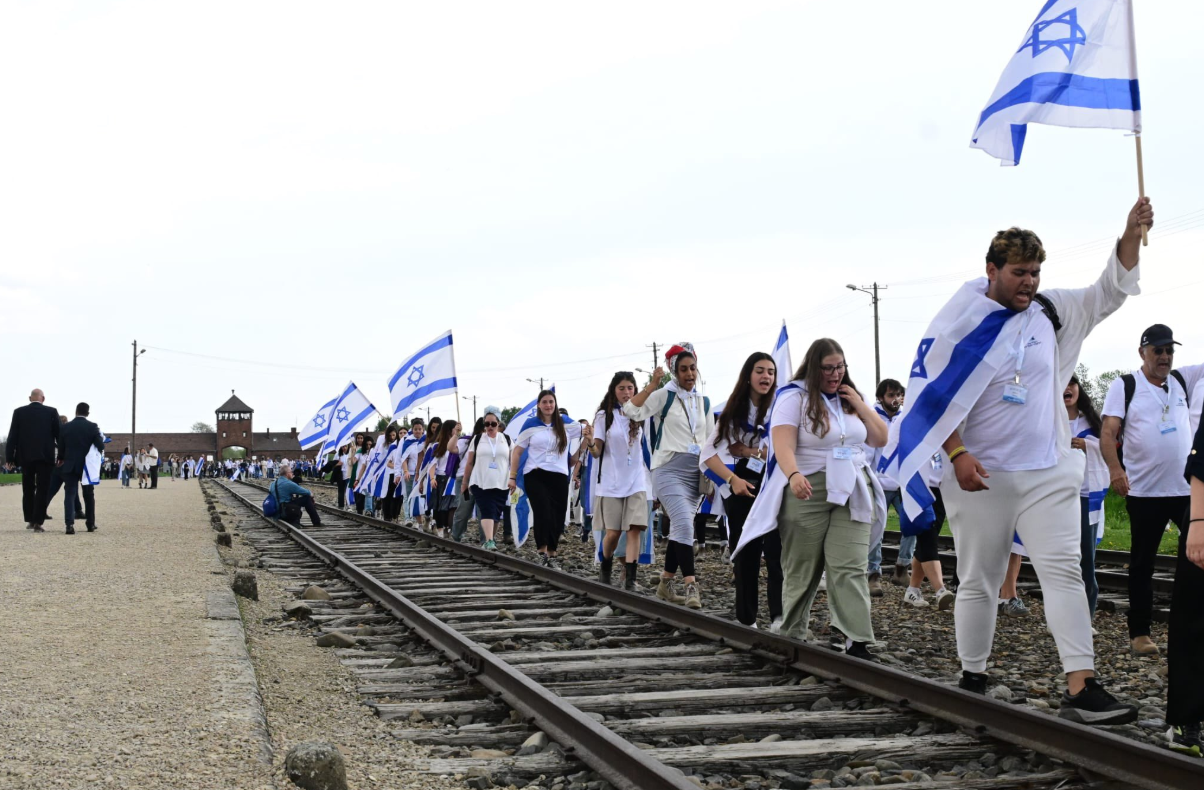
As the March of the Living returns to Auschwitz-Birkenau this week, it arrives in a very different atmosphere from the one that shaped it for decades.
The March has always brought Holocaust survivors and young people together to walk from Auschwitz to Birkenau. The act itself is simple. The meaning has never been. It rests on the idea that memory, carried carefully across generations, might shape how societies recognise and respond to hatred before it takes hold again.
That belief has been easier to sustain at a distance.
This year, the UK delegation includes not only Holocaust survivors, students and community leaders, but also individuals who have survived antisemitic attacks in Britain. Among them is a survivor of the synagogue attack in Manchester.
Their presence does not need explanation. It reflects something that has already become visible across the country.


In the months since 7 October, Jewish communities in the UK have faced a sustained rise in threats, harassment, and violence. Incidents that might once have felt exceptional have become more frequent, more public, and harder to dismiss as isolated.
For many, this has not felt like a new phenomenon emerging. It has felt like something long assumed to be contained pushing back into view.
The inclusion of a Manchester synagogue attack survivor alters the way the March is experienced. Auschwitz remains what it is, a place that marks the most extreme consequence of antisemitism. But the journey to it no longer begins at a historical distance. It begins at home.
For years, there has been a quiet confidence in Britain that antisemitism, while present, operated within limits. That it was different in character, less violent, less embedded than in other parts of Europe. That assumption shaped how incidents were interpreted and how seriously early signs were taken.
It is much harder to sustain now.
Bringing contemporary survivors into the same space as Holocaust survivors does not collapse past and present into a single narrative. The Holocaust stands apart in its scale and intent. Nothing in the present should be framed as equivalent to it.
But the presence of those who have experienced antisemitism in Britain introduces a different kind of proximity. It draws attention to the earlier stages, the points at which hostility becomes visible, debated, and sometimes absorbed into the background before it is widely recognised as a threat.
That process is not unfamiliar. It is part of the history the March has always sought to preserve.
What changes this year is the distance between recognition and experience.
For young people in the UK delegation, the March is no longer only an encounter with the past. It unfolds alongside accounts of what is happening now, in the same country they come from, in places they recognise. The effect is not dramatic, but it is difficult to ignore.
It becomes harder to treat antisemitism as something that belongs primarily to history when its contemporary form is present in the same conversation.
The role of Holocaust survivors has always been to bear witness to where unchecked hatred can lead. That testimony remains irreplaceable. What is now being added to it is a different kind of witness, one that speaks to how that hatred reappears and settles in again, often without immediate resistance.
From Auschwitz to Manchester, the line is no longer theoretical. It runs through the same societies that have long considered themselves alert to the lessons of the past.
What those lessons require in practice is less settled.
Scott Saunders MBE is founder and chairman of March of the Living UK

Keep community journalism free.
Jewish News is free for everyone. No paywall. No barriers. Just trusted journalism for anyone who wants to stay connected to Jewish life in Britain.
If you value that, please support us.
From as little as £5 a month, you can help keep our journalism free and accessible to all.
Every day, we report on the issues that matter to our community. We celebrate achievements, support charities, challenge antisemitism and ensure Jewish voices are heard more widely.
From as little as £5 a month, you can help us continue to:
- Report on the stories shaping Jewish life in the UK and beyond
- Bring our community together through shared stories, events and campaigns
- Celebrate the people, culture and moments that define our community
- Support organisations doing vital work across Jewish Britain
You can make a one-off donation or become a regular supporter. Every contribution helps keep our journalism free, independent and accessible to all.
If everyone who values Jewish News gave a small amount, it would make a real difference to our future.