Prefer Jewish News on Google
Tory conference panel sounds alarm over antisemitism in popular culture
Danny Stone, chief executive of the Antisemitism Polcy Trust, was joined by former Tory MPs Nicola Richards and Robert Largan
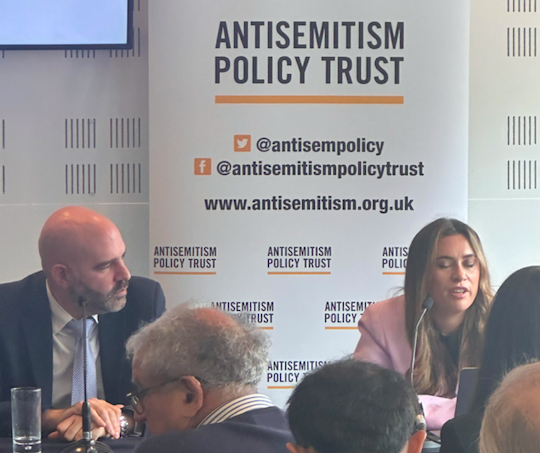
An Antisemitism Policy Trust event at the Tory Party conference has raised serious concerns about the infiltration of antisemitic sentiment into popular culture, which is being left unchecked while other forms of racism are more actively addressed.
Danny Stone, chief executive of the Trust, was joined by former Tory MPs Nicola Richards and Robert Largan for a candid discussion on how antisemitism has been allowed to permeate popular culture.
Examples ranged from some of the controversies around rap trio Kneecap, known for their support of the Palestinian cause, to the inadvertent inclusion of antisemitic tropes in mainstream TV dramas and films.
Richards, the ex-MP for West Bromwich East, said last week’s terror attack in Manchester highlighted “the challenge we face with my generation and younger people, who have a complete disconnect between Israel and how their words are considered antisemitic.”
She noted a casual approach to anti-Jewish tropes among younger generations: “There has also been a rise in the number of people saying, ‘I don’t care if you call me antisemitic’—all of this is happening in the context of popular culture as well,” Richards added.


Former High Peak MP Robert Largan, who grew up in north Manchester, reflected on the recent attack on Heaton Park synagogue: “I wish I could tell you all I was surprised, but that would be lying.
“This whole thing has had an air of inevitability about it,” he continued. “It’s been two years since the October 7 massacre, and while it was happening—the rape, butchery, and murder of Jews—excited them. They wanted to take to social media and celebrate on the streets.
“You would hope this moment would lead to reflection, but what has actually happened is an escalation of that cycle.
“There has been a never-ending ramping up of rhetoric, propaganda, and the glamorisation of terrorism.”
He warned, “We have seen people in popular culture pandering to those on the streets—some are motivated by a hunt for votes, others by social media popularity, and a few by genuine conviction.”
Both former politicians agreed that there is a two-tier response to racism, with antisemitism often treated less seriously than other forms of hate.
They pointed to comments made by Kneecap and other artists that have gone unpunished.
The Irish rap trio firmly deny any claims of antisemitism, and claim they are being targetted for their support for Palestinians.
Richards observed that inflammatory language is now embedded in pro-Palestine activism, with prominent figures “given license” to use language that would be condemned if directed at other minorities.
In his speech, Stone traced the history of antisemitism in Western culture, from Shakespeare to the views of composer Richard Wagner.
In recent years, he noted, the problem has spiraled, fueled by the output of rap stars like Ye (formerly Kanye West) and questionable dialogue in dramas aired by Netflix and other TV channels

Keep community journalism free.
Jewish News is free for everyone. No paywall. No barriers. Just trusted journalism for anyone who wants to stay connected to Jewish life in Britain.
If you value that, please support us.
From as little as £5 a month, you can help keep our journalism free and accessible to all.
Every day, we report on the issues that matter to our community. We celebrate achievements, support charities, challenge antisemitism and ensure Jewish voices are heard more widely.
From as little as £5 a month, you can help us continue to:
- Report on the stories shaping Jewish life in the UK and beyond
- Bring our community together through shared stories, events and campaigns
- Celebrate the people, culture and moments that define our community
- Support organisations doing vital work across Jewish Britain
You can make a one-off donation or become a regular supporter. Every contribution helps keep our journalism free, independent and accessible to all.
If everyone who values Jewish News gave a small amount, it would make a real difference to our future.