Prefer Jewish News on Google
Trials of people charged with supporting Palestine Action to be reviewed
Trials paused as court orders July review of Palestine Action support cases amid ongoing Home Office appeal
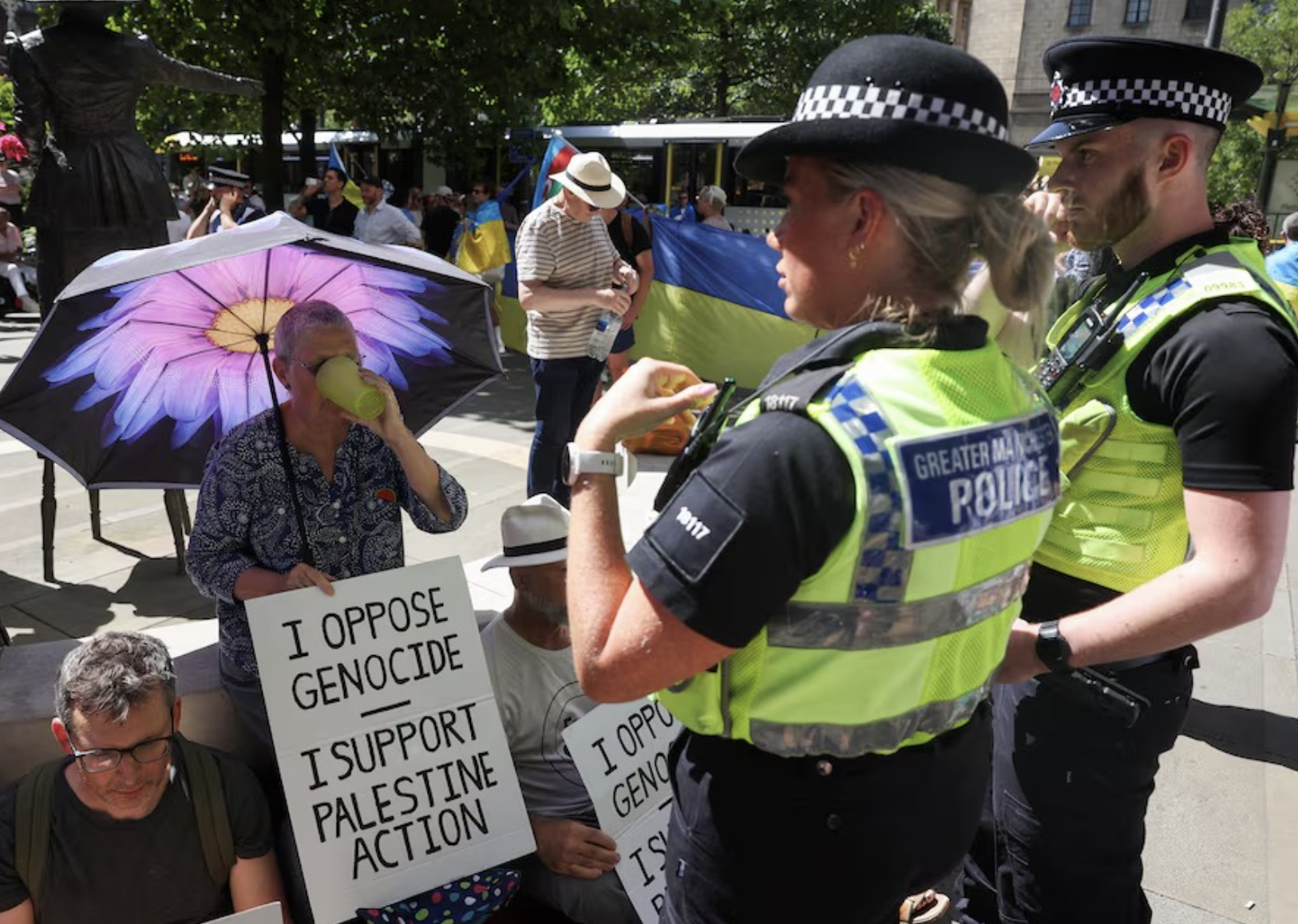
All trials of people charged with supporting Palestine Action after it was banned as a terror group have been put on hold, a judge has said.
On Tuesday, Chief Magistrate Paul Goldspring, sitting at Westminster Magistrates’ Court, said the cases of all defendants currently awaiting trial are to be reviewed on 30 July.
This means the trials of defendants charged with offences under section 13 of the Terrorism Act 2000, where they are accused of a reasonable suspicion of support for a proscribed organisation, have been adjourned for a blanket review at the same court.
It comes as the Home Office has been allowed to challenge the High Court’s ruling that the decision to ban Palestine Action was unlawful, at the Court of Appeal.
Mr Goldspring’s decision came as the first people charged under section 13 of the Terrorism Act 2000 appeared in court, just days before their trial was due to begin.



Jeremy Shippam, 72, of Yapton, West Sussex, Judit Murray, 71, of West Ewell, Surrey, and Fiona Maclean, 54, of Hackney, north-east London, were to face a three-day trial from March 16 for allegedly holding placards saying “I oppose genocide, I support Palestine Action”.
They were arrested after a protest in Parliament Square, Westminster, on 5 July.
Mr Goldspring said it would be “sensible” to look at all cases currently in the system, adding he was “reluctant” to look at different dates for the various cases as it “would just become unwieldy”.
Defence counsel suggested that calls would be made to the Attorney General and the Crown Prosecution Service for a rethink as to whether any of the cases should go ahead at all.
Sultana Tafadar KC, for Shippam, told the court: “My instructing solicitor represents 30 or so defendants.
“It seems to me that a representation may be made on behalf of the entire group.”
Mr Goldspring said it was “a huge undertaking for everybody, including the courts” to prepare cases which “may or may not” be necessary.
He released Shippam, Murray and Maclean on unconditional bail, telling them: “We are going to have a review on 30 July, unless something happens in the meantime, which we do not expect.”
They had each previously pleaded not guilty to a charge of displaying an article in a public place, arousing reasonable suspicion that they are a supporter of a proscribed organisation, under section 13 of the Terrorism Act 2000.
After the hearing, Raj Chada, head of criminal defence at Hodge Jones & Allen, who represent hundreds of protesters who have been charged, said: “We are calling on the CPS to see sense and drop these charges so the resources can be used to catch and convict real criminals rather than those holding placards exercising their democratic right to peaceful protest.”
Three judges ruled on 13 February that the Government’s move to proscribe the group was unlawful, and said that they “propose to make an order quashing” the decision.
Home Secretary Shabana Mahmood said she was “disappointed” by the outcome and would fight to prevent the proscription being lifted.
In a High Court order, the Home Office was given the green light to challenge the decision at the Court of Appeal.
Palestine Action was banned under the Terrorism Act 2000 by then-Home Secretary Yvette Cooper last year.
It made it a criminal offence to belong to or support Palestine Action, punishable by up to 14 years in prison.
Huda Ammori, Palestine Action’s co-founder, began legal action against the Home Office over the decision last June, and her barristers told the High Court last year that the ban was an “ill-considered, discriminatory, due process-lacking, authoritarian abuse of statutory power”.
In their decision last month, Dame Victoria Sharp, Mr Justice Swift and Mrs Justice Steyn said the ban was “disproportionate”.
The three judges also said the ruling quashing the ban was paused “pending determination of the defendant’s appeal to the Court of Appeal, or further order”.

Keep community journalism free.
Jewish News is free for everyone. No paywall. No barriers. Just trusted journalism for anyone who wants to stay connected to Jewish life in Britain.
If you value that, please support us.
From as little as £5 a month, you can help keep our journalism free and accessible to all.
Every day, we report on the issues that matter to our community. We celebrate achievements, support charities, challenge antisemitism and ensure Jewish voices are heard more widely.
From as little as £5 a month, you can help us continue to:
- Report on the stories shaping Jewish life in the UK and beyond
- Bring our community together through shared stories, events and campaigns
- Celebrate the people, culture and moments that define our community
- Support organisations doing vital work across Jewish Britain
You can make a one-off donation or become a regular supporter. Every contribution helps keep our journalism free, independent and accessible to all.
If everyone who values Jewish News gave a small amount, it would make a real difference to our future.