Prefer Jewish News on Google
New exhibit explores what Britain knew about the Holocaust
Lord Pickles and Ed Balls of Holocaust Memorial Foundation stress importance of building in heart of London
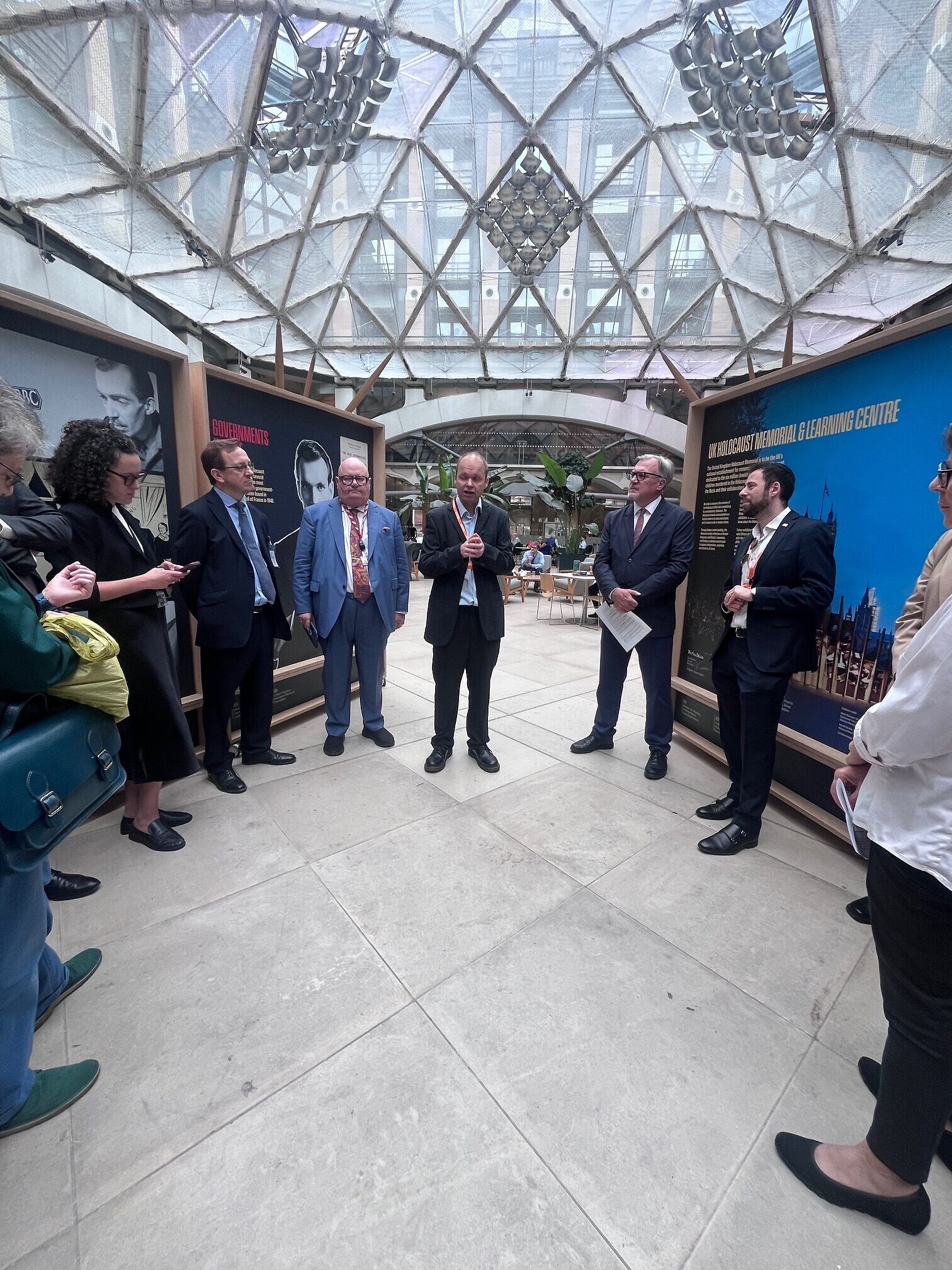
The first glimpse of what is envisaged for the long-awaited Holocaust Memorial building, next to the UK parliament, was unveiled at Portcullis House on Monday — and Lord Pickles and Ed Balls, the cross-party chairs of the Holocaust Memorial Foundation, vowed that “concrete steps” would happen soon, within the timing of Andy Burnham’s government.
The taster exhibition, unveiled together with a scale model of the proposed Holocaust Memorial building in Victoria Gardens, is called “What Did Britain Know About the Holocaust”, and takes as its starting point the assumption that Britain only really knew what was going on after the liberation of Belsen in April 1945.
But as Martin Winstone, the project historian for the UK Holocaust Memorial, pointed out, much was known at least three years earlier, from continuing newspaper accounts — shown in the exhibition and reflecting reports from across the country —to a major declaration on December 17 1942 by Allied governments, condemning the Holocaust and pledging to bring the perpetrators to justice once the Nazis were defeated.
The exhibition will tour the UK in the coming months — initially in the parliaments or assemblies of Scotland, Wales and Northern Ireland — and then for public view to other cities. Winstone said: “This came about in the wake of the passage of the Holocaust Memorial Act earlier this year. We thought it was the right time to begin to share some of the research we’ve been doing, and to start a national conversation about this history, and why it matters to us.”
He said that some of the opposition to the proposed Memorial and Learning Centre had been from those who said “what’s the Holocaust got to do with us?” But he said the exhibition “very much showed” that the Holocaust was a British concern throughout the war years. “We show not only how much was known by government, but also by the British people.”


In fact, he said, that although for much of the war British combatants did not serve in Europe, there was a prisoner of war camp close to Auschwitz — “and some of these British PoWs were serving alongside Jewish Auschwitz prisoners in the IG Farben chemical factory”.
Winstone told Jewish News of the appropriateness of the present venue: “Portcullis House [part of the parliamentary estate] stands on the site of the building where Charles de Gaulle had his first home for the Free French, when he came to London in 1940”. The French and the Polish governments in exile were among those who made London their base during the war in Europe, allowing for much information to be traded with the British authorities.
Jews living in Britain were all too aware of what was happening, Winstone said. “In December 1942 there were services of mourning in synagogues all round the country and, for example, in Liverpool’s Greenbank synagogue, there were 1500 people attending. For many of those people it was not just mourning for Jews as Jews — but mourning the loss of parents, siblings…in other words, an immense family tragedy.”
Among those who raised the matter of the systematic murder of European Jewry was the publisher Victor Gollancz, Winstone said. He issued a pamphlet in 1942, a “bestseller called Let My People Go”, calling on British people to “mobilise and put pressure on their politicians to do more to save Jewish lives”.
For the first time, it is believed, the permanent exhibition will include testimony from Nazi perpetrators, at least 600 of whom were allowed into Britain after the war.
Speaking alongside Lord Pickles, Ed Balls and Martin Winstone was Dr Robbie Williams, chief executive of the USC Shoah Foundation, founded by Steven Spielberg. The Foundation will share survivor testimony with the UK centre which, Lord Pickles predicted, is likely to become the most visited Holocaust centre in the world.
Anita Peleg, who chairs Generation 2 Generation, a group focused on continuing survivor testimony, praised the initiative of the UK Holocaust Memorial in keeping the collective narrative alive when the last survivors have died.

Keep community journalism free.
Jewish News is free for everyone. No paywall. No barriers. Just trusted journalism for anyone who wants to stay connected to Jewish life in Britain.
If you value that, please support us.
From as little as £5 a month, you can help keep our journalism free and accessible to all.
Every day, we report on the issues that matter to our community. We celebrate achievements, support charities, challenge antisemitism and ensure Jewish voices are heard more widely.
From as little as £5 a month, you can help us continue to:
- Report on the stories shaping Jewish life in the UK and beyond
- Bring our community together through shared stories, events and campaigns
- Celebrate the people, culture and moments that define our community
- Support organisations doing vital work across Jewish Britain
You can make a one-off donation or become a regular supporter. Every contribution helps keep our journalism free, independent and accessible to all.
If everyone who values Jewish News gave a small amount, it would make a real difference to our future.